NSIB, Benue Government Strengthen Partnership on Transport Safety, Blue Economy Development
Oru Leonard
The Nigeria Safety Investigation Bureau (NSIB), and the Benue State Government have intensified efforts to strengthen transportation safety and institutional capacity as part of plans to support the state’s maritime and blue economy development.
The renewed collaboration follows a series of engagements initiated after the recent boat accident on the River Benue that claimed 11 lives. In the aftermath of the tragedy, the Director-General and Chief Executive Officer of the NSIB, Captain Alex Badeh Jr., led a high-level delegation to Makurdi where the Bureau conducted an on-the-spot safety assessment, met with Governor Hyacinth Alia, community leaders and boat operators, and reaffirmed its commitment to improving safety on the state’s inland waterways.
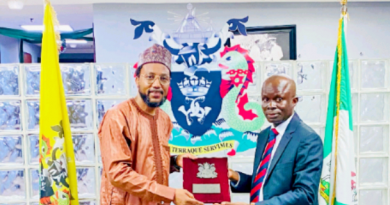
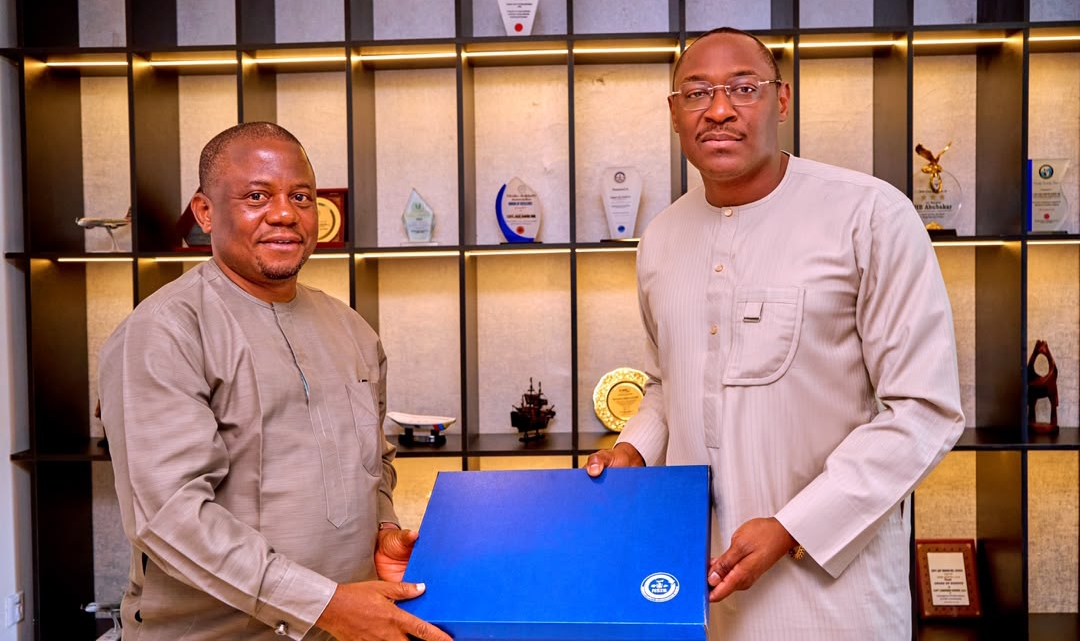
Building on that intervention, Captain Badeh on Monday hosted the Benue State Commissioner for Maritime and Blue Economy, Hon. Denis Ter Iyaghigba, and his delegation at the Bureau’s headquarters in Abuja to explore areas of long-term collaboration.
The delegation included Mr. Charles Terfa Ikyaave, Director overseeing the Office of the Permanent Secretary of the Ministry, Dr. Harris Dera, Special Adviser (Technical) to the Commissioner, and Mr. Lubem Gena, Head of Media, Publicity and Orientation in the Commissioner’s Office.
Discussions centred on establishing a framework for cooperation in transport safety, accident investigation, institutional development, knowledge exchange and capacity building, all considered vital for the safe growth of Benue State’s inland waterways and blue economy.
Speaking during the meeting, Captain Badeh described the engagement as a significant step towards transforming an unfortunate incident into a lasting partnership focused on prevention and safety.
“Our recent visit to Benue was born out of tragedy, but it also opened the door to meaningful engagement with the state government. Today’s meeting demonstrates that our relationship is evolving beyond accident response into a strategic partnership built on prevention, technical cooperation and institutional capacity development,” he said.
He stressed that transport safety requires sustained collaboration among governments, regulators and technical agencies, adding that the NSIB remains committed not only to investigating accidents but also to preventing future occurrences through knowledge sharing, institutional strengthening and the promotion of global safety standards.
Responding, Commissioner Iyaghigba described the Abuja meeting as the foundation of a long-term partnership that would strengthen Benue’s capacity to safely develop its inland water transport and blue economy sectors.
He commended the NSIB for its swift response to the recent boat mishap, noting that the Bureau’s intervention demonstrated professionalism and compassion.
“Our visit today is a continuation of that engagement. We are here to build a partnership that will equip our institutions with the technical knowledge, safety culture and operational capacity required to unlock the enormous potential of Benue’s waterways while protecting lives,” the commissioner said.
He reaffirmed the Benue State Government’s commitment to working closely with the NSIB in policy development, personnel training and the adoption of international best practices to improve safety governance across the maritime sector.
As part of the visit, the Benue delegation toured the Bureau’s investigation laboratories, technical workspaces and specialised accident investigation facilities, gaining firsthand insight into the NSIB’s investigative processes and technical capabilities.
The visit also reinforced discussions on future cooperation in professional training, knowledge sharing and institutional support.
The renewed engagement underscores the growing partnership between the NSIB and the Benue State Government, with both parties committed to fostering a preventive safety culture and strengthening transportation safety across Nigeria’s aviation, marine, rail and road sectors while supporting the sustainable development of the blue economy.