
AFRICA’S VALUE ADDITION TO DEMOCRACY
By Citizen Bolaji Akinyemi
Knowledge begins with discovery, is strengthened through practice, and is transformed through experience. Africa’s democratic journey now presents an opportunity to contribute something significant to the continuing evolution of democracy itself.
Africa does not merely need more elections. It needs a deeper democratic conversation about what happens after the ballot.
The principles and institutions of modern democracy were introduced to Africa, and African nations embraced them in different forms and at different times. Yet, our experience has revealed a gap between electoral democracy and the lived experience of citizens. Too often, our democratic practice remains Campaign Democracy, where political competition is heavily concentrated on winning power, while citizens are left waiting for the dividends of that victory.
Perhaps the next frontier is to move from democracy as an event to democracy as an experience.
This is where the emerging experience of Abia State becomes worthy of broader examination. The election of Governor Alex Otti provides a contemporary case study of an administration seeking to translate electoral legitimacy into measurable public value. His administration’s emphasis on governance, institutional reform, infrastructure and public service delivery raises an important question for democracies everywhere:
Can democracy strengthen its legitimacy when citizens can measure the value delivered by the mandate they gave at the ballot box?
This question goes beyond Abia. It speaks to Africa’s continuing democratic evolution.
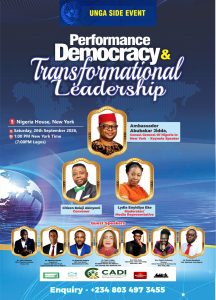
At our UNGA Side Event, we intend to place the Abia Experience and the Otti Story within the wider global conversation on democratic renewal. We do not present Abia as a finished model, nor Governor Otti’s experience as a universal template. Rather, we present it as a living laboratory from which developing democracies can observe, interrogate, learn and adapt.
Perhaps Africa’s value addition to democracy will not be found merely in how effectively we reproduce democratic institutions, but in what we contribute to their continuing evolution.
Campaign Democracy asks: Who won?
Performance Democracy asks: What has the mandate delivered?
That distinction may represent one of the most important conversations Africa can bring to the global democratic table.
The light emerging from Abia therefore deserves global attention, not because it represents a finished destination, but because it may illuminate another path: a democracy in which the ballot is not the end of citizenship, the mandate is not merely the beginning of political power, and governance is ultimately measured by the value it creates in the lives of the people.
Africa may not merely be learning democracy. Africa may yet help democracy learn to perform.