Renewed Hope For Women: Tinubu Pushes Stronger Economic Inclusion As Nigeria Marks 2026 International Women’s Day
Maryam Aminu
Nigeria’s First Lady, Senator Oluremi Tinubu, has reaffirmed the Federal Government’s commitment to widening economic opportunities for women through targeted social intervention programmes under the Renewed Hope Agenda, describing women as central to national development and family stability.
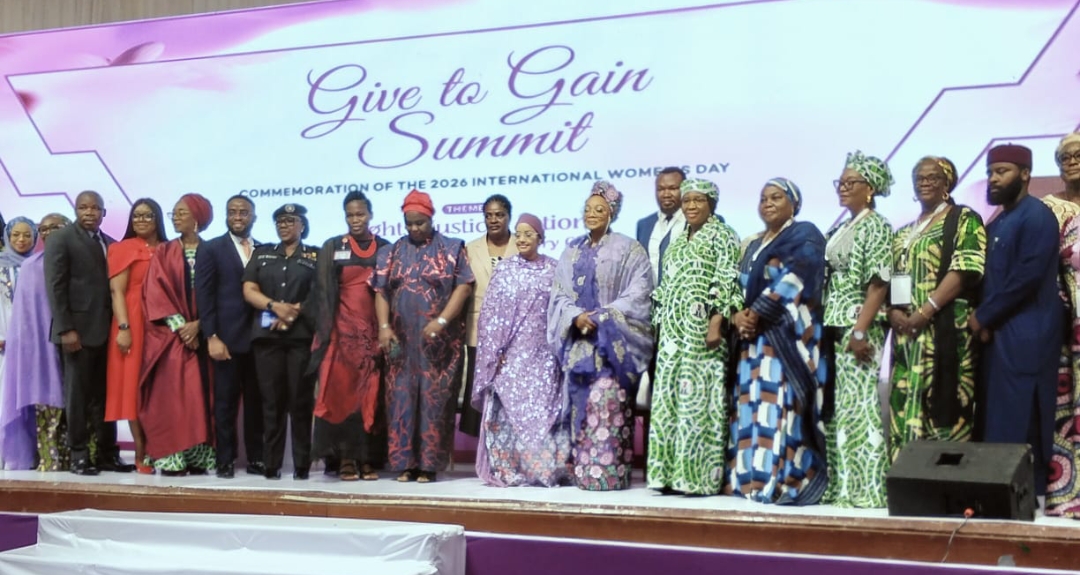
Represented by Fatima Abbas-Tajudeen, wife of the Speaker of the House of Representatives, at the “Give to Gain” Summit held in Abuja to commemorate the 2026 International Women’s Day, the First Lady said government policies are being deliberately designed to strengthen support systems that improve the lives of women and families across the country.
The summit, organised by the Federal Ministry of Women Affairs in collaboration with development partners, carried the theme “Rights, Justice, Action for All Women and Girls”, and brought together policymakers, development experts, and private sector stakeholders to examine the state of women’s empowerment in Nigeria.
According to her message, Senator Tinubu noted that Nigerian women remain the backbone of homes, enterprises, and communities, stressing that the Renewed Hope Social Impact Intervention 774 is a key initiative aimed at expanding access to economic opportunities across all local government areas in the country.
She also pointed out that the declaration of 2026 as the Year of Families and Social Development reflects government recognition of the family unit as the foundation of national progress, with women playing a pivotal role within it.
Delivering the keynote address, the Honourable Minister of Women Affairs, Hajiya Imaan-Sulaiman Ibrahim, described the summit as a shift from discussion to implementation, insisting that women’s empowerment must translate into measurable outcomes rather than policy statements alone.
She highlighted that while women contribute significantly to critical sectors such as agriculture where they account for over 40 percent of the workforce many still face limited access to finance, structured markets, and formal economic systems.
The minister explained that ongoing interventions under the Renewed Hope framework are designed to close these gaps through skills development, grants, enterprise support, and social protection programmes targeting women nationwide, including rural communities across all 774 local government areas.
She further emphasized that empowering women is not only a social responsibility but also an economic strategy essential to achieving Nigeria’s broader development goals, including its ambition for a trillion-dollar economy.
Representing UN Women in Nigeria and ECOWAS, Beatrice Eyong, through Patience Ekeoba, stressed that despite making up nearly half of the population, women remain significantly underrepresented in political leadership and decision-making spaces.
She called for deliberate reforms to remove barriers limiting women’s participation in governance and leadership, adding that inclusive systems remain critical to sustainable national growth.
Also speaking , the Director General of the Securities and Exchange Commission, Dr Emomotimi Agama, represented by Bola Ajomale, raised concerns over persistent gaps in women’s access to finance and investment opportunities.
He urged stronger gender-responsive financial policies, improved access to capital for women-led businesses, and greater inclusion of women in sustainable investment portfolios, noting that unlocking women’s economic potential would significantly boost national productivity.
He also observed that women tend to show stronger interest in environmentally sustainable investments, suggesting that gender inclusion could accelerate growth in the green economy.
The summit also featured the unveiling of the “Give to Gain” empowerment initiative, alongside testimonials from beneficiaries of the Nigeria for Women Scale-Up Project and the Renewed Hope WAVE Programme 774.
Panel discussions held during the event