Nigeria Unveils 2026–2030 Action Plan to Eliminate Child Labour
Oru Leonard
The Federal Government has unveiled the reviewed National Policy on Child Labour and National Action Plan for the Elimination of Child Labour (2026–2030), with a renewed call for concrete action to protect Nigerian children from exploitation.
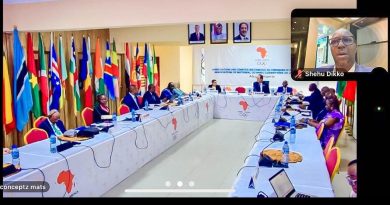
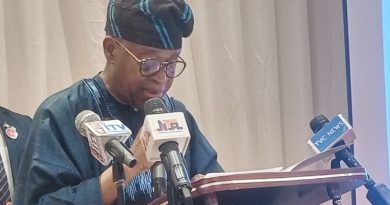
The Minister of Labour and Employment, Dr. Muhammad Maigari Dingyadi, made the declaration on Wednesday, September 16, 2026, at the National Dialogue on Advancing the Implementation of Nigeria’s National Policy on Child Labour and National Action Plan, held at the ECOWAS Commission Auditorium, Abuja.
The two-day dialogue, which ends Thursday, is themed “From Commitment to Action” and forms part of Nigeria’s activities commemorating the 2026 World Day Against Child Labour.
Dingyadi said child labour remains a major obstacle to human dignity, social justice and sustainable development, noting that it deprives children of childhood, education, healthcare and opportunities to realise their potential.
According to him, findings from Nigeria’s National Child Labour Survey indicate that millions of children remain engaged in child labour, with many exposed to hazardous activities in agriculture, mining, domestic service, street trading, construction and other sectors.
“The statistics generated are not merely numbers; they represent children whose dreams are interrupted and whose rights are denied,” the minister said.
He stressed that the Federal Government views the situation with “utmost seriousness” and would continue to pursue measures aimed at eliminating child labour.
Dingyadi said the Renewed Hope Agenda of President Bola Ahmed Tinubu addresses several underlying factors contributing to child labour through its focus on economic growth and job creation, food security and agriculture, education and human capital development, social welfare and poverty reduction, security and rule of law, youth empowerment and good governance.
He reaffirmed Nigeria’s commitment to implementing relevant national legislation and international labour standards, particularly ILO Conventions 138 on Minimum Age for Admission to Employment and 182 on the Worst Forms of Child Labour, both of which Nigeria has ratified.
The minister said Nigeria’s participation in the 6th Global Conference on the Elimination of Child Labour in Marrakech, Morocco, in February 2026, further strengthened the country’s resolve to translate international commitments into concrete national action.
He explained that the reviewed policy and action plan provide a roadmap covering prevention, protection, enforcement, rehabilitation, institutional coordination and accountability in the fight against child labour.
Dingyadi also linked the initiative to Sustainable Development Goal Target 8.7, which calls for urgent measures to eradicate forced labour, modern slavery, human trafficking and the worst forms of child labour.
The minister emphasised that government alone cannot eliminate child labour, calling for a “whole-of-government and whole-of-society approach.”
He urged state governments to domesticate and implement the National Policy and Action Plan, while calling on the Nigeria Governors’ Forum and Nigeria Governors’ Spouses Forum to champion child protection initiatives at state level.
He also urged the National Assembly to strengthen legislation protecting children and support initiatives addressing the welfare of children and vulnerable families.
Dingyadi called on employers to ensure their businesses and supply chains are free from child labour, while urging workers’ organisations to promote decent work for adults.
Development partners, community leaders, civil society organisations and faith-based organisations were also asked to intensify advocacy and public awareness, while parents and guardians were urged to prioritise education and protect children from exploitative labour.
“As we commence this National Dialogue today, I urge every participant to move beyond discussions and make concrete commitments,” he said.
The minister called for stronger institutions, improved enforcement of labour laws, expanded social protection coverage, better access to quality education and responsible business practices as key measures for tackling child labour.
He expressed appreciation to the ECOWAS Commission for its support through the FMM West Africa Project II in implementing the Regional Action Plan on the Elimination of Child Labour.
He also commended the International Labour Organization (ILO) for its partnership through ACCEL Africa and Project II, as well as the Government of the Kingdom of the Netherlands and members of the National Steering Committee on the Elimination of Child Labour.
Dingyadi further acknowledged the contribution of the National Bureau of Statistics for providing technical expertise and child labour data used in policy formulation and decision-making.
The minister said the ultimate goal was to build a Nigeria where children are not forced to work instead of learning and where decent work for adults enables families to thrive without relying on child labour.
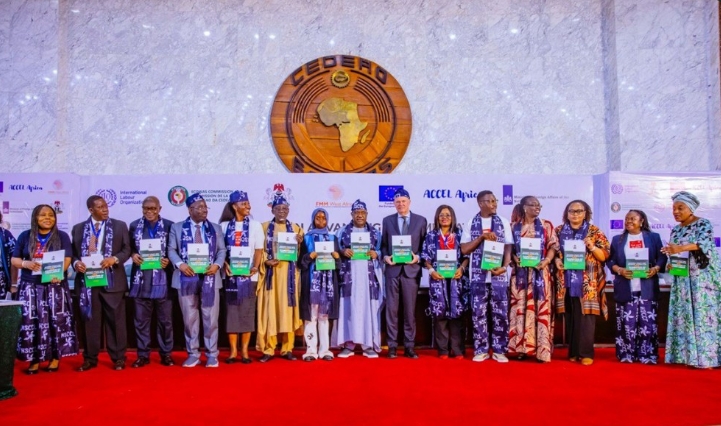
The event also featured the official launch of the 2024 National Child Labour Survey Report, the National Policy on Child Labour, and the National Action Plan for the Elimination of Child Labour (2026–2030).