AMUPITAN’S PRESS CONFERENCE
Nick Dazang
Every chairperson of the Independent National Electoral Commission (INEC), comes to the daunting job with his style, mode of procedure and vision.
Professor Joash Amupitan seems to revel in courting potentates, to thrive on assessing the Commission’s preparedness on a piecemeal, zonal basis and to summon stakeholders to a bazaar-like conclave.
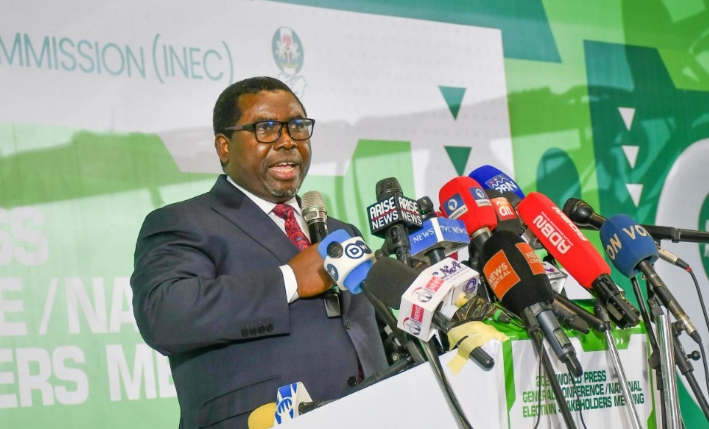
On Tuesday, 6th October 2026, the INEC Chairman summoned nearly all stakeholders in the electoral process to what he referred to as a “World Press Conference and National Stakeholders Meeting” at the International Conference Center, Abuja. The occasion, he explained, was to mark 100 days to the conduct of the 2027 General Elections.
Likening the occasion to a “call to action”, Professor Amupitan took his guests through the entire gamut of the electoral process. He addressed the Commission’s preparedness relating to funding, the register of voters, political party candidate nominations, newly created constituencies, procurement, logistics, operational deployment, electoral technology, accreditation, vote buying, party monitoring, zonal readiness assessments, inclusivity, voter education and publicity, capacity building, ad hoc staff requirements, the National Situation Room and Collation Center, and the protocols that will underpin the declaration of the results.
A number of issues were underscored in salient relief. They include the fact that following series of Continuous Voter Registration (CVR), exercises, as provided by Section 10 of the Electoral Act 2026, 10,772,421 registrants were added to the National Register of Voters. It now comes to a total of 103.43 million.
Additionally, 53,528,218 of the registered voters, representing 51.75 percent, are of the male gender while 49,900,497 voters, representing 48.75 percent, are of the female gender. What is revealing is that the Register is dominated by voters, aged 35 to 49. They number: 43,265,946, representing 41.83 percent. Those in the age category of 18 to 34 years number: 29, 777, 578, representing 28.79 percent. People With Disability (PWD) number: 232,658. They represent 0.23 percent of registered voters.
Ten States, led by Lagos, have the largest number of voters. Bauchi, which is keeping the rear of the big ten, has 3,012,547 voters. Lagos, the highest, has 7,488,633 voters. It is followed by three States in the North West geopolitical zone, namely: Kano, with 6,570,276 voters; Kaduna, with 4,662,640 voters; and Katsina, with 3,876,051 voters.
Contracts have been awarded, and are said to be at an advanced stage, for additional 57,000 Biomodal Voter Accreditation (BVAS) devices. Contracts have also been awarded for additional voting cubicles and ballot boxes.
Furthermore, procurement for the printing of ballot papers and result sheets are reported to be nearly completed and advancing towards final awards. It is, however, not clear if they will be printed in-country or off-shore.
The Commission is said to have renewed and strengthened its Memorandum of Understanding (MoU), with its key transport unions/providers, namely, the National Union of Road Transport Workers (NURTW), the Road Transport Employers Association of Nigeria (RTEAN), and the Marine Workers Union of Nigeria (MWUN).
Apart from permanent INEC Staff, the Commission will deploy 707,384 ad hoc personnel for the Presidential and National Assembly elections that will hold on Saturday, 16th January 2027. The same number will be deployed in the Governorship and State Houses of Assembly elections scheduled for Saturday, 6th February 2027. This brings the total to:1,414,768. This number, which is to be deployed across 176,846 Polling Units (PUs) nation-wide, does not include security personnel to man the PUs. This will be supplied by the Office of the National Security Adviser (ONSA).
Professor Amupitan announced that automated Artificial Intelligence (AI), tools were being integrated into INEC’s results verification process under a five-pillar AI-Governance Framework/Policy.
He reiterated the Commission’s determination to carry out a comprehensive, nation-wide election, simulation and mock accreditation exercise in November this year.
It is appropriate for the Election Management Body (EMB), to be upbeat and exude confidence before the conduct of a General Election. Such can-do-spirit infects other stakeholders and invests them with the assurance that better elections are afoot. But it is rather premature, and out of place, for the Commission to chime or express smug satisfaction over some Observer Reports showering kudos on it. A careful reading of all the credible Observer Reports of the off-cycle Governorship elections and the sundry bye-elections show that they took exception to the brazen vote trading that visited these elections. They were unanimous in expressing indignation at the violence that defined the weeks and days leading up to the conduct of the Osun off-cycle Governorship Election.
Though there seemed to be some improvements over the conduct of Anambra, Ekiti and Osun off-cycle Governorship Elections, a cursory review will show that the Ekiti and Osun elections were smoothly conducted in previous election cycles as well (even in spite of Osun’s peculiarly testy and fierce contests). Thus, any excitement must be modulated by this reality.
We are told that the Commission has renewed and strengthened its MoU with its transport providers. In what practical ways were these renewals and strengthening carried out? Will there be consequences for providers who default? Will we see a change from their hitherto lackadaisical attitude to a business-like one, governed by patriotism and a high sense of duty?
It is relieving that the Commission has reiterated its resolve to carry out a simulation and a mock accreditation ahead of the 2027 General Elections. A similar simulation before the conduct of the Osun election revealed chinks in the INEC fortress. These were swiftly repaired. We hope to see a repeat, even though modalities are yet to be in the public domain.
The “World Press Conference and Stakeholders Meeting” may have been impactful. But it should not, and cannot, replace regular engagements with critical stakeholders where probing and disconcerting questions could be asked.
Besides, the format of a press conference does not allow for security agencies, diplomats and development partners to open up or ask searching questions.
Professor Amupitan will discover, in due course, that even the best laid plans can unravel or go awry. Matters will then arise. In such circumstances, engagements become indispensable, if not inevitable, to elicit the robust support and understanding of stakeholders.
Come to think of it, how effective and impactful are zonal readiness assessments? Previous assessments, done with the full complement of Commission members, Resident Electoral Commissioners and Administrative Secretaries in attendance, allowed for all to share experiences and lessons in a free, untrammeled manner. They provided the Commission an opportunity to gauge the morale of its officials/commanders, to foster interaction and cohesion and to provide leadership/direction.
Besides, the conduct of elections in our clime, by virtue of its massive logistics and deployment (which Professor Amupitan has underlined), has been equated with warfare. War thrives on cultivating and sustaining a rapport and camaraderie that goes beyond a single front/election. How do you achieve comradeship and working in concert when you segment your troops who are facing the same objective or peril?
What deliberate awareness is the Commission creating for voters who have been assigned new PUs following the creation of voter access to polling units before the conduct of the 2023 General Elections? Will the AI framework/policy not come to legal grief like its predecessors, the Smart Card Reader (SCR) and the IReV?
The Commission should address these, and several other concerns, if it intends to conduct an election that, in its aspiration, “serves as a global benchmark for transparency, integrity and peace”.