When Bishophood Becomes Politics: The Dangerous Politicisation of the Church
By Oru Leonard
There is something deeply troubling about the increasing politicisation of religious leadership in Nigeria, particularly when titles, clerical appearances and ecclesiastical institutions appear to be deployed in ways that can confuse the public and blur the distinction between established church structures and newly formed associations.
The Catholic Bishops’ Conference of Nigeria (CBCN), has existed since the 1950s and has, over decades, established itself as the recognised umbrella body through which Catholic bishops in Nigeria engage with one another, the government and society.
Against this historical background, the emergence of other organisations using the description of “bishops” deserves public scrutiny—not because other Christian organisations do not have the right to organise themselves, but because religious titles carry enormous significance in a deeply religious society such as Nigeria.
The issue becomes even more sensitive when government officials receive delegations presented to the public as “bishops”. The question Nigerians should ask is simple: Are we witnessing the normal engagement between government and religious leaders, or are religious titles increasingly being politicised for access, recognition and patronage?
The symbolism of clerical dressing
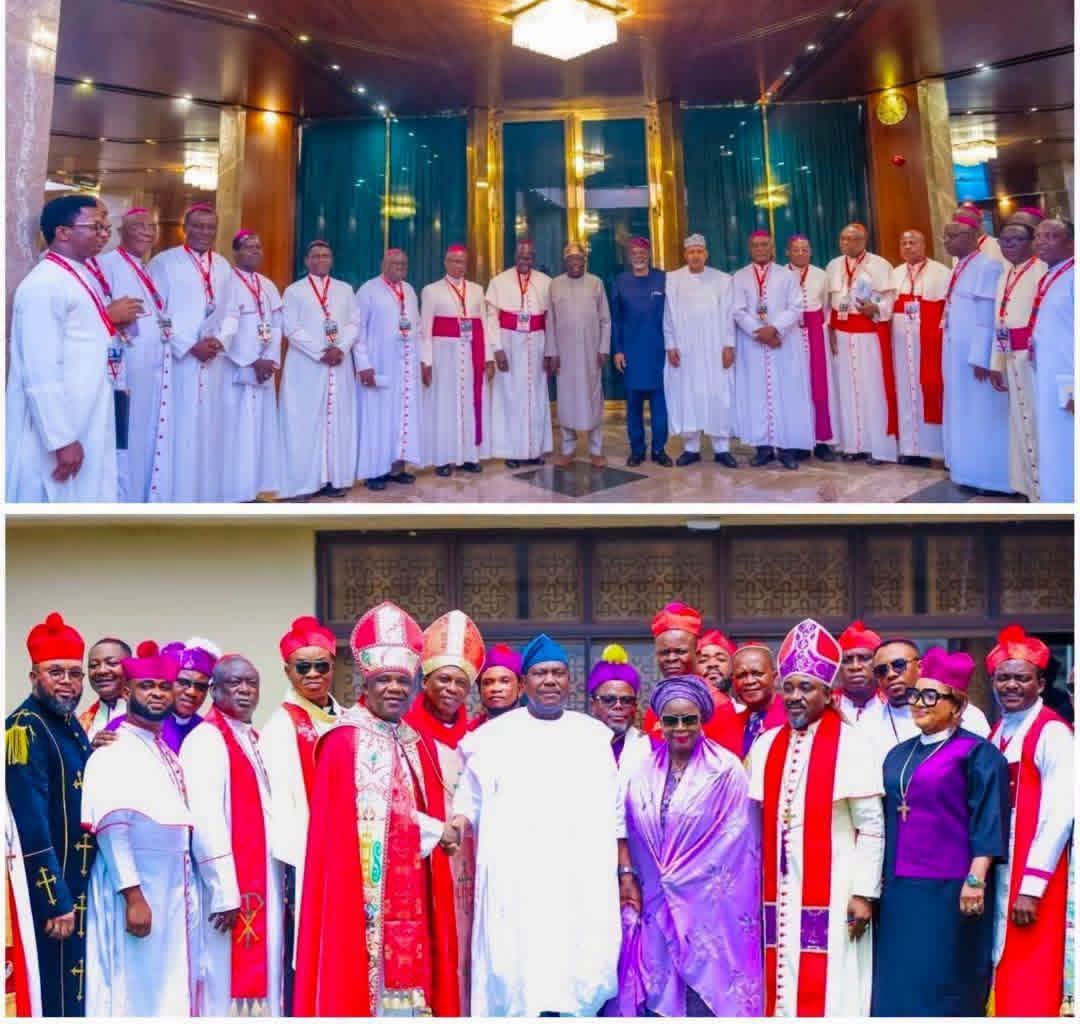
The photographs from recent engagements provide an interesting point for discussion.
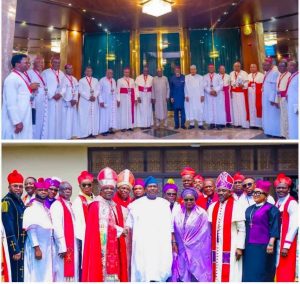
A meeting with a political leader is not the same thing as celebrating Mass
That distinction matters because public perception matters.
When people see a group of men dressed in elaborate episcopal or liturgical-looking regalia standing before to government officials, many ordinary Nigerians may naturally assume that they are looking at an established body of bishops representing a major Christian denomination.
That is why government officials have a responsibility to be precise in identifying the organisations and leaders they receive.
Is every “bishop” the same?
Nigeria’s Christian landscape is diverse. There are established denominations, independent churches, Pentecostal ministries, charismatic fellowships and numerous associations. Many of these organisations have their own structures and titles.
There is nothing inherently wrong with a Christian organisation adopting the title “bishop” within its ecclesiastical structure.
But government must distinguish between an individual holding the title of bishop within a particular church organisation and a bishop representing a nationally established episcopal conference.
That distinction becomes particularly important when official photographs and government communications are released into the public space.
The public deserves clarity.
When religious recognition becomes political currency:
The more fundamental concern is what happens when religious titles become a route to political access.
Government should not create the impression that proximity to political power can be secured through the multiplication of religious titles or the creation of organisations whose principal value appears to be access to political authorities.
If every political administration begins to recognise competing groups according to political convenience, we risk turning religious leadership into another arena for patronage.
That would be unhealthy for both religion and democracy.
A government can engage Christian leaders, Muslim leaders, traditional rulers, civil society organisations and professional bodies without compromising its neutrality. But such engagement should be transparent and institutionally grounded.
The question of leadership and accountability
There is also a legitimate question about the internal governance of emerging religious associations.
Where an association has existed for several years, Nigerians are entitled to ask how its leadership is selected, whether elections are regularly conducted, whether there is rotation of offices and whether members have genuine opportunities to determine their leaders.
A religious association that continually presents the same individual as its permanent national leader should be able to explain its governance structure.
Is there an elected convention? Are there constitutional provisions for tenure? Are elections conducted? Can members challenge the leadership?
These are not attacks on Christianity. They are legitimate questions about institutional accountability.
And they should apply equally to every religious organisation, regardless of denomination.
Government must not manufacture religious legitimacy
The Federal Government should be particularly careful in this area.
Government recognition does not confer ecclesiastical legitimacy. Neither does a photograph with the President.
The President receives thousands of individuals and organisations. A government audience should not automatically be interpreted as endorsement of the theological status, institutional legitimacy or representative authority of every delegation received.
This is where official communication becomes important.
If a group is an association of charismatic church leaders, call it exactly that. If it is the Catholic Bishops’ Conference of Nigeria, identify it as such. If it represents a particular Pentecostal or independent church network, state that clearly.
Titles should not be allowed to obscure institutional identity.
The bigger danger: The danger goes beyond the church.
Nigeria already has enough divisions created by ethnicity, politics, religion and social class. We should not introduce another layer in which religious titles become instruments of political competition.
The church must retain its moral authority to speak truth to power. But that moral authority can be weakened when religious leaders appear to compete for political patronage.
Likewise, government must resist the temptation to cultivate religious constituencies for political convenience.
The relationship between the state and religious institutions should be based on mutual respect, transparency and the national interest—not on who can produce the largest delegation, the most impressive regalia or the loudest claim to represent a particular religious constituency.
Let the church remain the church
There is nothing wrong with bishops meeting presidents. There is nothing wrong with religious leaders seeking government appointments or engaging government on issues affecting their communities.
But there is something wrong when religious identity becomes deliberately blurred for political advantage.
Nigeria needs religious leaders who can challenge government when government is wrong, commend it when it is right and maintain sufficient independence to speak for the people without fear of losing access to power.
The President does not need bishops who merely praise him.
Nigeria needs religious leaders who can tell the truth to power.
And government does not need to manufacture religious legitimacy.
It needs to respect the legitimate structures that exist, recognise diversity where it genuinely exists, and ensure that official engagements do not inadvertently turn religious titles into instruments of political patronage.
The church should influence politics through moral authority—not become another political constituency competing for appointments, recognition and access.
That is the line Nigeria must be careful not to cross.
Oru Leonard Oru (FRPA), is a Media and Business Development Practioner based in Nigeria.
oruleonard50@gmail.com