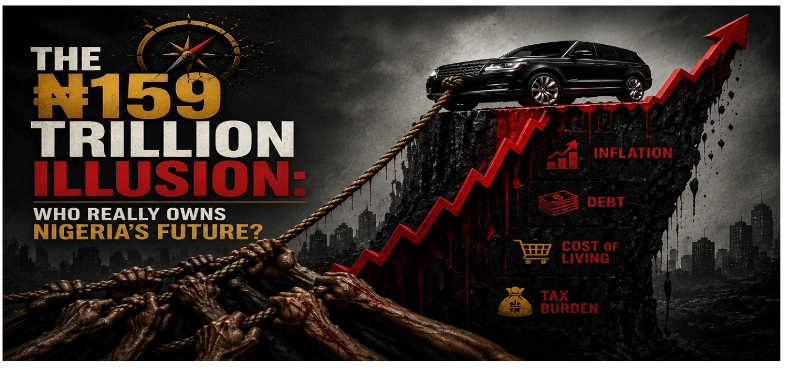
THE ₦159 TRILLION ILLUSION: WHO REALLY OWNS NIGERIA’S FUTURE?
Dr. Iyke Ezeugo || June 22nd, 2026
When a nation’s public debt skyrockets to an astronomical ₦159.28 trillion in a matter of months, the immediate, visceral fear is that the country is being blindly auctioned off to the highest bidder. But if you analyze Nigeria’s fiscal obligations strictly through the lens of the Naira, you are staring at a terrifying, albeit distorted, illusion.
To truly understand the crushing weight of Nigeria’s borrowing under the present administration, we must look past the breathless headlines. We must examine the hard currency, dissect the fine print, and unmask the specific creditors holding the collateral of the nation’s future.
While the breathtaking leap in the Naira figure—now representing roughly $110.97 billion—is primarily a mathematical side-effect of the currency’s dramatic devaluation, the underlying dollar debt stock reveals a far more calculated story. It is a story of aggressive, high-stakes fiscal restructuring. The government is rapidly swapping cheap, conditional debt for expensive commercial bonds, formalizing hidden overdrafts, and tying the nation’s infrastructural destiny to rigid foreign contracts.
Before we examine how long it will take to escape this trap and what the alternatives are, let us map exactly who owns the ledger.
Part I: The Architects of the Ledger
Domestic borrowing currently accounts for the lion’s share of the burden at ₦84.85 trillion (53.27%). However, the external debt—standing at $51.86 billion—is where the nation’s sovereignty is truly negotiated.
1. The Multilateral Shield: The World Bank and the “Policy Trap”
Multilateral institutions hold a combined $23.85 billion, with the World Bank alone accounting for a staggering $19.89 billion.
The Catch: While these are the “cheapest” loans available (1-2% interest), they act as a rigid policy trap. To keep this liquidity flowing, Nigeria must strictly adhere to Washington-approved fiscal reforms—most notably, sustaining the painful removal of the petrol subsidy and allowing the Naira to float freely.
2. The Bilateral Dragon: China Eximbank and “Tied” Infrastructure
Bilateral loans stand at $6.72 billion, dominated entirely by the Export-Import Bank of China.
The String Risk: Chinese debt funds visible mega-projects. However, these loans legally mandate that Chinese state-owned enterprises will be the sole contractors. China is securing guaranteed, dollar-denominated export contracts for its own industries, which Nigeria must repay over decades.
3.The Ways & Means Tax: The most controversial element of the domestic debt is the securitization of the ₦23.9 trillion “Ways and Means” advances—money illegally printed out of thin air by the previous administration to cover shortfalls. The current administration formalized this liability into high-interest government bonds. Taxpayers are now paying premium interest rates to service the cost of past administrative incompetence.
Part II: The Eurobond Casino and the Real-World Impact
To understand why the debt feels so suffocating to the everyday citizen, we must pull back the curtain on the most volatile segment of the external ledger: Commercial Debt, which sits at $18.55 billion.
How the Eurobond Market Actually Works
When the Nigerian government needs quick cash with no policy strings attached, it issues a “Eurobond.” Despite the name, these are simply sovereign bonds issued in a foreign currency, typically US Dollars. The buyers are not governments; they are ruthless international private investors—hedge funds, global asset managers, and foreign pension funds.
Because Nigeria is viewed as a high-risk emerging market, these investors demand a steep premium. In late 2025, Nigeria issued a $2.35 billion Eurobond, agreeing to pay yields of 8.63% and 9.13%.
Here is the mechanical trap: Nigeria earns Naira, but must pay this 9% interest in Dollars. Every time the Naira devalues against the Dollar, the cost of servicing that debt mechanically explodes. If the government issues a $2 billion bond at 9%, it owes $180 million in interest annually. If the exchange rate is ₦500/$, that’s ₦90 billion. If the exchange rate crashes to ₦1,400/$, that exact same debt suddenly costs ₦252 billion to service.
The government touts the oversubscription of these bonds as “investor confidence,” but the reality is simpler: Wall Street loves high-yield debt backed by a sovereign nation’s tax base.
The Stranglehold on Manufacturing and the Inflation Squeeze.
This massive borrowing directly bleeds into the real economy. For the 2026 fiscal year, Nigeria is projected to spend over ₦15.5 trillion just on servicing its debt. To find this staggering amount of Naira, the government borrows heavily from the domestic market.
This triggers a devastating economic phenomenon known as the “Crowding Out Effect”:
Manufacturing is Starved: When the government issues risk-free Treasury Bills offering 20% to 24% interest, commercial banks pour their money into government debt. Why would a bank take the immense risk of lending to a Nigerian manufacturer at 28% to buy factory equipment when they can lend to the government at 22% with zero risk? Credit to the private sector dries up. Manufacturers cannot expand, factories close, and jobs disappear.
The Inflation Ripple and the Foreign Exchange Death Spiral: Because manufacturers cannot access affordable credit, domestic production collapses. To fill the massive void left by idle local factories, the nation is forced to import basic, everyday goods. This triggers a desperate, systemic scramble for US Dollars to pay foreign suppliers.
But this legitimate demand for import financing is only half the crisis.
The foreign exchange market is simultaneously choked by a darker, more parasitic pressure: the political class. Billions of Naira looted from the public treasury are systematically dumped into the parallel market to be converted into US Dollars. Corrupt officials and politicians weaponize the dollar as the ultimate vehicle for concealment, converting massive volumes of stolen wealth into high-denomination foreign currency simply because it is lighter to carry, easier to hoard in physical vaults, and simpler to launder across borders without triggering banking red flags.
This twin assault—importers scrambling for commercial survival and elites hoarding stolen wealth—creates an artificial, insatiable demand that chases a highly limited supply of dollars. This puts crushing demand-pull pressure on the foreign exchange market, guaranteeing that the Naira continues to bleed value and never organically recovers.
As the currency collapses, the cost of importing those exact same everyday goods skyrockets, unleashing severe “imported inflation.” Simultaneously, the government—desperate to squeeze enough Naira from the economy to convert into Dollars to service its Eurobond masters—aggressively hikes internal taxes, customs duties, and energy tariffs. The surviving local business owner, battered simultaneously by a collapsed currency, expensive imported raw materials, and crippling government levies, has only one option for survival: pass this entire compounded cost directly to the consumer.
Although the everyday citizen may not understand the complex macroeconomic formulas driving these changes, they feel the visceral pinch of skyrocketing prices.
This is why the vulcanizer in Yaba and the market woman in Onitsha feel the sovereign debt deep in their bones. They are the ones secretly paying the 9% Eurobond yield every time they buy a vastly overpriced mudu of beans, a bottle of cooking oil, a bag of cement, or a liter of fuel.
There is a profound disconnect between the official, sterilized inflation figures touted by government bureaus and the brutal existential reality in the markets. When the official textbook math claims inflation is hovering at 33%, but the price of a bag of rice has jumped from ₦30,000 to over ₦90,000—a 200% decimation of purchasing power—the textbook has failed the people. I provided a profound exploration of this exact deception in my recent article, “BEYOND TEXTBOOK ECONOMICS: THE EXISTENTIAL REALITY OF NIGERIA’S INFLATION,” exposing how colorful economic theories are weaponized to make devastating poverty appear mild.
Part III: The “Breathing” Math – A Timeline to Nowhere
The anatomy of national bankruptcy is not a sudden explosion; it is a slow, mathematical suffocation that ordinary people in the streets often do not understand, even as they are soaked by the rain of its direct effects.
Today, driven by aggressive taxation and devaluation, the government’s projected annual retained revenue has climbed to roughly ₦15 trillion. But the mandatory internal annual spending—wage bills, pensions, and critical administrative overheads required just to keep the government “breathing”—now stands at roughly ₦8.5 trillion.
Take note: this ₦8.5 trillion does not cover the bedrock of a functioning society. It does not fund the equipping of primary healthcare centers where women are forced to give birth by flashlight. It does not patch the deadly craters on the East-West road or the Lagos-Ibadan expressway. It does not pay the demands of ASUU to keep our children in lecture halls, nor does it secure the farmers in the Middle Belt so they can harvest food without the threat of banditry. It merely pays the bureaucracy to exist.
If the government collects ₦15 trillion and spends ₦8.5 trillion just to breathe, it is left with a “surplus” of ₦6.5 trillion.
Let us assume an extreme, hypothetical scenario: Nigeria declares a total developmental freeze—no new roads, no hospitals, no power grids—and dedicates every single kobo of that ₦6.5 trillion surplus to paying down the ₦159.28 trillion principal. At 0% interest, it would take 24.5 years of absolute infrastructural starvation to clear the ledger.
But here is the crushing reality: with blended interest obligations frequently exceeding ₦8 trillion annually, the surplus doesn’t even cover the interest.
To put it in terms anyone can understand: Imagine you earn ₦100 a day. You need ₦80 just to eat, leaving you with ₦20. But you owe a debt of ₦1,000, and the interest on that debt is ₦50 every single day. No matter how hard you work, you are falling deeper into the hole.
Therefore, the true number of years it will take to clear this debt using operating surpluses is not 24 years. It is infinity.
It is imperative that every citizen understands this. This is the crux of the matter. When we say our future has been mortgaged, this is the exact math of how and why. Once the populace grasps that they are trapped in a loop of infinite debt, the passive acceptance of multi-billion dollar loan approvals will end. It becomes glaringly obvious why aggressive taxation is squeezing the life out of the middle class—the government is scrambling to find the ₦50 daily interest just to keep the foreign creditors from repossessing the nation.
Part IV: Escaping the Trap – The Alternatives to Borrowing
A nation cannot borrow its way out of a debt crisis. If endless borrowing and punitive taxation are mathematically unsustainable, what are the feasible, world-class alternatives for a nation like Nigeria under our current conditions?
Asset Financialization, Not Asset Stripping: Nigeria sits on hundreds of billions of dollars in dead corporate assets—from prime real estate to idle state-owned enterprises. Instead of selling them off cheaply to cronies or borrowing against them, the government must corporatize these assets. By listing state-owned assets on local and international exchanges, Nigeria can attract equity capital rather than debt. Equity shares the risk with the investor; debt guarantees the risk falls on the citizen.
Expanding the Tax Net, Not the Tax Rate: The current strategy is intellectually lazy: taxing the exact same formal businesses and compliant citizens at progressively higher rates. The alternative is leveraging digital identity and frictionless payment systems to capture the massive informal economy. If 40 million informal merchants pay a frictionless micro-tax of just ₦200 daily through their digital wallets—and if those funds bypass the leaky pipelines of “tax consultants” and corrupt middlemen to reach the treasury directly—it generates almost ₦3 trillion annually without suffocating major employers.
The Shift to Blended Finance and PPPs: The government has no business borrowing $2 billion to build a power grid or a railway. These are commercially viable projects. By shifting strictly to Public-Private Partnerships (PPPs) and concession models, private capital funds the infrastructure in exchange for tolling or operating rights over 30 years. The infrastructure gets built, the sovereign balance sheet remains untouched, and there is no pressure to aggressively tax the people to keep the show running.
A Ruthless Cut to the Cost of Governance: The ₦8.5 trillion cost of “breathing” is severely bloated by a sprawling bureaucracy, duplicated agencies, political patronage, and unhinged fiscal recklessness. A quick dig into the 2024, 2025, and 2026 expenditure frameworks reveals staggering amounts earmarked for executive luxuries—billions of Naira allocated for fleets of imported SUVs for lawmakers, billions more to renovate luxury lodges for the executive branch, and controversial insertions for presidential yachts. Implementing a structural reduction in recurrent expenditure is politically explosive, but it is mathematically non-negotiable. Every Naira saved from the luxury of governance is a Naira that doesn’t need to be borrowed at 22% interest.
The Bottom Line
Nigeria’s public debt strategy is no longer a story of reckless, blind acquisition; it is a story of brutal, calculated survival mechanics.
By aggressively courting conditional World Bank funds, taking on massive Eurobonds to plug budget holes, and leveraging heavily tied Chinese project loans, the quality and cost of the nation’s debt have fundamentally altered the social contract. The elites understand the macroeconomic game, but the math dictates a painful future.
The causal chain is clear: secretive high-interest loans lead to severe revenue shortfalls, which mandate aggressive domestic borrowing, which crowds out private manufacturing, which inevitably triggers runaway inflation and the relentless taxation of the masses.
Government executives may push these loan requests through the backdoor of the National Assembly, securing rubber-stamped legislative approvals handed out hurriedly without the input of the electorate. They will secretly sign the papers in air-conditioned boardrooms in Abuja, Washington, or Beijing, devoid of any public disclosure regarding the true costs, terms, or long-term implications.
But when the taxes rise, when private businesses are starved of credit, when infrastructure stalls for the next two decades, and when inflation bites deep to meet these strict, unforgiving servicing obligations, it is the everyday citizen whose life, family, and future serves as the ultimate, inescapable collateral.
If the nation does not pivot aggressively toward equity financing, public-private partnerships, and a ruthless reduction in the cost of governance, the ledger will consume the country it was meant to build.
(For further context on the revenue sustainability projections discussed, see: Nigeria’s ₦68.32TN 2026 Budget Debt Concerns)
Dr. Iyke Ezeugo is a Forensic Researcher, a Social Impact Expert, and a Satirist who uses his perspectives and parodies to challenge the status quo, spark debates, and inspire fresh perspectives on public affairs through insightful intellectual injection.