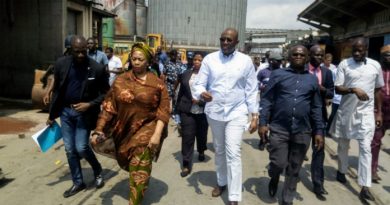
Senator John Owan Enoh…… From The Politics of Policy to the Business of Production
By Omini Oden
There is a moment in every serious political career when experience must prove that it can produce more than influence. For Senator John Owan Enoh, that moment is unfolding on the factory floor.
After more than two decades in Nigeria’s legislative arena, where budgets, appropriation, public finance, oversight and representation formed much of his professional vocabulary, John Owan Enoh now occupies one of the most economically consequential positions at the National level as the Honourable Minister of State for Industry.
The assignment has placed him at the intersection of politics and production, where the elegance of policy language must eventually submit to the harder realities of Capital, Electricity, Technology, Infrastructure, Productivity, Jobs and Markets. It is also a fitting, if demanding, stage for a politician whose career has increasingly revolved around the institutions and economics of governance.
What makes the present moment particularly interesting is that Enoh is not approaching industrial policy as a new entrant into economic administration. His years in the “Green and Red Chambers” of at National Assembly, with his extensive engagement with Finance and Appropriation, gave him a better understanding of how government mobilizes and allocates resources. His movement into executive office now places him on the other side of the equation; How can policy, capital and institutional authority be converted into productive capacity? That is the real test of his current assignment.
Nigeria’s industrial history is littered with policies that sounds and appears ambitious when launched and became less consequential at the implementation phase. The country has never or rarely lacked ideas about industrialization; the more enduring difficulty has been creating the conditions in which those ideas can survive contact with the Nigerian operating environment. Enoh appears conscious of this gap.
One of the defining features of his present approach has been an insistence that industrial policy must move from announcement to implementation and from implementation to measurable outcomes. The Industrial Revolution Work Group, established as a platform bringing together government, manufacturers, financiers and other stakeholders, has adopted a 30-to-90-day implementation framework and proposed a quarterly industrial scorecard covering such indicators as financing delivered, infrastructure provided, firms supported, production increased, employment created and local contracts awarded.
The importance of this approach lies less in the machinery of another government committee than in the philosophy behind it. Industrialization is ultimately measurable. A factory either increases production or it does not; an entrepreneur either receives affordable capital or remains constrained; a manufacturing line either creates jobs and value or it becomes another underutilized asset.
The move towards measurable delivery therefore gives Enoh’s industrial brief a potentially useful discipline, government must increasingly account for what its policies produce, not on just what they promise. A legislative education that now meets the real economy. This would sharpen the opening around the central paradox, a politician whose career was built around scrutinizing how government spends money is now helping create the productive economy that makes such spending sustainable. That gives the piece more authority, while keeping the favourable assessment grounded in documented initiatives rather than praise alone.
There is an interesting continuity between John Enoh’s legislative past and his present responsibility. His years in Finance and Appropriation at the National Assembly exposed him to the fiscal architecture of the Nigerian state, how resources are raised, appropriated and distributed. Industry presents the complementary question, what happens to those resources when they enter the productive economy? The distinction is critical.
Public expenditure can stimulate an economy but sustainable prosperity ultimately depends on productive enterprise. Government can appropriate money for infrastructure, establish incentives, create institutions and formulate policies but it is enterprises that ultimately build factories, employ workers, develop products, take commercial risks and compete in domestic and international markets. This explains why John Enoh’s current emphasis on private-sector partnership is significant. His ministry’s industrial strategy increasingly treats government as an enabler of enterprise rather than the substitute for it. That is a necessary distinction in a country where the state has historically been expected to solve almost every economic problem.
The industrial state that Nigeria requires is neither a state that abandons business to market forces nor one that attempts to run the economy from government offices. It is a state capable of providing the infrastructure, regulation, incentives and coordination that make productive investment commercially viable. Few issues expose the challenge more clearly than industrial finance.
Enoh has repeatedly drawn attention to the difficulty Nigerian manufacturers face in accessing affordable long-term capital. He has argued that manufacturers cannot compete effectively when borrowing costs are exceptionally high compared with financing conditions in competing economies. Manufacturing is a patient business. A factory requires substantial investment in machinery, land, power, technology, inventory, skills and distribution before returns can be realized. An economy that asks manufacturers to finance long-term production with very expensive short-term money is effectively asking them to compete with one hand tied behind their backs. This is why the reported mobilization of more than $380 million in strategic industrial financing under the current policy framework is worth watching, not because of the size of the figure, what happens after the announcement.
Does the money reach productive enterprises Does it expand capacity? Does it create jobs? Does it replace imported inputs?Does it generate exports? Those are the questions that turn financial commitments into economic evidence. The same principle applies to power.
Nigeria cannot build a competitive manufacturing economy while treating electricity as an incidental matter.
Energy costs are embedded in virtually every manufactured product and unreliable supply forces businesses to absorb additional costs through alternative sources of power. The Federal Government’s proposed 50MW dedicated electricity project for manufacturers at Idu Industrial Estate in Abuja represents more than an infrastructure intervention. Senator John Enoh has presented it as a potential model for industrial clusters elsewhere. When such an approach will be successfully implemented and replicated, it could illustrate a more practical form of industrial policy, identify a binding constraint, target it directly, measure the outcome and scale what works. That is the sort of policy logic that moves industrialization away from rhetoric and towards administration.
At the heart of the Minister’s industrial message is another familiar but unfinished Nigerian ambition, “Value Addition” Nigeria has enormous agricultural and mineral resources, yet too much of the country’s economic value has historically been lost between the point of extraction and the point of final consumption. Raw materials leave the country; finished or semi-finished products return at prohibitively higher prices. Industrialization seeks to reverse that pattern.
Cotton for instance should not be exported, it should feed textile and garment industries as readily available raw material thst is affordable. Agricultural produce should increasingly move into processing and packaging. Crude resources should support petrochemical and downstream industries. Solid minerals should generate domestic processing and manufacturing capacity. The logic is straightforward, the more value created within Nigeria, the greater the potential for employment, skills, technology transfer, industrial linkages and foreign exchange earnings.
This is also where the new Nigeria Industrial Policy 2025 assumes importance. The policy sets ambitious targets for expanding manufacturing’s contribution to GDP while emphasising industrial infrastructure, value chains, investment, innovation, digital industrialization and sustainability.
Senator Enoh’s responsibility is not to have invented these challenges, it is to help turn the policy framework into an operating system for Nigerian industrial sector. There may be an advantage in having someone with Enoh’s political background at the centre of this conversation.
Industrial policy is not an exercise in economics alone, it requires negotiation across ministries, agencies, financial institutions, manufacturers, organized labour, state governments, development partners and investors. It requires political understanding as well as technical competence. Years spent in navigating legislative committees and political institutions can provide useful experience in precisely this kind of stakeholder environment but executive office changes the standard of accountability. A legislator can interrogate why a programme has failed.
A minister must help make the programme work. That is why Enoh’s present assignment should ultimately be judged not by his legislative experience alone, nor by the number of industrial initiatives announced under his watch but by whether the institutional environment for production actually improves. The challenges remain substantial. Manufacturers continue to contend with high production costs, expensive financing, infrastructure deficits, regulatory burdens and other structural constraints. These are problems no minister can solve in isolation.
The favourable case for John Owan Enoh, therefore, is not that he has somehow solved Nigeria’s industrial problems. The stronger and more defensible proposition is that his background, current policy orientation and emphasis on measurable implementation places him in a potentially strong position to contribute to their solution. That distinction matters.
Perhaps the most compelling way to understand the minister’s present chapter is as a movement from political capital to productive capital. The legislature gave him institutional experience. Politics gave him networks and political understanding.
Executive office has figured him out with the responsibility of translating those assets into policy outcomes. Industry demands something more tangible. It demands capital invested in machines, reliable power, competitive businesses, skilled workers, technology, local supply chains and products capable of competing beyond Nigeria.
This is why the current phase of Enoh’s career may eventually prove more consequential than any previous office he has held. He is no longer dealing primarily with the politics of who gets what from government. He is confronting the larger economic question of how Nigeria can produce enough of what it needs and compete effectively in what it offers the world.
There is reason, therefore, to take the present industrial agenda seriously without romanticising it. The new policy framework is ambitious. The financing initiatives are important. The emphasis on industrial clusters and dedicated power addresses genuine constraints.
The effort to bring manufacturers and financiers directly into policy implementation is sensible. The proposed scorecard could provide an important mechanism for measuring progress. Let’s not forget, industrial transformation takes time.
The final verdict will not come from conferences, policy launches or ministerial speeches. It will come from the economy itself. It will be seen in factories operating at higher capacity, Nigerian products gaining market share, new investments becoming productive, young Nigerians finding sustainable industrial employment, domestic supply chains deepening and more value being retained within the Nigerian economy. For Senator John Owan Enoh, that is the significance of the moment.
A long legislative career has brought him to the point where the language of appropriation must meet the language of production; where oversight must give way to execution and where political experience must demonstrate its economic usefulness. If he can help narrow the obstinate distance between policy and production, his present assignment will have achieved something considerably larger than another ministerial chapter. It will have demonstrated that political experience, when combined with institutional understanding and an uncompromising focus on implementation, can become an instrument of economic transformation.
For now, the work continues. And the factory floor, ultimately, will have the final word.
Omini Oden ACPA, FCAI, is a
Development Communication Strategist, Governance & Policy Analyst
Writes from Abuja