REFLECTIONS ON EKITI GOVERNORSHIP ELECTION
Nick Dazang
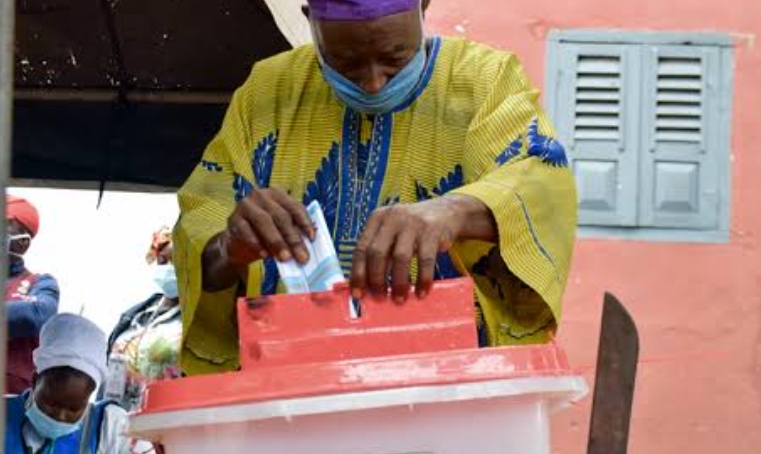
The Off-cycle Governorship Election in Ekiti State, which took place on Saturday, 20th June 2026, proved the bookmakers right. Bar isolated incidents of violence, the election was adjudged, by all stakeholders, to be largely peaceful. This agrees with a salutary streak that has defined the conduct of off-cycle governorship elections in that State since 2014.
The election was also distinguished by one phenomenon: Since the inauguration of the Fourth Republic in 1999, no incumbent Governor of Ekiti has helmed the State, back to back, for two consecutive constitutionally allowed tenures of eight years. This time around, the incumbent, Abiodun Abayomi Oyebanji, of the All Progressives Congress(APC), has broken that jinx. He has also made history.
His victory was both resounding and comprehensive. The APC candidate secured 319,224 votes. His runner up, Olumayokun Oluwole Oluyede of the Peoples Democratic Party(PDP) received 40, 543 votes while the second runner up, Oluwadare Patrick Bejide of the African Democratic Congress(ADC), got 12,872 votes.
By the accounting of the Independent National Electoral Commission(INEC), 2,229 Polling Units(PUs) out of 2,445 across the State had opened at 8.30 a.m. on Election Day, the time officially designated for opening of polls. This represents 98.8%. This feat could be accomplished due to the fact that before then, it had earlier activated its 177 Registration Area Centers(RACs) strewn across the State to the tune of one hundred percent.
In spite of the novelties and new demands of Section 60 of the Electoral Act 2026, to wit: that the Presiding Officer shall after counting the votes at the PU, enter the votes scored by each candidate in a form prescribed by the Commission; that the form shall be signed and stamped by the Presiding Officer and countersigned by the candidates or their polling agents; that the Presiding Officer shall count and announce the result of the polling unit etcetera, 2,379 out of Ekiti State’s 2,445 PU results had been uploaded on the INEC Results Viewing Portaln(IReV) as at 4.00 a.m. of Sunday, 21st June 2026.
Sixty-six PU results reportedly stalled due to connectivity challenges relating to transmission of the results.
On voter turn out, which has been downward bound since 2014, this election has moved the needle on the clock by at least two minutes. From 36.05% voter turnout registered in 2022, this election registered a voter turnout of 38.7%.
By all accounts, the election was credible. It also reflected the intend of the voters. YIAGA-AFRICA, which deployed its Watching the Vote (WTV) and Process and Results Verification for Transmission (PRVT) methodologies, said the outcome of the election announced by INEC was consistent with its verification estimates.
If the election was largely peaceful and credible, it was marred by widespread vote buying and inducements. The coalition of observer groups under the auspices of the European Union Support to Democracy and Good Governance in Nigeria (EU-SDGN) and the Center for Democracy and Development (CDD) were unanimous on these.
Speaking on behalf of the coalition on Election Day, Mr. Lanre Arogundade, stated that the election was threatened by “isolated cases of violence, well organized voter inducement and vote buying schemes”.
The media were also awash with reports of polling agents issuing numbered slips to voters after they had cast their ballots. Other voters were encouraged and, in some instances, cajoled to put down their names in some strange and mysterious lists. The notion was to facilitate vote trading without the exchange of cash in the precincts of the PUs, thereby circumventing the law and outwitting the anti-corruption agencies.
The Commission was slovenly and less than careful with its official figures. Where it had initially advertised that fourteen (14) candidates were contesting, it turned out, by virtue of the final result collated and declared, that fifteen (15) candidates contested the election.