LAPO Forum Calls for Accountability, Sustainable Funding for WASH Facilities in Nigerian Schools
…Says nearly 29 million children lack drinking water in schools
Oru Leonard
The Lift Above Poverty Organization (LAPO), has called on federal, state and local governments to strengthen accountability, provide sustainable funding and ensure proper maintenance of water, sanitation and hygiene (WASH) facilities in Nigerian schools.
Stakeholders also urged authorities to prioritise the functionality of school water and sanitation infrastructure, warning that the construction of facilities without adequate maintenance and funding arrangements undermines their long-term benefits to pupils.
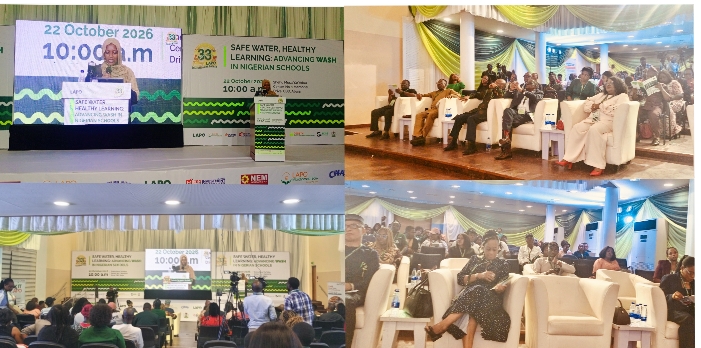
The recommendations were contained in a communiqué issued at the end of LAPO’s 33rd Annual Development Forum, held on Thursday, October 22, 2026, at the Shehu Musa Yar’Adua Centre, Abuja.
The forum, themed “Safe Water, Healthy Learning: Advancing WASH in Nigerian Schools,” brought together stakeholders from the education, water and sanitation, public health, government, civil society and development sectors to discuss practical and sustainable solutions to the challenges of providing safe water and sanitation facilities in schools.
According to the communiqué, the 2023 national WASH mapping survey indicated that nearly 29 million Nigerian children had no drinking water in their schools, highlighting the scale of the challenge facing the country’s education sector.
The forum noted that inadequate access to safe drinking water, functional toilets and handwashing facilities exposes schoolchildren to preventable health risks, disrupts learning and undermines their dignity.
It stressed that safe water, adequate sanitation and proper hygiene are essential to creating a conducive learning environment and improving educational outcomes.
The event was chaired by the Minister of Women Affairs and Social Development, Imaan Sulaiman-Ibrahim, and co-chaired by former Minister of Aviation, Chief Osita Chidoka, of the Athena Centre for Policy and Leadership, who was represented by Deputy Corps Marshal (rtd) Victor Nwokolo.
The keynote paper was presented by Zainab Ibrahim Budah, Senior Learning and Development Specialist in the Department of Education Support Services of the Federal Ministry of Education.
LAPO Founder, Dr. Godwin Ehigiamusoe, served as chief host, while Oladimeji Adeyemi, Head of Education at UNESCO, was the special guest of honour.
Other participants included Professor Osaren Emokpae, immediate past Chairman of the LAPO Board of Directors, and Benson Attah, National Coordinator of the WASH NGO Network.
Participants identified poor maintenance, inadequate budgetary provisions and weak institutional accountability as major obstacles to sustainable WASH services in Nigerian schools.
The communique observed that existing boreholes, toilets and other sanitation infrastructure frequently become unusable because of insufficient operational funding, inadequate maintenance and unclear responsibility for repairs.
The forum also expressed concern that responsibilities for school WASH services are spread across education authorities, water agencies, state and local governments, school administrators and development partners, without sufficiently defined accountability for the continued operation of facilities.
It therefore called for clear assignment of responsibility to ensure that every public school has a designated institution accountable for its water, sanitation and hygiene services.
The forum recommended that all school WASH projects should incorporate comprehensive maintenance plans and dedicated recurrent budgetary allocations to guarantee the continued functionality of facilities. In addition WASH Clubs were recommended to be established in schools.
It further urged governments and development partners to move away from measuring success mainly by the number of facilities constructed and instead assess the proportion of facilities that remain safe, accessible and functional for daily use. I
The forum also highlighted the disproportionate effects of inadequate sanitation facilities on adolescent girls and children with disabilities.
It noted that the absence of private, functional toilets and adequate menstrual hygiene facilities could contribute to absenteeism and interrupted education among girls.
Similarly, children with disabilities face additional barriers where sanitation facilities are inaccessible or unsuitable for their needs.
To address these concerns, the communiqué urged governments and relevant stakeholders to provide facilities that guarantee privacy, safety and adequate menstrual hygiene support for girls, while ensuring accessibility for children with disabilities.
It also called for the integration of WASH services into school infrastructure planning and education policy implementation to improve enrolment, attendance, retention and learning outcomes.
The forum called for greater community participation in monitoring school WASH facilities, reporting breakdowns and ensuring that responsible institutions take prompt corrective action.
It recommended empowering school-based management committees, parents, local organisations and community stakeholders to participate actively in monitoring the availability and functionality of water and sanitation infrastructure.
The communiqué also proposed the establishment of publicly accessible records showing the operational status of school WASH facilities and identifying the institutions responsible for their maintenance.
According to the forum, such records would enable parents and communities to monitor service delivery and demand timely action when facilities become unusable.
It further recommended regular inspections, performance reviews and stronger coordination among federal, state and local governments, education authorities, water and sanitation agencies, school administrators and development partners.
The forum emphasised that the ultimate measure of success in school WASH interventions should be the benefits delivered to students rather than the number of projects completed.
It called for an assessment framework that prioritises children’s access to safe, functional, inclusive and sustainable water and sanitation facilities.
The communiqué also urged development partners and implementing agencies to incorporate long-term maintenance, operational funding and institutional ownership into the planning and implementation of WASH projects.
It called on LAPO and other stakeholders to sustain engagement with government institutions, development partners and communities to promote the implementation, monitoring and evaluation of the forum’s recommendations.
In its conclusion, the forum reaffirmed that safe water, adequate sanitation and proper hygiene are indispensable to children’s health, dignity and educational development.
It urged the Federal Government, state governments, local government authorities, relevant agencies, development partners, school administrators, civil society organisations, parents and communities to work collaboratively to ensure that every Nigerian child has access to safe and functional WASH facilities at school.
The forum also commended LAPO for sustaining its Annual Development Forum as a platform for dialogue, knowledge exchange and advocacy on critical national development issues.
It called on stakeholders to translate the recommendations into concrete actions that will improve school WASH services and enhance the quality of education in Nigeria.