Enikanolaiye Urges NTAC to Drive Public Diplomacy Under Nigeria’s 4-D Foreign Policy
Oru Leonard
Abuja, Aug. 2, 2026 – The Honourable Minister of State for Foreign Affairs, Ambassador Sola Enikanolaiye, has directed the Nigeria Technical Aid Corps (NTAC) to intensify public diplomacy and media engagement to increase Nigerians’ awareness of the Ministry of Foreign Affairs’ activities and the country’s growing global development contributions.
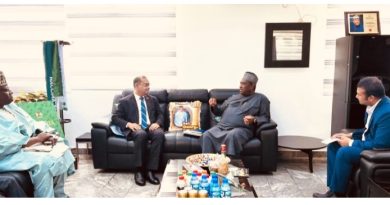
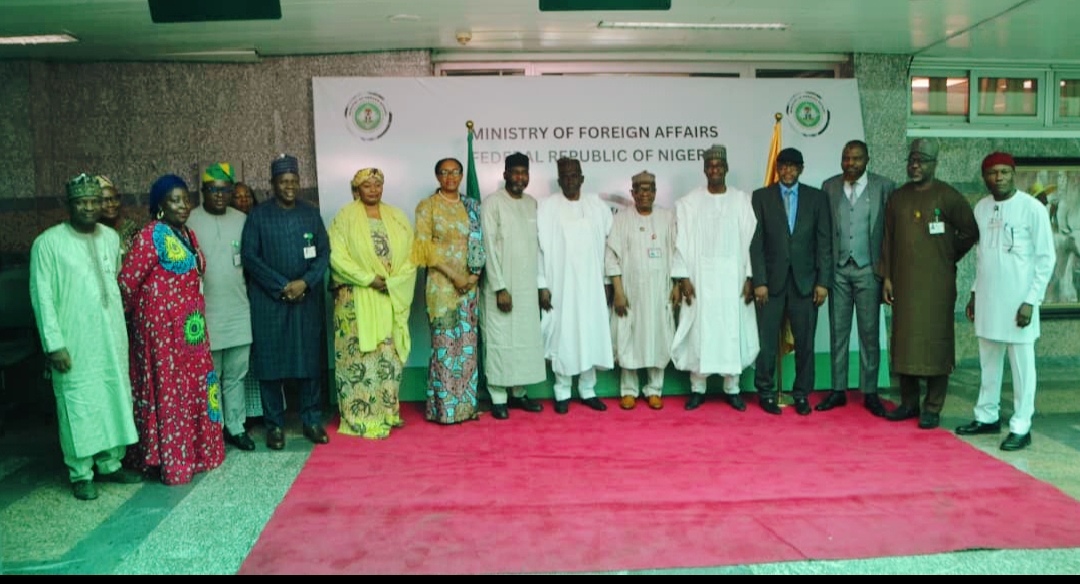
The Minister gave the charge during a courtesy visit by the Director-General of NTAC, Hon. Yusuf Buba Yakub, and the agency’s management team in Abuja, where both sides discussed strategies for repositioning Nigeria’s foreign policy under President Bola Ahmed Tinubu’s 4-Ds Foreign Policy doctrine.
Ambassador Enikanolaiye stressed that effective communication had become as important as policy implementation, urging both institutions to adopt a deliberate and well-funded media strategy.
“We need to create more announcements for Nigerians to know what we are doing in the Ministry and NTAC. Nigerians have not been fully aware of the work of TAC and the Ministry. We must up our game in the media,” he said.
He commended the Ministry’s spokesperson for ongoing publicity efforts but maintained that a comprehensive communication strategy was essential to showcase Nigeria’s diplomatic achievements.
The Minister described NTAC as a critical instrument in implementing Nigeria’s foreign policy centred on the four pillars of Demography, Democracy, Development and Diaspora, noting that the agency had continued to achieve significant results despite limited resources.
He also disclosed that the Ministry of Foreign Affairs is undergoing extensive reforms aimed at improving efficiency and aligning its operations with Nigeria’s national interests under the Renewed Hope Agenda.
Earlier, NTAC Director-General Yusuf Buba Yakub highlighted the agency’s achievements since its establishment in 1987, describing it as one of Nigeria’s most effective soft power diplomacy initiatives.
According to him, NTAC has deployed more than 10,000 Nigerian professionals to over 40 countries across Africa, the Caribbean and the Pacific, providing expertise in education, healthcare, engineering, agriculture, information technology and public administration.
He noted that the programme has significantly strengthened human capacity in beneficiary countries, with several former Nigerian volunteers rising to senior academic and administrative positions, including vice-chancellors and deputy vice-chancellors in foreign universities.
Yakub also recalled that an NTAC volunteer was appointed by the Government of Sierra Leone to lead the country’s COVID-19 management efforts, describing it as evidence of Nigeria’s growing international credibility.
The DG said the agency has expanded its operations in line with President Tinubu’s foreign policy objectives, particularly in the Caribbean, following the President’s recent visit to St. Lucia, where a new NTAC agreement was signed.
He added that Grenada and St. Kitts and Nevis had been added to the list of active partner countries, while dormant partnerships with Jamaica, Rwanda, Seychelles and Zanzibar had been revived.
Currently, 274 Nigerian professionals are serving as NTAC volunteers across 13 countries, including The Gambia, Uganda, Sierra Leone, Liberia, Rwanda, Jamaica, Benin Republic, Grenada, Guinea-Bissau, Seychelles, Zanzibar, Equatorial Guinea, and St. Kitts and Nevis.
Yakub further disclosed that discussions are at advanced stages to establish new technical aid agreements with Zambia, Ethiopia, Angola, Trinidad and Tobago, and Barbados, a move expected to expand Nigeria’s development cooperation and diplomatic footprint.
Also speaking, the Permanent Secretary of the Ministry of Foreign Affairs, Ambassador Dunoma Umar Ahmed, called for the adoption of digital innovations to strengthen NTAC’s operations. He advocated the creation of a digital database of Nigerian experts, virtual technical assistance platforms, stronger diaspora engagement, results-based monitoring and evaluation, youth-focused technical diplomacy, and joint innovation projects with partner countries.
The meeting reaffirmed the Federal Government’s commitment to leveraging technical cooperation, knowledge transfer and South-South collaboration as key instruments for advancing Nigeria’s foreign policy and enhancing the country’s global influence through soft power diplomacy.