DICAN Conference Warns of Rising Information Warfare Threats, Launches National Fact-Check Network
Oru Leonard
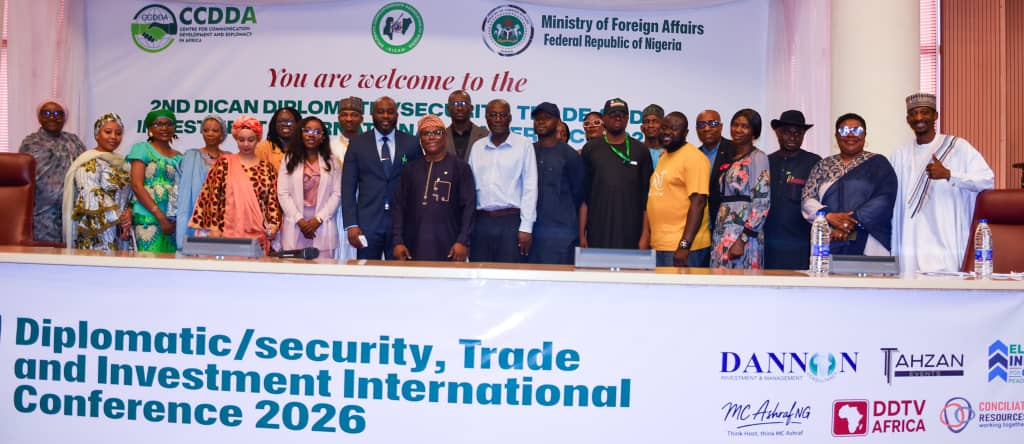
The 2nd Diplomatic, Security, Trade and Investment International Conference has raised concerns over the growing threat posed by information warfare, deepfakes and coordinated disinformation campaigns to global security, democracy, trade and investment.
The conference, organised by the Diplomatic Correspondents’ Association of Nigeria (DICAN), in collaboration with the Centre for Communication Development and Diplomacy in Africa (CCDDA), PR Nigeria and other partners, was held on Wednesday at the Rotunda Hall of the Ministry of Foreign Affairs in Abuja.
Themed “Information Warfare: Strengthening Global Security, Trade and Investment Through Collaborative Truth – The Role of Diplomacy, Intelligence and Media,” the conference brought together diplomats, intelligence chiefs, senior government officials, academics, private sector operators, civil society groups and international media practitioners.
In a communiqué issued at the end of the conference, participants described information warfare as a rapidly evolving global threat that has moved beyond “amateurish fake news” into sophisticated industrial-scale manipulation driven by Artificial
Intelligence and deepfake technologies.
According to the communiqué, over 70 per cent of Foreign Information Manipulation and Interference (FIMI) campaigns now deploy generative AI and high-fidelity deepfakes to trigger market panic, manufacture diplomatic tensions and distort public perception.
The conference warned that the economic implications of disinformation have become severe, with global losses estimated at over 100 billion dollars annually through reduced investments, market instability and increased security spending.
Participants also expressed concern over the impact of micro-targeted disinformation on democratic systems, especially as more than 40 countries are expected to conduct major elections between 2024 and 2026.
The communiqué stated that foreign and domestic actors were increasingly weaponising digital platforms to manipulate public opinion, distort electoral choices and undermine confidence in democratic outcomes.
The conference further noted that in Nigeria and across Africa, information warfare has aggravated insecurity, with insurgent groups and separatist movements using online propaganda and localised digital content to inflame ethnic and religious tensions, weaken regional trade cooperation and disrupt diplomatic relationships.
Despite these concerns, participants acknowledged positive gains in Nigeria’s economic diplomacy, revealing that non-oil exports reached a record 6.1 billion dollars in 2025, representing an 11.5 per cent increase over 2024.
The communiqué noted that value-added products accounted for 51 per cent of the export growth, stressing that sustaining investor confidence would depend heavily on “absolute information integrity.”
A major highlight of the conference was the official launch of the Nigeria Fact-Check and Information Integrity Network (NFIIN), a collaborative initiative involving DICAN, CCDDA, PR Nigeria and 69 non-governmental organisations across Nigeria’s 36 states.
According to the organisers, the network has established six regional situation rooms with dedicated desk officers tasked with tracking, verifying and countering false information and harmful narratives.
The conference also unveiled a tri-lingual public integrity campaign aimed at promoting media literacy and responsible information sharing in English, Hausa, Yoruba and Igbo languages.
The campaign adopted three key slogans: “Verify Before You Share,” “Truth Matters: Build a Stronger, Safer Society,” and “Think Before You Share.”
Participants described the initiative as a strategic effort to localise public awareness and build resilience against disinformation at the grassroots level.
The conference equally honoured several individuals and institutions with Awards of Excellence for promoting peace, democracy and information integrity.
Among the awardees mentioned in the communiqué was former President Goodluck Ebele Jonathan and the European Union for their contributions to democratic stability and responsible information engagement.