Oru Urges Emotional Intelligence and Mental Health Management for Security, Media Personnel
Maryam Aminu
Chief Executive Officer of Oru Media and Associates, Oru Leonard Oru, has called for deliberate efforts to build the emotional intelligence and positive mental health of security operatives and media practitioners, saying the ability to manage emotions is critical to sound judgment, restraint and responsible communication.
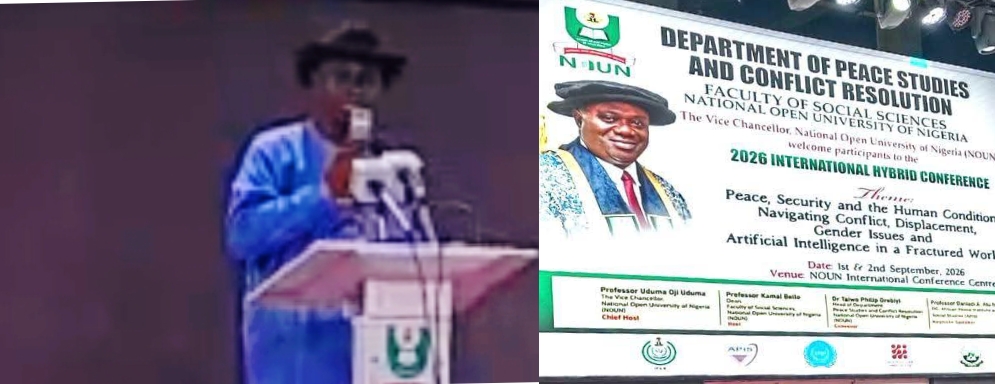
Oru made the call at the 2026 International Hybrid Conference organised by the Department of Peace Studies and Conflict Resolution, Faculty of Social Sciences, National Open University of Nigeria (NOUN), in Abuja.
Speaking on the theme, “Peace, Security and the Human Condition: Navigating Conflict, Displacement, Gender Issues and Artificial Intelligence in a Fractured World,” Oru said technical competence alone was insufficient for professionals whose decisions and communication could have far-reaching consequences for society.
He said security personnel must be equipped not only with operational skills but also with the emotional discipline required to manage pressure, reactions and interactions in the field.
According to him, greater attention to emotional intelligence among both security operatives and media practitioners would promote restraint, improve decision-making and help prevent situations from escalating into conflict.
Oru also challenged the perception that peace and security were exclusively the responsibility of security agencies, insisting that every individual and institution had a role to play.
“Peace and security are the business of everyone,” he said, explaining that the responsibility begins with the individual, extends to society and ultimately involves formal security institutions.
He said peace should not be defined merely as the absence of war, but should encompass peace of mind, a peaceful environment and the ability of people to coexist without unnecessary tension and fear.
Oru further urged journalists and other media practitioners to recognise the power of their platforms and deploy them to promote unity rather than division.
He said the responsibility had become more critical with the rapid spread of information, particularly with the growing influence of Artificial Intelligence.
According to him, media professionals must exercise greater caution over the information they create, amplify and disseminate, while ensuring that emerging technologies are not used to fuel misinformation, tension or conflict.
He consequently advocated stronger emphasis on emotional balance among media practitioners, academics, security personnel and other professionals, saying technical expertise should be matched by the ability to understand emotions, manage reactions and communicate responsibly.
The two-day conference, held from September 1 to 2 at the NOUN International Conference Centre, Abuja, brought together academics, policymakers, diplomats, students, media practitioners and other stakeholders to examine contemporary challenges affecting peace, security and human welfare.
The Director-General of the African Peace Institute and Social Studies, Prof. Danladi Atu, called for a shift from traditional state-centred security to a human-centred approach that prioritises the protection, dignity and welfare of citizens.
Atu said security should not be measured solely by the absence of war, but by whether ordinary people could live without fear, want, exclusion and indignity.
He also called for greater inclusion of women, youths and local communities in peace and security structures, saying they should be recognised as mediators, negotiators, early-warning actors, peacebuilders and decision-makers.
On displacement, Atu warned that the effects of conflict often persist long after the cessation of violence, leaving affected communities grappling with lost livelihoods, trauma, poverty and social fragmentation.
The Bangladesh High Commissioner to Nigeria, Miah Md. Mainul Kabir, stressed the need to link peace and security with economic and social development.
Kabir highlighted Bangladesh’s experience in United Nations peacekeeping, poverty reduction, food security and women’s empowerment, while calling for the responsible use of Artificial Intelligence.
He warned against the exploitation of AI for disinformation and cyber threats, urging stakeholders to harness the technology as an instrument for inclusion and development.
Representing the Vice-Chancellor of NOUN, Prof. Uduma Oji Uduma, the Deputy Vice-Chancellor, Shehu Adamu, said universities must move beyond identifying societal challenges to developing practical solutions through research, innovation and dialogue.
Adamu noted that AI could strengthen conflict prediction, early-warning systems and humanitarian interventions, but stressed the need for responsible management of misinformation, ethics and data.
The conference provided a multidisciplinary platform for stakeholders to examine emerging threats to peace and security and develop practical recommendations for policy, peacebuilding and human development.