
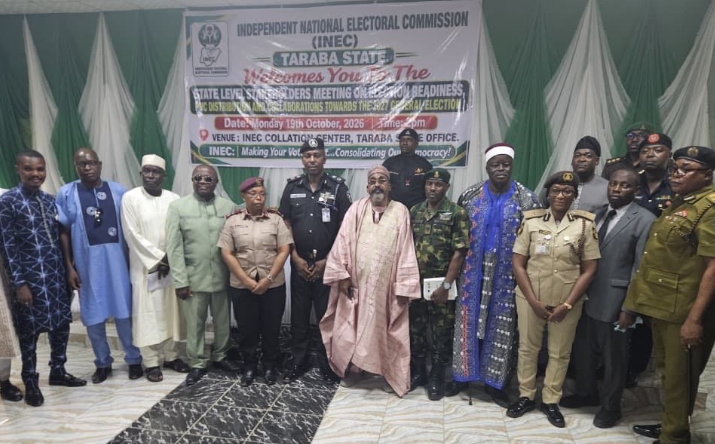
INEC Taraba: Indris engages staff, electoral officers, stakeholders, security agencies on election project plan
Oru Leonard
The Independent National Electoral Commission (INEC) in Taraba State has intensified preparations for the 2027 general elections, setting key performance indicators for staff and electoral officers while strengthening collaboration with security agencies and other critical stakeholders.
The Resident Electoral Commissioner (REC), in the state, Dr Sa’ad Umar Idris, unveiled the commission’s Election Project Plan (EPP) during a series of strategic meetings with staff, Electoral Officers (EOs), political parties, civil society organisations, the media and security agencies.
The engagements, held between October 17 and 20, 2026, focused on operational readiness, institutional neutrality, technological compliance, logistics, voter education, security coordination and stakeholder participation to ensure credible, free, fair, peaceful and inclusive elections.
At a meeting with staff of the state office on October 17, Idris described election management as a serious responsibility requiring effective planning, coordination and teamwork.
He urged staff to embrace the commission’s election project plan, stressing that INEC personnel, as electoral umpires, must maintain the highest standards of neutrality, integrity and professionalism.
The REC also disclosed that the commission was working to improve staff welfare and the operational environment, while encouraging employees to contribute ideas towards achieving the objectives of the 2027 electoral process.
The meeting featured an interactive session during which staff discussed the commission’s level of preparedness and aligned with the REC’s vision for credible elections.
In a separate engagement with Electoral Officers from the state’s 16 local government areas, Idris emphasised strict adherence to electoral timelines, operational transparency and the effective deployment of technology.
He outlined six key pillars of the election project plan: institutional neutrality and professionalism, technological integrity, operational transparency, inclusive participation, early recruitment and training of ad-hoc personnel, and robust security coordination.
The plan also provides for the early recruitment and vetting of Supervisory Presiding Officers, Presiding Officers, Assistant Presiding Officers, Registration Area Centre managers and Registration Area Technical Support personnel.
The REC stressed the need for thorough background checks to prevent the recruitment of individuals whose political affiliations or conduct could compromise the integrity of the electoral process.
On logistics, Electoral Officers were directed to assess storage facilities, power generators and Registration Area Centres across the 16 local government areas to identify and address potential operational challenges before election day.
They were also instructed to establish clear schedules for the movement of sensitive and non-sensitive election materials from the state headquarters to local government areas, registration areas and polling units.
The plan further provides for the assessment and maintenance of the Bimodal Voter Accreditation System (BVAS), including necessary hardware servicing, software upgrades and battery replacements.
Preparations for voter register verification and the systematic distribution of Permanent Voter Cards (PVCs) also featured prominently in the operational roadmap.
Stakeholders Pledge Support
On October 19, the REC convened an expanded stakeholders’ meeting involving members of the Inter-Agency Consultative Committee on Election Security (ICCES), political parties, civil society organisations, youth groups, women’s associations, the media, faith-based organisations and a representative of the Aku Uka, chairman of the Taraba State Council of Traditional Rulers.
The meeting reviewed the Election Project Plan, action plan, key performance indicators and election-day mobilisation strategies.
Discussions also covered the display of the National Register of Voters, PVC collection, readiness assessments for the 2027 general elections, collaboration among stakeholders and the shared civic responsibilities required for a credible electoral process.
Goodwill messages were delivered by the Commissioner of Police, who also co-chairs ICCES; the Inter-Party Advisory Council (IPAC); the representative of the Aku Uka; the Coalition of Civil Society Organisations; the Muslim Council; the Christian Association of Nigeria (CAN); the Joint National Association of Persons with Disabilities; the National Council of Women Societies (NCWS); the National Youth Council of Nigeria (NYCN); and the Taraba State Independent Peace Committee.
Political party representatives commended the engagement and called on INEC to sustain its open-door policy, guarantee equal access to stakeholders and maintain transparent mechanisms for resolving electoral disputes.
Security agencies reaffirmed their readiness to work together under the ICCES framework to secure all stages of the electoral process, including ad-hoc staff training and election-day operations.
Civil society organisations and media representatives also pledged support for voter education, public sensitisation and impartial observation of the elections.
Idris urged Electoral Officers to replicate the stakeholder engagement framework in their respective local government areas by holding regular consultations with traditional rulers, community leaders and political actors.
He warned staff against partisan conduct, stating that any proven alignment with political actors or candidates would attract disciplinary action in accordance with the INEC Staff Handbook.
He also directed officers to comply strictly with statutory deadlines and the operational schedules contained in the election project plan.
INEC, Security Agencies Map Out Election Security Strategy
As part of efforts to safeguard the electoral process, the REC convened an ICCES meeting on October 20, bringing together heads of security agencies in the state, with the Commissioner of Police serving as co-chair.
The meeting focused on security arrangements for INEC offices, ongoing PVC collection, the identification of security flashpoints, voter protection and the coordination of electoral logistics.
According to the operational resolutions reached at the meeting, security agencies agreed to strengthen joint deployments across the 16 INEC local government offices and 168 registration areas in the state.
The committee also agreed to assess security threats and map high-risk areas to guide the deployment of personnel and resources ahead of the elections.
Under the proposed security framework, the Nigeria Police Force and the Nigeria Security and Civil Defence Corps are to provide security at INEC local government offices, strongrooms and collation centres.
The resolutions also provide for restricted-access arrangements around designated electoral facilities and the deployment of mobile security units to strategic locations to facilitate rapid responses to emergencies.
On PVC collection, security agencies were directed to maintain order at distribution centres across the 16 local government areas during the designated collection hours of 9 a.m. to 3 p.m.
The arrangements are intended to protect voters, electoral officers and community leaders from harassment, intimidation and obstruction during the exercise.
The meeting also emphasised intelligence gathering and monitoring to prevent voter inducement, extortion and attempts to unlawfully obtain uncollected PVCs.
In addition, the committee reviewed security vulnerabilities across the state, including difficult terrain and areas requiring specialised security deployment.
The REC stressed the need for coordinated security operations to protect electoral personnel, election materials and collation centres throughout the electoral process.
The series of engagements underscores INEC Taraba’s focus on early planning, staff accountability, stakeholder collaboration and election security ahead of the 2027 general elections.
The commission’s ability to implement the project plan, meet established performance targets and sustain cooperation among stakeholders will be central to delivering peaceful, inclusive and credible elections in the state.
Source: Marvin Mathias Bandawa
Public Affairs Officer INEC, Taraba State


