NOUN Conference Calls for Human-Centred Approach to Peace, Security
Maryam Aminu
The National Open University of Nigeria (NOUN) has called for a human-centred approach to peace and security, with stakeholders advocating greater protection of human dignity, women’s empowerment, responsible use of artificial intelligence and inclusive development.
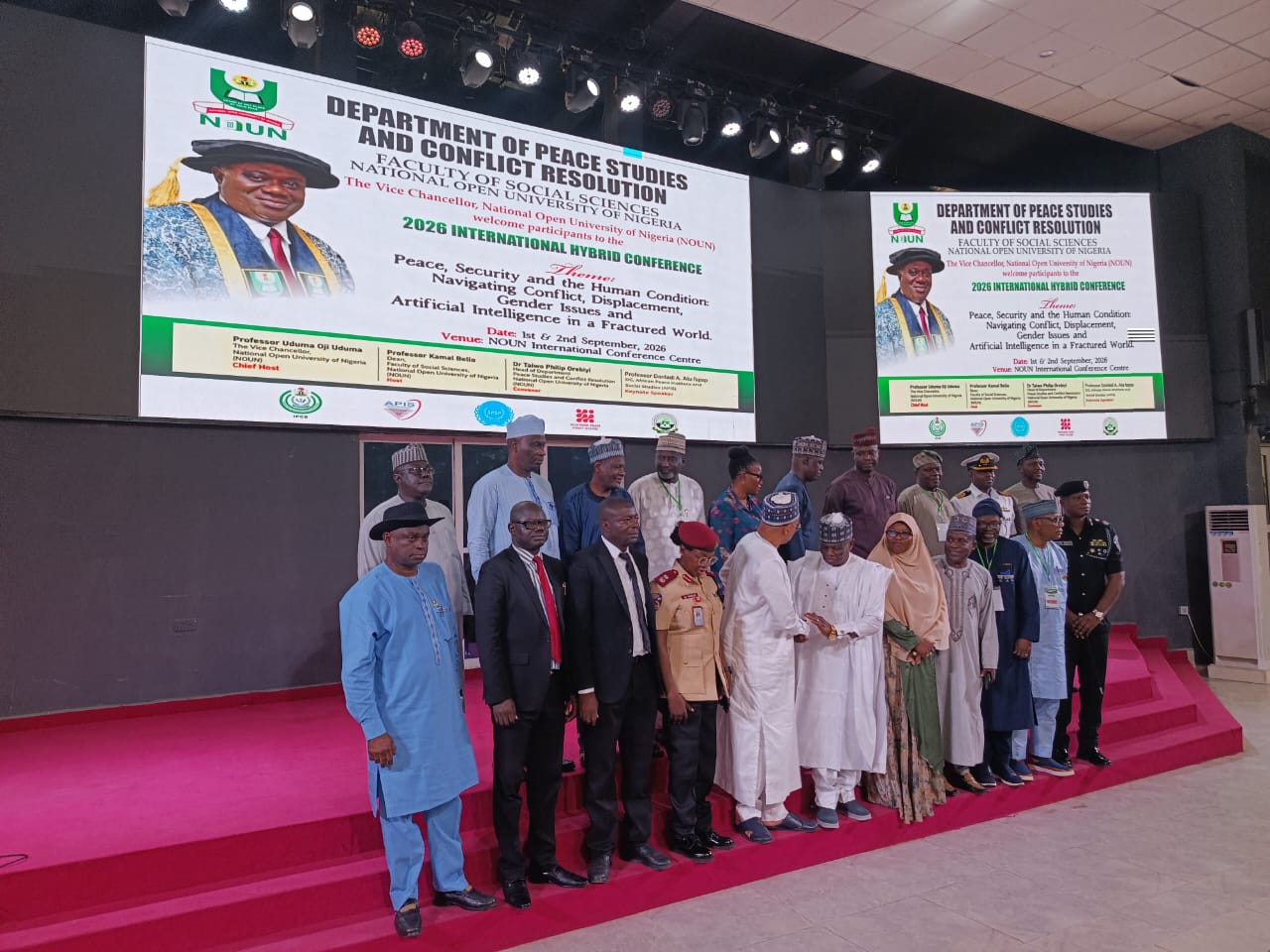
The call was made at the 2026 International Hybrid Conference organised by the Department of Peace Studies and Conflict Resolution, Faculty of Social Sciences, NOUN, which held from September 1 to 2, 2026.
The conference was themed: “Peace, Security and the Human Condition: Navigating Conflict, Displacement, Gender Issues and Artificial Intelligence in a Fractured World.”
In his welcome remarks, the host of the conference, Prof. Bello, underscored the importance of creating an intellectual platform where scholars, policymakers, diplomats, students, media practitioners and other stakeholders could critically examine the complex challenges confronting humanity.
Prof. Bello said the conference reflected NOUN’s commitment to promoting scholarship, dialogue and research capable of addressing contemporary challenges to peace, security and human development.
He noted that the convergence of armed conflicts, forced displacement, gender inequality, insecurity and rapid technological advancement had created new challenges that required multidisciplinary approaches and stronger collaboration among institutions and nations.
The conference brought together academics, policymakers, diplomats, students, media practitioners and other stakeholders to deliberate on emerging threats to peace, security and human welfare.
Speaking at the event, the Director-General of the African Peace Institute and Social Studies, Prof. Danladi Atu, called for a shift from traditional state-centred security to a human-centred approach that prioritises the protection, dignity, welfare and participation of citizens.
Atu said security should not be measured merely by the absence of war, but by whether ordinary people could live without fear, want, exclusion and indignity.
He advocated greater inclusion of women, youths and local communities in peace and security architecture, stressing that they should be recognised as mediators, negotiators, early-warning actors, peacebuilders and decision-makers rather than merely victims of conflict.
On displacement, the scholar warned that the consequences of conflict often persist long after violence ends, resulting in loss of livelihoods, trauma, poverty, exclusion and social fragmentation.
He further cautioned that while Artificial Intelligence presents opportunities for conflict prediction, early warning, humanitarian response and research, its development and deployment must be guided by ethics and human dignity.
Also speaking, the Bangladesh High Commissioner to Nigeria, H.E. Miah Md. Mainul Kabir, stressed the importance of linking peace and security with economic and social development.
Kabir highlighted Bangladesh’s experience in United Nations peacekeeping, poverty reduction, food security and women’s empowerment, noting that sustainable peace requires addressing the social and economic conditions that often fuel instability.
The envoy also called for the responsible use of Artificial Intelligence, warning against its exploitation for disinformation and cyber threats while advocating its deployment as an instrument of inclusion, development and human welfare.
The Vice-Chancellor of NOUN, Prof. Uduma Oji Uduma, represented by the Deputy Vice-Chancellor, Shehu Adamu, said universities must move beyond identifying societal challenges to developing practical solutions through research, innovation and dialogue.
He noted that AI could strengthen conflict prediction, early-warning systems and humanitarian interventions, while urging responsible management of misinformation, ethics and data.
The two-day conference, according to the organisers, provided a multidisciplinary platform for translating research and scholarly discussions into practical recommendations for policy, peacebuilding and human development.
The organisers lead by the dean of Social Studies of the University, b GFexpressed optimism that the deliberations would contribute to stronger partnerships among academia, government, international organisations and civil society in addressing emerging threats to global peace and human security.