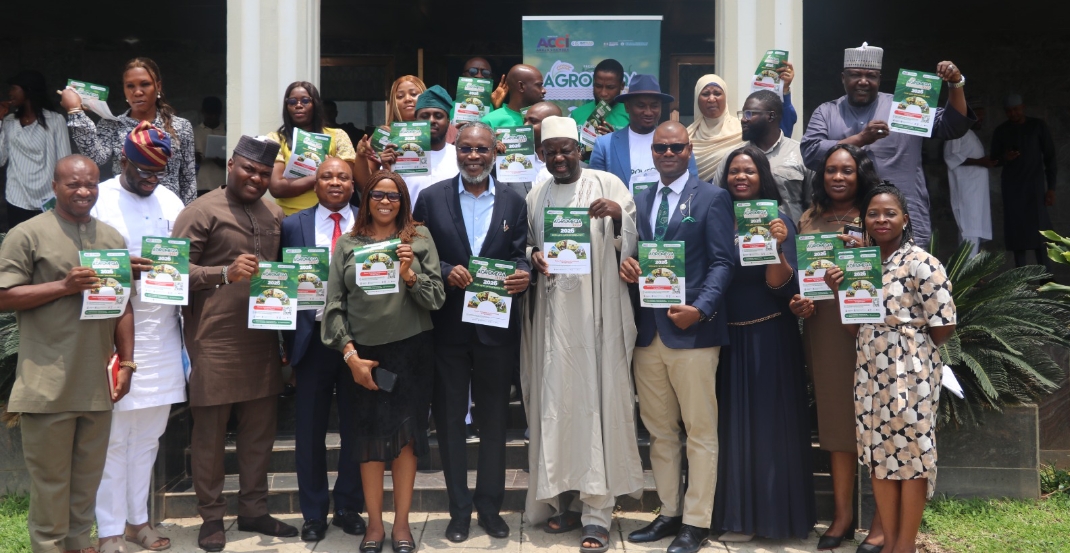
ACCI Unveils AGROMEQA Expo, Calls for ‘No Idle Land’ Policy to Boost Nigeria’s Food Production
Oru Leonard
The Abuja Chamber of Commerce and Industry (ACCI) has unveiled plans for the maiden edition of the Agricultural Mechanization for Export-Quality Products in Africa (AGROMEQA EXPO 2026), while simultaneously calling for a national policy to ensure the productive utilisation of Nigeria’s vast land resources.
The two initiatives were presented on Tuesday in Abuja as part of efforts by the organised private sector to promote agricultural mechanisation, attract investment, strengthen food security and position Nigeria as a competitive agro-exporting nation.
Speaking at a press briefing, President of ACCI, Chief Emeka Obegolu, SAN, PhD, announced that AGROMEQA EXPO 2026 would now hold from October 15 to 16, 2026, at the Prince Adetokunbo Kayode, SAN, Trade and Convention Centre, ACCI Complex, Airport Road, Abuja.
The Expo, organised by the Agricultural Trade Group and JMT Plus Farms and Agro-Allied in collaboration with ACCI, will be held under the theme, “Technology and Investment for Agro-Export.”
Obegolu said the event was designed to reposition Nigeria’s agricultural sector through mechanisation, technology, value addition, investment, research and stronger market linkages.
According to him, the Expo will provide a platform for farmers, investors, agribusiness operators, technology providers, financial institutions, researchers, agro-processors, exporters and policymakers to explore opportunities across the agricultural value chain.
He said a major highlight would be the official declaration of the Expo by Vice President Kashim Shettima, GCON, while the President of the Nigerian Association of Chambers of Commerce, Industry, Mines and Agriculture (NACCIMA), Engr. Jani Ibrahim, OON, mni, is expected to deliver the keynote address on “Agricultural Export and the Role of Private Capital in Its Value Chain.”
The two-day event will feature exhibitions of mechanised farming equipment, precision agriculture technologies, irrigation systems, agro-processing innovations, packaging solutions and climate-smart technologies.
It will also include technical sessions, investment forums, business-to-business engagements, workshops and live demonstrations, as well as a Schools’ Agro Exhibition and Competition aimed at encouraging young Nigerians to embrace agriculture and agribusiness.
Obegolu stressed that Nigeria must move beyond largely subsistence agriculture and embrace modern production systems capable of generating jobs, improving food security, expanding exports and stimulating rural development.
ACCI Proposes ‘Operation No Idle Land’
In a related development, ACCI Vice President, Agriculture, Olasetemi Bode Thompson, has written President Bola Ahmed Tinubu, urging the Federal Government to adopt a national initiative he described as “Operation No Idle Land” and declare a State of Emergency for Food Production.
Thompson argued that Nigeria’s agricultural potential could not be fully realised while significant portions of potentially productive land remained underutilised or completely idle.
He said his agricultural study tours and farm visits to the United States, Canada, Israel and several European countries had demonstrated the importance of mechanisation, efficient land utilisation, technology, infrastructure and value-chain integration in building successful agricultural economies.
The ACCI Vice President proposed that Operation No Idle Land should encourage landowners to put their land to productive use through agriculture, agribusiness, agro-processing, industry or other approved economic activities.
He also proposed that underutilised land could be leased to farmers, cooperatives, investors or companies capable of developing it productively, while organised schemes could aggregate land, capital, technology and market access.
However, Thompson emphasised that the initiative should not become a mechanism for indiscriminate land confiscation, insisting that legitimate property rights and due process must be protected.
He called for a national land audit and digital mapping exercise, the establishment of land banks and agricultural clusters, incentives for productive land use, and deliberate measures to expand access to land, finance, technology and markets for young people and women.
Other proposed pillars include public-private partnerships, improved security for farming communities and agricultural investments, transparent monitoring and measurable targets for cultivated hectares, food output, jobs created, investment attracted and reductions in post-harvest losses.
Thompson further urged the Federal Government to declare a State of Emergency for Food Production backed by a measurable and time-bound action plan.
He identified affordable agricultural finance, irrigation, mechanisation, improved seeds and inputs, extension services, research, rural roads, storage, processing infrastructure, security and sustainable market access as priority areas.
According to him, Nigeria can draw lessons from countries such as the Netherlands, Denmark and Germany, where technology, research, cooperative structures, logistics, infrastructure and strong links between agriculture and industry have helped create productive agricultural economies.
He therefore called on President Tinubu to convene a National Stakeholders’ Summit on Productive Land Use and Food Security, bringing together federal and state governments, the National Assembly, traditional institutions, farmers’ organisations, the private sector, financial institutions, researchers and development partners.
The two ACCI initiatives underscore the Chamber’s push for a more productive, technology-driven and investment-oriented agricultural economy, with mechanisation and efficient land utilisation placed at the centre of Nigeria’s food security and agro-export ambitions.