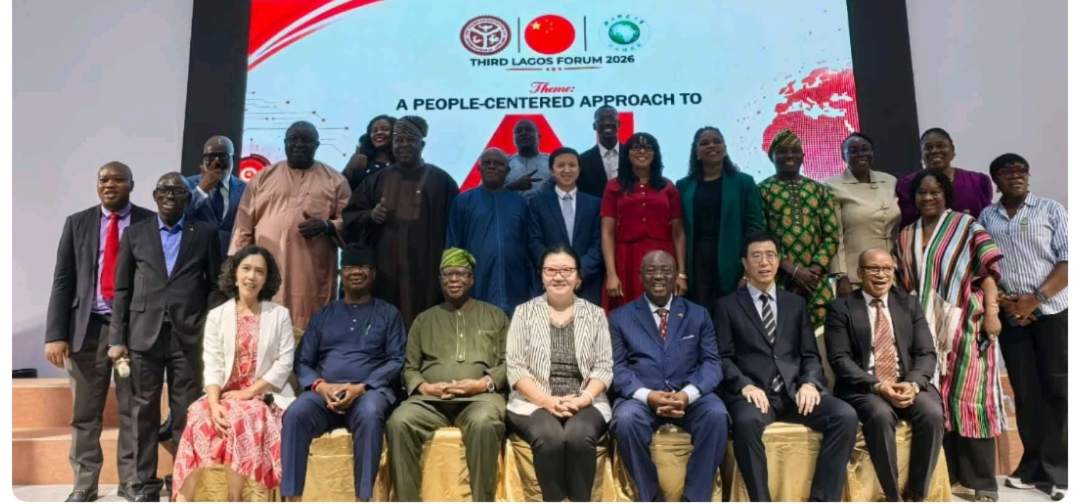
NACCIMA, China Push People-Centred AI Governance for Sustainable Economic Growth
Oru Leonard
The Nigerian Association of Chambers of Commerce, Industry, Mines and Agriculture (NACCIMA), the Consulate General of the People’s Republic of China in Lagos, and key stakeholders have called for stronger collaboration in leveraging Artificial Intelligence (AI) to drive sustainable economic development, bridge the digital divide, and promote inclusive growth in Nigeria.
The call was made on Wednesday at the Third Lagos Forum 2026, organised by the Chinese Consulate in partnership with the Nigerian Institute of International Affairs (NIIA) and the Institute of African Studies, Zhejiang Normal University (IASZNU), at the Shaolin Kungfu Restaurant in Lekki, Lagos.
The forum, themed “A People-Centred Approach to AI Governance: China–Nigeria Cooperation for Bridging the AI Divide,” brought together diplomats, academics, policymakers, private sector leaders, development partners, civil society organisations, and media practitioners to explore how AI can be harnessed responsibly for national development.
Speaking during a presentation titled “AI for Sustainable Development,” NACCIMA Director-General, Engr. Sola Obadimu, described Artificial Intelligence as a critical tool for improving productivity, enhancing trade competitiveness, strengthening healthcare systems, supporting Micro, Small and Medium Enterprises (MSMEs), boosting agricultural output, improving education, and accelerating inclusive economic growth.
Obadimu urged Nigerians to embrace AI responsibly while learning from China’s technological progress, stressing that the country’s AI ambitions must be supported by sustained investment in digital infrastructure, research, innovation, and human capital development.
“The successful adoption of Artificial Intelligence in Nigeria requires sustained investment in digital infrastructure, the development of human capital and digital skills, increased investment in research and innovation, strengthened public-private partnerships, and enhanced collaboration between governments, academia, industry, and development partners,” he said. He added that AI should be deployed to improve productivity, empower MSMEs, transform agriculture, strengthen healthcare delivery, enhance education, promote trade competitiveness, and drive sustainable economic development.
Participants at the forum also advocated deeper China–Nigeria cooperation in AI governance, knowledge exchange, capacity building, joint research, digital infrastructure development, technology partnerships, and innovation ecosystems to ensure that the benefits of emerging technologies are widely shared.
The stakeholders emphasised the need for ethical AI governance built on transparency, accountability, digital inclusion, and equitable access, while encouraging governments, academia, industry, development partners, and civil society to work together in developing policies that promote responsible AI adoption and safeguard public interest.
The event reaffirmed the shared commitment of Nigeria and China to advancing a people-centred approach to AI governance as a catalyst for sustainable development.
The forum was hosted by the Chinese Consul-General in Lagos, Her Excellency Yan Yuqing. Other dignitaries in attendance included former Nigerian Ambassador to China, Chief Jonathan Coker; Deputy Consul-General of China in Lagos, Wang Yue; Prof. Liu Hongwu of Zhejiang Normal University; Prof. Femi Otubanjo, representing the Director-General of the Nigerian Institute of International Affairs, Prof. Eghosa Osaghae; Dr. Zhang Sai of Zhejiang Normal University; and representatives of Huawei Nigeria, among other stakeholders.