The Architect of a New Conscience: Alex Otti, the Amazon of Umuahia, and the Anatomy of a Political Masterstroke
The Architect of a New Conscience: Alex Otti, the Amazon of Umuahia, and the Anatomy of a Political Masterstrok
Dr. Iyke Ezeugo || Saturday 30th May 2026
When Civilizations Tremble
There are moments in the life of a nation when the abyss opens silently. The markets still hum. The children still laugh. The politicians still preen before cameras. Yet beneath the fragile crust of normalcy, the moral foundations tremble. History whispers a terrible truth: empires rarely collapse from without; they erode from within—not for lack of gold or steel, but for want of men and women who refuse to bow when bowing becomes the easier path.
The ancient Greek philosopher Diogenes once walked the streets of Athens in broad daylight, carrying a lit lantern. When the curious crowds asked what he sought, he replied with devastating simplicity: “An honest man.”
Two millennia later, one imagines Diogenes still wandering—through the corridors of Washington, the parliament houses of London, the counting rooms of Zurich—but most urgently, through the political bazaars of modern Nigeria. And if tradition permits us this fancy, perhaps, just perhaps, he would pause in Umuahia.
For something extraordinary has risen in the heart of Abia State. Something that transcends steel and glass. Something that dares to answer Diogenes’ ancient quest.
The Anatomy of a Masterstroke
In the theatre of Nigerian politics, where integrity has long been the willing sacrifice on the altar of primitive accumulation, courage driven by personal values is rarely rewarded. It is silenced, sidelined, or simply bought. Yet every so often, the moral architecture of a nation is rebuilt not by the loudest voices in the chambers of power, but by the silent resolve of the few who refuse to bend.
And rarer still is the sight of a political leader who understands that the most potent weapon against the epidemic of electoral banditry is not a gun—nor even a new legislation—but a monument. A daily, breathing, undeniable reminder that virtue has a reward.
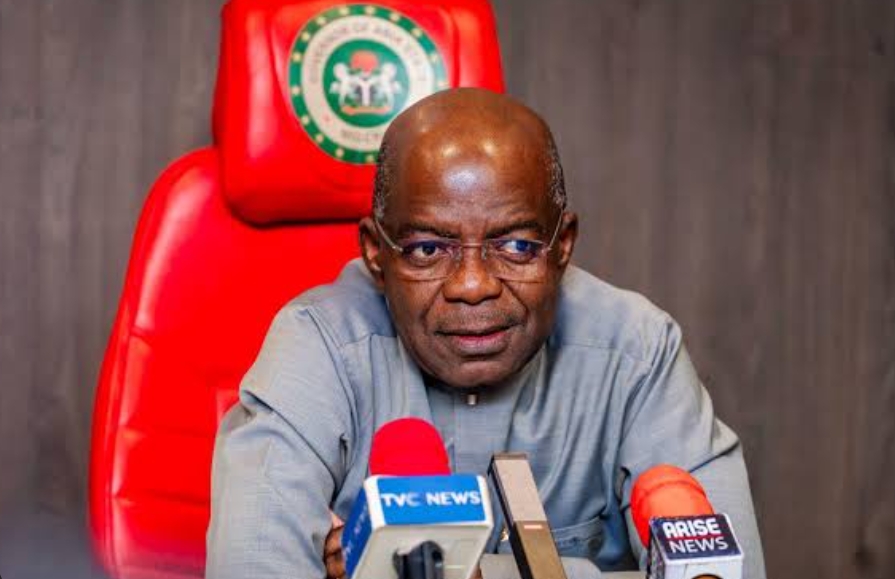
This week, in the bustling circulatory system of Umuahia, Governor Alex Chioma Otti did not merely commission a bus terminal. He etched a new stone into the conscience of the Abia people and Nigerians at large. By raising the Prof. Nnenna Oti Ultra-modern Bus Terminal—a colossus of glass, steel, and capacity capable of housing over 340 buses—Otti has performed an act of political philosophy that transcends infrastructure.
It is a direct, defiant counter-narrative to the moral decay that has become the hallmark of Nigeria’s ruling elite.
The question that lingers in the harmattan wind of our national life is not merely about the grandeur of the terminal, but about the profound why behind its name.
The 340-Bus Monument to One ‘No’
To understand the genius of this gesture, one must journey back to the precipice of March 2023. Abia State was a state holding its breath. The political assassin—not the crude type wielding an AK-47, but the sophisticated vampire wielding a ballot box stuffed with falsehood—had already written the state’s obituary in anticipation.
Enter Professor Nnenna Nnannaya-Oti.
In a season when the political class had perfected the art of the “mighty pen”—where returning officers were treated as mere cash-and-carry appendages of godfathers and moneybags—Oti stood alone. She did what the Roman Senator Cato the Younger did when Julius Caesar’s legions crossed the Rubicon: she chose the losing side of integrity over the winning side of compromise. Cato fell on his sword rather than live under tyranny; Oti risked everything—her career, her safety, her peace—rather than certify a lie.
While her contemporaries in other states either succumbed to the carotid artery of threat or sold the wills of millions for the proverbial “piece of bread,” she held the line.
She did the unthinkable in the Nigerian context: she refused to trade the destiny of a state for her personal comfort. In that singular moment, she became the last saving grace against the political strangulation of Abia, ensuring that the voice of the people was not extinguished by the heavily armed merchants of darkness—as it was in many other parts of the country.
Consider the historical parallel: In ancient Athens, the institution of ostracism allowed citizens to banish those who threatened democracy. But what Oti faced was the opposite—a system designed to banish truth itself. And she said no.
Governor Otti, one of the beneficiary of that courage with the power to acknowledge her, has now done what no other governor or political leader in recent memory has dared. He has built a shrine to integrity and courage. The terminal is not just a transport hub; it is a functional sculpture of gratitude.
“The decision to name this terminal after this excellent woman of valour also recognises that she represents a broad team of unsung heroes,” Otti declared at the commissioning.
In that statement, the Governor revealed a depth of character rarely seen in the corridors of power—a leader who knows that his mandate is not a trophy of war, but a trust held in escrow by the virtuous.
The Philosophy of the Pedestrian: Why Location Matters
Let us pause to admire the philosophical undercurrent of this project’s location. This is not a statue erected in a forgotten government house garden, where only visiting dignitaries might notice. Nor is it a portrait hung in a dusty local government secretariat, collecting the neglect of decades.
This is a bus terminal—situated in the bustling, breathing, unignorable circulatory system of Umuahia.
In choosing a bus terminal, Otti has democratized honour. He has performed what the Italian political philosopher Antonio Gramsci called a “war of position”—not a dramatic overthrow of the old order, but a slow, deliberate, architectural reshaping of common sense itself.
Consider who will pass through this place:
Ndi-oga (the big men and thick women)
Ndi-isi (the leaders)
Umu-boyi (the apprentices)
Ndi-nweala (the indigenes)
Ndi-mbiambia (the guests of the state)
Ndi-choochi (the churchgoers and preachers)
Ndi-almajiri (the wandering learners)
The civil servant, the academics, the market woman, the okada rider.
Every citizen who walks the streets of the capital will either enter, see, hear the conductor screaming the destination, or simply pass by the name “Nnenna Oti.” They will be reminded, daily and involuntarily, that their votes matter.
They will be reminded that there was once a woman who had the power to steal their future and chose instead to protect it.
This is the Socratic method of governance: a constant, silent questioning of the populace. “Are you doing the right thing?” the building seems to ask every commuter. “Would you stand when standing costs everything?”
The Roman philosopher Seneca wrote that “the greatest power is the power to refuse.” Every time a bus departs from that terminal, every time a traveller buys a ticket, that refusal is re-enacted. The building becomes a pedagogy—a daily school of civic virtue.
This stands in stark contrast to the prevailing norm where leaders scramble to name airports and expressways after themselves, their ancestors, or their political godfathers to curry favour. In Lagos, we have a stadium named after a dictator. In Abuja, expressways honour men whose greatest achievement was political survival. Elsewhere, universities have been renamed for fathers who did nothing but provide sperm and political connections.
But Otti has chosen to honour a figure of moral fortitude.
It signals a profound shift: from the worship of power to the worship of principle. From the cult of personality to the canonization of character.
As the British statesman Edmund Burke observed, “The only thing necessary for the triumph of evil is for good men to do nothing.” By making Oti’s name unavoidable, Otti ensures that no one in Abia can claim ignorance of what good looks like when it acts.
This is exactly what Nigeria needs to steer away from this tide of political dark age. For darkness thrives not in the absence of light, but in the absence of memory. The Nnenna Oti Terminal is memory cast in concrete.
A National Reboot: The War Against Moral Brevity
We live in an era of “moral brevity” —a tragic condition where the ethical range of the political elite has been shortened to the point of near extinction. Like a genetic mutation that deletes vital code, the Nigerian political class has largely lost the capacity for shame, for accountability, for the simple recognition that public office is a public trust.
Transparency International continues to rank us abysmally on the Corruption Perceptions Index. Yet where is the applause for the local actors fighting the rot? Where are the international honours for those who, in the crucible of pressure, chose honour?
It is a scandal of omission that Professor Nnenna Oti has not been draped in national honours by the institutions in Abuja. If the National Honours system were truly a reflection of service to the nation, her portrait should hang alongside the greats—alongside Tafawa Balewa’s dignity, alongside Gani Fawehinmi’s rage, alongside Ken Saro-Wiwa’s sacrifice.
But as Governor Otti has shown, leadership is not about waiting for the federal government to act. It is about taking responsibility for the culture of your domain. It is about what the German sociologist Max Weber called “the ethic of responsibility”—the understanding that a leader must answer not only for their intentions but for the consequences of their actions on the moral fabric of society.
Otti’s action drives home a crucial lesson: Integrity and courage must be institutionalized to survive. If virtue exists only in private hearts, it dies with those hearts. But when virtue is carved into public buildings, named into public squares, written into public memory—it achieves a kind of immortality.
By naming a permanent structure after her, Otti has ensured that the idea of Nnenna Oti—the radical, world-altering idea that one person can stand against the tide—will outlive this administration, outlive him, outlive all of us. He has given the youth of Abia and Nigeria at large a tangible, unignorable, daily-visible example that refusing to compromise is a viable career path.
The Jewish philosopher Martin Buber distinguished between “I-It” relationships—where we treat others as objects—and “I-Thou” relationships—where we encounter others as sacred beings. Nigerian politics has long been an I-It enterprise: voters as means, officials as tools, integrity as inconvenience. Otti’s gesture attempts an I-Thou politics: recognizing Oti not for what she could do for him, but for who she is.
As Plutarch noted, “The mind is not a vessel to be filled, but a fire to be kindled.” Governor Otti has kindled a fire in Umuahia. He has shown that governance is not just about the arithmetic of road construction—though he has silently done plenty of that, surpassing many contemporaries—but about the algebra of values.
The ‘New Abia’ Standard vs. The Old Nigeria
Consider the contrast. In the Old Nigeria, the political assassin does not merely kill the body; he kills the spirit. He does so by normalizing fraud. When those appointed to defend the people’s will exchange that will for “contracts” and “gratifications,” they castrate the future of the nation. They commit what the philosopher Kwame Anthony Appiah calls a “failure of ethical imagination”—the inability to conceive of a world different from the corrupt one they inhabit.
In the Old Nigeria, heroes are forgotten and villains are celebrated. Roads are named after men who stole the treasury. Universities honour dictators who shut down the minds they were meant to liberate. The logic is simple and brutal: power confers virtue, and virtue is whatever power says it is.
But Dr. Otti has chosen a different path. He is using the tools of infrastructure to rebuild the superstructure of the state’s morality. His administration has delivered hundreds of kilometres of roads—the transformation of the Umuahia-Uzuakoli-Ohafia highway stands as a testament to his engineering pedigree, alongside many inter-community linkage roads.
Yet, unlike his peers who commission roads and disappear before the asphalt has cooled—or before the first rainfall exposes their substandard work—Otti uses these ceremonies to tell stories. Stories of sacrifice, of struggle, of redemption.
In his address, he recalled the long walk to liberation, noting that “the appetite for quality road infrastructure remains evergreen… we have now turned our attention to the broad spectrum of transport infrastructure.”
But the unspoken subtext is unmistakable: We are building because we are free, and we are free because of her courage.
This is the leadership Nigeria desperately needs. A leadership that understands that development is not an end in itself, but a means—a vehicle—to create a society where decency is the currency, where honesty is not a liability, where the man who does right is not a fool but a hero.
Otti is not just fixing the potholes on the roads; he is trying to fix the potholes in the national soul.
The Silence of the Guardians: An Appeal to Global Conscience And yet.
The silence from The Hague, from the global democracy watchdogs, from the Western embassies regarding Professor Oti is deafening. They are quick to fly flags at half-mast for their own heroes. They are swift to issue statements when their interests are threatened. They are rapid to sanction violators when it costs them nothing.
But where are they when an African woman defies a system rigged against her?
The American civil rights icon Rosa Parks is celebrated worldwide. A statue stands in the U.S. Capitol. Her name is taught in every school. Yet Parks’ courage was refusing to give up a bus seat—a profound act, yes, but one where the personal cost, while real, was primarily social and legal.
Professor Oti faced something potentially far more dangerous: the organized machinery of Nigerian electoral manipulation, backed by godfathers with resources, with thugs, with the capacity to make her disappear. And she said no.
This is not about vanity for the Professor, who continues to serve in academia with the same quiet dignity that characterized her moment of trial. She did not seek fame; fame has found her. She did not ask for a terminal; the terminal was a gift from a grateful governor.
But amplifying her story is a strategic necessity for a dying world. We are in a battle for the soul of democracy, and this battle has become more fierce in Nigeria than ever. As the political scientist Robert Putnam documented, democracies depend on “social capital”—the networks of trust and reciprocity that make collective action possible. Every act of electoral fraud erodes that capital. Every act of courage rebuilds it.
Governor Alex Otti has provided the blueprint. He has shown that while the “madness” of Nigerian politics is contagious, there is an antidote: Recognition. By celebrating those who do right, we shame those who do wrong. By building a terminal for an Amazon, we build a prison for the assassin.
The German theologian Dietrich Bonhoeffer, executed by the Nazis for his role in the resistance, wrote that “silence in the face of evil is itself evil. Not to speak is to speak. Not to act is to act.” The international community’s silence is not neutrality; it is complicity. Every moment they fail to celebrate Oti is a moment they implicitly endorse the system she resisted.
As the 20 electric buses begin to ply the routes, and as the 30 additional buses arrive, the people of Abia will move. But they will move with the memory of a woman who refused to move an inch from the truth.
The Verdict: A Masterpiece in an Age of Ruins
In a nation where the political class suffers from a terminal lack of imagination regarding integrity, Dr. Alex Otti has written a masterpiece. He has proven that you can win power without losing your soul, and that you can govern without forgetting the midwives of your victory.
The Roman Emperor Marcus Aurelius, in his Meditations, wrote: “Waste no more time arguing what a good man should be. Be one.” Otti has not argued. He has built. He has acted. He has honoured.
The Nnenna Oti Bus Terminal is not just the best thing to happen to Abia’s transportation system; it is the best thing to happen to Nigeria’s political value system in a decade. Perhaps in a generation.
Let the world take note: In the city of Umuahia, courage has a home. And in Dr. Alex Otti, courage has a grateful tenant.
Let Diogenes finally extinguish his lantern. For in Umuahia, an honest woman has been found—and a leader wise enough to build her a shrine.
Long live the Amazon of Integrity.
Long live the New Abia.
Long live a Nigeria that dares to honour its heroes.
Dr. Iyke Ezeugo is a Forensic Researcher, a Social Impact Expert, and a Satirist who uses his perspectives and parodies to challenge the status quo, spark debates, and inspire fresh perspectives on public affairs through insightful intellectual injections.