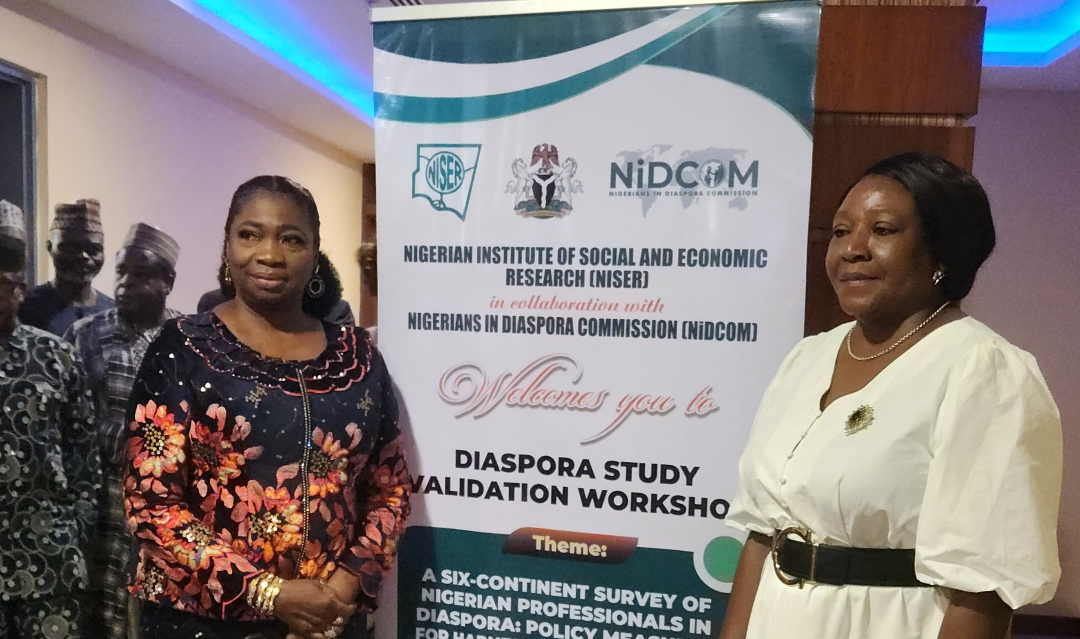
NISER, NiDCOM Validate Diaspora Study to Strengthen Nigeria’s Development Policy Framework
Oru Leonard
Abuja, April 28, 2026 — The Nigerian Institute of Social and Economic Research (NISER), in partnership with the Nigerians in Diaspora Commission (NiDCOM), has commenced a high-level validation workshop on a landmark diaspora study aimed at strengthening Nigeria’s policy framework for national development.
The study, titled “A Six-Continent Survey of Nigerian Professionals in Diaspora: Policy Measures for Harnessing Contributions to National Development,” is being validated at a workshop held at BON Hotel Octagon. The event attracted policymakers, National Assembly members, diaspora experts, professional bodies, development partners, media practitioners, and representatives of Ministries, Departments, and Agencies (MDAs).
In her welcome address, the Director-General of NISER, Antonia Taiye Simbine, described the initiative as a significant milestone in advancing evidence-based policymaking and strengthening diaspora engagement.
She noted that the validation workshop reflects a shared commitment among stakeholders to harness the vast potential of Nigerians in the diaspora for national development, emphasizing that the strong participation highlights the importance attached to data-driven policy formulation.
Simbine explained that NISER, as Nigeria’s premier policy research institution, is mandated to provide rigorous and practical policy solutions to address the country’s socio-economic challenges. She added that the diaspora study aligns with this mandate and was undertaken in collaboration with NiDCOM to support national development through informed research.
Highlighting the importance of the diaspora, she stated that Nigerians abroad contribute over $20 billion annually in remittances, positioning Nigeria among Africa’s top recipients. Beyond financial contributions, she stressed the value of diaspora engagement in areas such as knowledge transfer, innovation, technology exchange, mentorship, and global networking.
However, she identified key challenges hindering optimal engagement, including policy inconsistencies, weak institutional coordination, regulatory bottlenecks, and trust deficits, noting that the study seeks to address these issues through practical and implementable recommendations.
Also speaking, NiDCOM Chairman/CEO, Abike Dabiri-Erewa, described Nigerians in the diaspora as a highly skilled and globally competitive community making significant contributions across sectors including healthcare, technology, entrepreneurship, and the creative industries.
She emphasized that the workshop provides an opportunity to critically evaluate diaspora contributions and reposition them toward sustainable development, stressing the need to shift from consumption-driven remittances to investment-oriented contributions.
Dabiri-Erewa further highlighted the importance of structured engagement, policy coherence, investment-friendly environments, and data-driven strategies, urging stakeholders to work toward reversing brain drain and promoting “brain gain” and “brain circulation” for national progress.
In his remarks, the Abuja Office Head of the Institute of Chartered Accountants of Nigeria (ICAN), Mr. Adamu Yusuf, commended the initiative, describing the validation process as critical to ensuring credible and inclusive policy outcomes.
He reiterated the importance of diaspora contributions in investment, innovation, and institutional development, encouraging stakeholders to provide actionable recommendations to strengthen the final report.
Representing the President of the Nigerian Medical Association (NMA), Prof. Bala Mohammed Audu, Dr. Liman Idris Mohammed of the National Hospital Abuja underscored the role of diaspora collaboration in strengthening Nigeria’s healthcare system.
He noted that Nigerian medical professionals abroad have played a pivotal role in advancing healthcare delivery in Nigeria, citing examples such as the establishment of modern medical facilities and the introduction of specialized services like In-Vitro Fertilization (IVF).
He further added that, the findings of the study will be reviewed by the NMA leadership to explore ways of integrating its recommendations into healthcare policy and practice, with a focus on enhancing knowledge exchange and professional collaboration.
According to the Director of Media, Public Relations and Protocols
Abdur-Rahman Balogun,the workshop is expected to refine the study’s findings, build consensus among stakeholders, and produce a robust policy framework for effectively integrating diaspora contributions into Nigeria’s national development agenda.
COVER PHOTO CAPTION, L-R: CHAIRMAN/CEO, NIGERIANS IN DIASPORA COMMISSION (NIDCOM), HON. (DR) ABIKE DABIRI-EREWA AND DIRECTOR-GENERAL, NIGERIAN INSTITUTE OF SOCIAL AND ECONOMIC RESEARCH (NISER), PROF. ANTONIA TAIYE SIMBINE, DURING THE DIASPORA STUDY VALIDATION WORKSHOP IN ABUJA.