Nigeria Launches High-Level Sustainable Aviation Fuel Programme to Lead Africa’s Green Aviation Drive
Oru Leonard
Nigeria has formally launched an ambitious Sustainable Aviation Fuel (SAF) programme aimed at decarbonising its aviation sector and positioning the country as Africa’s leading producer of cleaner aviation fuel.
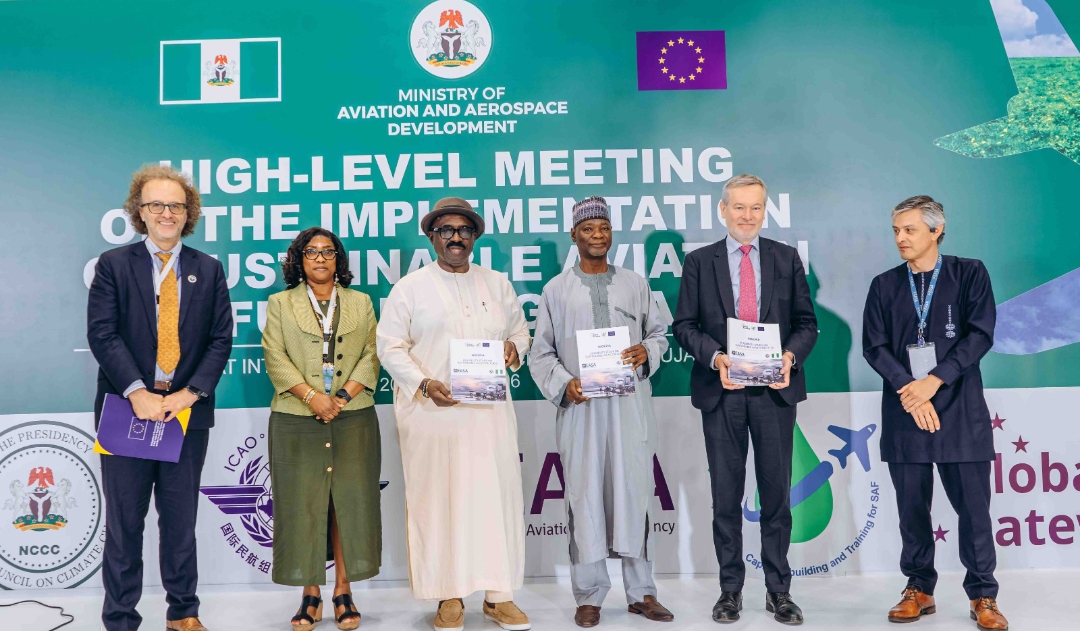
The initiative was unveiled in Abuja with the inauguration of the National High-Level Sustainable Aviation Fuel (SAF) Steering Committee, the presentation of the National Sustainable Aviation Fuel Feasibility Study, and the launch of the ICAO-supported Sustainable Aviation Fuel Business Implementation Study.
The event, held at the Bola Ahmed Tinubu International Conference Centre, was organised by the Nigerian Civil Aviation Authority (NCAA) in partnership with the International Civil Aviation Organization (ICAO), the European Union (EU), and the European Union Aviation Safety Agency (EASA). It attracted senior government officials, development partners, industry leaders, researchers and other stakeholders committed to advancing Nigeria’s transition to environmentally sustainable aviation.
Inaugurating the steering committee, the Minister of Aviation and Aerospace Development, Festus Keyamo (SAN), described the initiative as a landmark achievement in Nigeria’s efforts to build a resilient, competitive and environmentally sustainable aviation industry.
Represented by the Director of Air Transport Management in the ministry, Ahmed Tijjani Abdullahi, the minister said aviation remains a critical driver of economic growth, regional integration, trade and tourism, but stressed that the industry must also play its role in reducing greenhouse gas emissions.
He said Sustainable Aviation Fuel presents Nigeria with a strategic opportunity to cut carbon emissions while attracting investment, creating jobs, strengthening energy security and unlocking value across the nation’s agriculture, energy and industrial sectors.
Keyamo highlighted Nigeria’s competitive advantage, citing its vast agricultural resources, status as one of the world’s largest cassava producers, abundant agro-industrial residues, expanding refining capacity, growing technical expertise and strategic location as factors that could make the country a major SAF producer and supplier in Africa.
He commended ICAO, the European Union, EASA and the NCAA for supporting Nigeria’s SAF initiative and praised the Technical Working Groups whose efforts culminated in the completion of the National Sustainable Aviation Fuel Feasibility Study.
The minister assured investors of the Federal Government’s commitment to providing policy support, an enabling regulatory framework and investment incentives needed to develop a commercially viable Sustainable Aviation Fuel industry.
According to him, the newly inaugurated steering committee will provide strategic leadership, coordinate relevant government agencies and oversee implementation of Nigeria’s Sustainable Aviation Fuel Programme.
He also welcomed the commencement of the ICAO-supported Business Implementation Study, describing it as a critical next step that will identify commercially viable investment opportunities and facilitate the development of bankable SAF projects capable of attracting both local and international investors.
Director-General of the Nigerian Civil Aviation Authority, Capt. Chris Ona Najomo, described the occasion as a defining moment in Nigeria’s aviation sustainability journey, noting that the country was moving from planning to implementation.
Najomo explained that the feasibility study, developed under ICAO’s Assistance, Capacity-building and Training for Sustainable Aviation Fuels (ACT-SAF) Programme with funding from the European Union and technical support from EASA, provides the evidence-based foundation for converting Nigeria’s abundant feedstock resources into commercially viable Sustainable Aviation Fuel production.
He reaffirmed the NCAA’s commitment to coordinating stakeholders and driving implementation of the programme as the secretariat of the National High-Level Sustainable Aviation Fuel Steering Committee.
Goodwill messages were delivered by representatives of ICAO, the European Union, the Federal Ministries of Innovation, Science and Technology, Agriculture and Food Security, Petroleum Resources, the National Council on Climate Change, and NNPC New Energy Limited.
The speakers unanimously stressed the need for strong collaboration across government, industry and development partners to establish a sustainable aviation fuel industry capable of supporting economic diversification, energy security, climate action and employment generation.
With the inauguration of the steering committee and the launch of the Business Implementation Study, Nigeria has entered a new phase in its pursuit of cleaner aviation, reinforcing its ambition to become Africa’s leading Sustainable Aviation Fuel production hub while contributing to global efforts to achieve net-zero emissions in the aviation sector.