Nigeria at 66: FG Tasks Stakeholders on Consolidating Reforms for Shared Prosperity
Oru Leonard
The Federal Government has called for sustained implementation and consolidation of ongoing economic reforms, saying the next phase of Nigeria’s recovery must translate emerging economic stability into stronger growth, jobs, investment and improved living standards for citizens.
The Minister of Information and National Orientation, Mohammed Idris, made the call on Wednesday, September 30, 2026, at the State House, Abuja, while speaking at the Independence Day Public Lecture organised by the Federal Government to mark Nigeria’s 66th Independence Anniversary.
The lecture, held under the theme, “From Reforms to Stability: Consolidating Nigeria’s Renewed Hope for Shared Prosperity,” focused on Nigeria’s economic journey, the reforms introduced by the President Bola Ahmed Tinubu Administration and the need to ensure that their benefits reach a wider segment of the population.
Idris said the 66th Independence Anniversary provided an opportunity to reflect on the country’s journey, recognise the sacrifices and resilience of Nigerians and renew commitment to building a more prosperous, secure and united nation.
According to him, the reforms undertaken over the past three years had begun addressing longstanding structural weaknesses in the economy and creating a foundation for sustainable growth.
“The reforms of the past three years have not been easy. They have demanded sacrifice and patience from Nigerians.
But they have also begun the difficult process of correcting longstanding structural weaknesses and laying stronger foundations for the future,” he said.
The Minister cited the 4.43 per cent economic growth recorded in the second quarter of 2026, alongside increased domestic refining capacity, investment and productive activity, as signs of improving economic conditions.
He, however, stressed that the ultimate measure of the reforms would be their ability to generate employment, expand opportunities and improve household livelihoods.
“Our goal is clear: to turn reform into stability, stability into growth, and growth into a new era of shared prosperity in which every Nigerian can aspire, work and prosper,” Idris said.
Idris also charged the media with strengthening fact-based public discourse, particularly as Nigeria approaches another electoral cycle.
He urged journalists and media organisations to prioritise verification, responsible reporting and national cohesion, saying political disagreements should not weaken the country’s shared national identity.
“The media, particularly as we approach another electoral cycle, carries a special responsibility to promote informed public discourse anchored on facts, verification and national cohesion,” the Minister said.
The Head of the Civil Service of the Federation, Olumuyiwa Enitan Abel, said the public service remained central to translating government policies and reforms into measurable improvements in the lives of citizens.
He said the ongoing transformation of the civil service was aimed at improving efficiency, professionalism, accountability and citizen-centred service delivery through stronger performance management, digitisation, continuous learning and innovation.
“Our responsibility is clear: to ensure that policies are effectively implemented, programmes produce measurable results, and the machinery of government delivers with greater speed, professionalism and purpose,” Abel said.
In his public lecture presentation, the Governing Council Chairman Philomath University, Kuje, Dr. Collins A. Aimuan, reviewed Nigeria’s political and economic development since independence and examined the structural and fiscal challenges confronting the country.
He identified tax reform, petroleum-sector reforms, power-sector reforms, infrastructure investment and expanded education financing among measures aimed at restructuring the Nigerian economy.
Aimuan said the reforms represented an attempt to alter the underlying structure of the economy and called for their institutionalisation beyond individual administrations to ensure policy continuity.
“The reforms represented an attempt to change the underlying architecture of Nigeria’s economy,” he said.
He also highlighted developments in education financing, infrastructure and local government administration, including the expansion of the Nigerian Education Loan Fund and investments in major road corridors.
Aimuan advocated stronger legislative and institutional backing for reforms to ensure continuity and long-term impact. He also proposed changes to the tenure structure of elected executives, including a single-term arrangement.
The Secretary to the Government of the Federation, Senator George Akume, said Nigeria had experienced difficult periods since independence but had continued to demonstrate resilience and commitment to the Nigerian project.
Akume said the Tinubu Administration’s major economic decisions, including the removal of petrol subsidy, foreign-exchange reforms and fiscal measures, were introduced to address economic challenges and restore stability.
“This administration took office in 2023 and immediately took bold decisions needed to save the nation from imminent collapse. Such decisions include the removal of the petrol subsidy, unification of the foreign-exchange market, tax and other fiscal reforms,” he said.
The SGF said the next phase should focus on converting economic growth into jobs, incomes and opportunities while sustaining investment in infrastructure, agriculture, education, healthcare, social protection and security.
He added that government was expanding access to compressed natural gas, supporting food production and agricultural value chains, widening education financing and strengthening interventions for vulnerable Nigerians.
“We know the path will not be easy but our goal is clear: shared prosperity for all Nigerians. We will deepen our reforms, keep investing in education, infrastructure and healthcare, and make sure growth leads to real opportunities for everyone,” Akume said.
The event was attended by senior government officials, including Special Adviser to the President on Policy Coordination and Head of the Central Results Delivery Coordination Unit, Hadiza Bala Usman; Minister of Steel Development, Prince Shuaibu Abubakar Audu; Minister of Water Resources and Sanitation, Prof. Joseph Terlumun Utsev; Minister of State for Foreign Affairs, Ambassador Sola Enikanolaiye; Minister of State for Petroleum Resources (Gas), Ekperikpe Ekpo; Minister of State for Budget and Economic Planning, Dr. Doris Nkiruka Uzoka-Anite; and Minister of State for Regional Development, Uba Maigari Ahmadu.
Also present were the Permanent Secretary, Federal Ministry of Information and National Orientation, Dr. Binyerem C. Ukaire; Permanent Secretary, Federal Ministry of Marine and Blue Economy, Mrs. Fatima S. Mahmood; other senior government officials and distinguished guests.
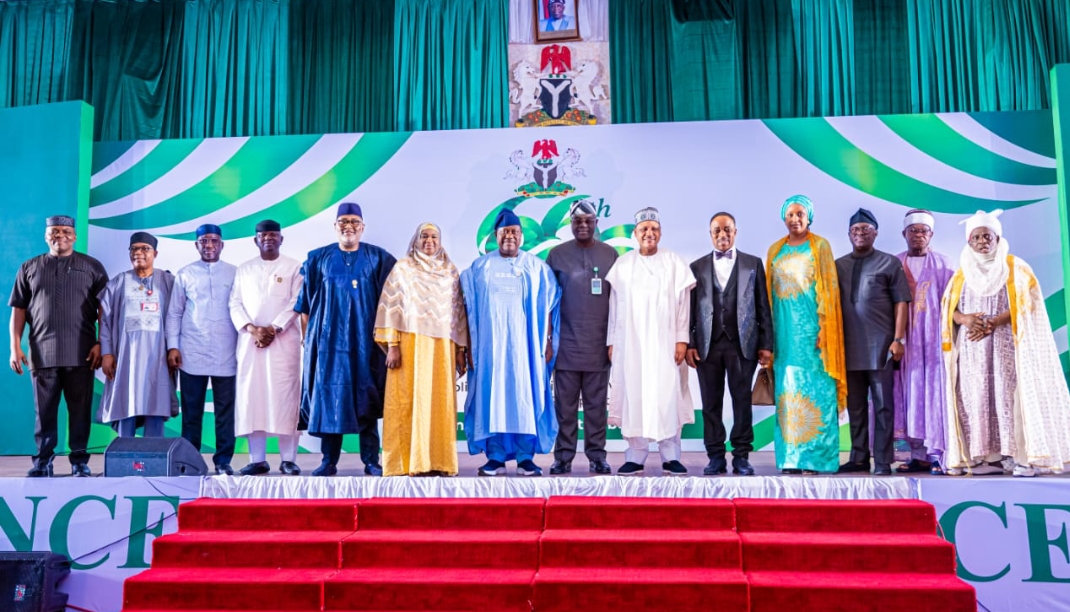
Cover Photo Caption: The President of the Federal Republic of Nigeria, President Bola Ahmed Tinubu, represented by the Secretary to the Government of the Federation, Senator George Akume, CON, joined the Honourable Minister of Information and National Orientation, Mohammed Idris, fnipr; Special Adviser to the President on Policy Coordination and Head of the Central Results Delivery Coordination Unit (CRDCU), Hadiza Bala Usman; Head of the Civil Service of the Federation, Mr. Abel Olumuyiwa Enitan; Minister of State for Foreign Affairs, Ambassador Sola Enikanolaiye; Minister of State for Petroleum Resources (Gas), Rt. Hon. Ekperikpe Ekpo; Minister of Water Resources and Sanitation, Engr. Prof. Joseph Terlumun Utsev; Minister of State for Regional Development, Uba Maigari Ahmadu; and other dignitaries at the 66th Nigeria’s Independence Anniversary Public Lecture, themed “Consolidating Nigeria’s Reform for Shared Prosperity,” on September 30, 2026, in Abuja.
Photo: Khalid Ahmed/FMINO.