MAKING THE MINERAL SECTOR A BLESSING
Nick Dazang
In 2012, Michael L. Ross published a book entitled: THE OIL CURSE: HOW PETROLEUM WEALTH SHAPES THE DEVELOPMENT OF NATIONS.
The book turned out to be a landmark. It made waves and it elicited rave reviews and comments.
The book generated more than casual interest because of the painful paradox it aptly captured in the oil, and by extension, the extractive eco-system.
THE OIL CURSE argued that oil wealth creates less economic growth than it ought to; that it creates more jobs for men than women; that it creates more challenges for the poor than the affluent; that oil companies drill more in poor nations thereby spreading the curse; and that “good geology often leads to bad governance”.
Additionally, countries flush with petroleum dollars are hardly democratic. They are usually less stable economically. And they are prone to frequent upheavals and civil wars.
A cursory look at the countries blessed with petroleum, from Saudi Arabia to Venezuela justifies Ross’s arguments.
By the same token, the same incubus that afflicts the petroleum sector appears to be the case with Africa’s mineral-rich countries. The Democratic Republic of Congo(DRC), one of the most blessed with solid minerals on planet earth, is a basket case. Niger Republic, in spite of its endowment with the highest grade of uranium, and now petroleum, is merely struggling to survive. Until now, it lived on aid, niggardly dolled out by donor countries.
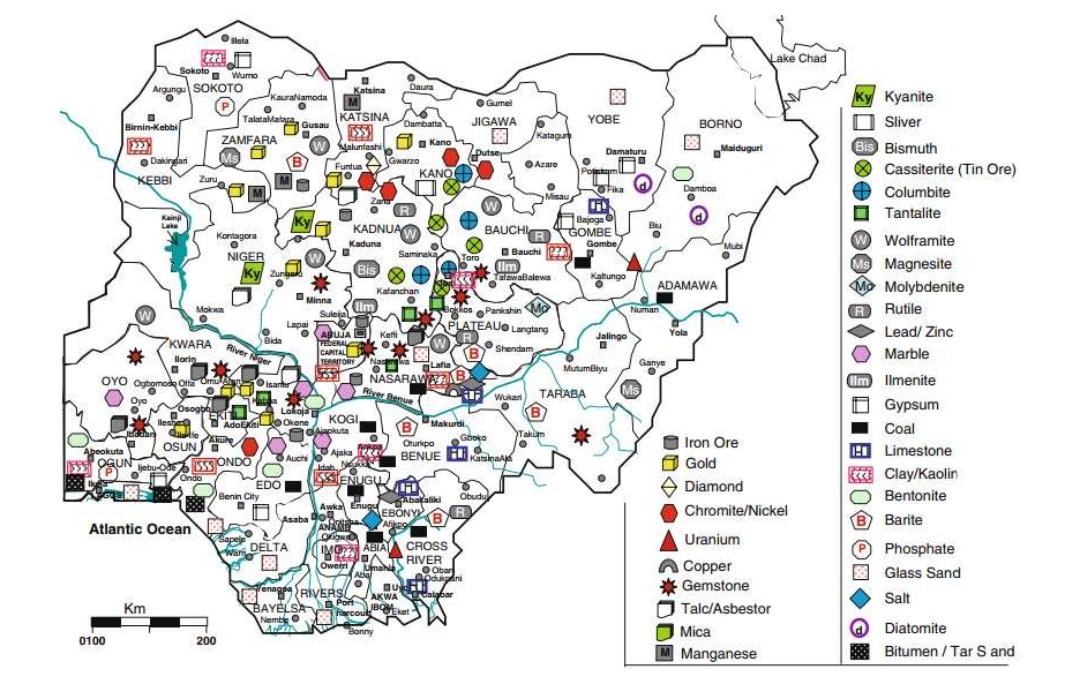
Nigeria, another intriguing case, is said to be blessed with forty four(44) solid minerals across its thirty six(36) States and the Federal Capital Territory(FCT). Its major minerals are: oil, gas, tin, columbite, tantalite, gold, coal, limestone, iron ore, kaolin, barite, bitumen and lately, lithium in Nasarawa and Kaduna States.
In the past two years,the mineral sector has contributed significantly to the country’s Gross Domestic Product(GDP) compared to previous years. In 2026, the mineral sector, as at March, had contributed 1.8% to GDP, all thanks to localized processing investments and regional value addition strategies.
Part of this dramatic growth is related to limestone, which accounted for nearby 69% of total mineral production. With companies such as Romolus Mining scaling up their gold and lithium portfolio investments to $150million and other domestic beneficiation plants, including the $600million plant in Nasarawa State and another $200million in the FCT., the solid mineral sector is surely going to get a shot in the arm. Its contribution to GDP is also expected to increase, by leaps, in the coming years.
Matters are also helped by the government’s resolve to subscribe to the high-minded control of these minerals by way of local processing and refining as being canvassed by the African Development Bank(AfDB). This is, incidentally, in tandem with the Zimbabwe and Burkina Faso models.
Even before the advocacy of mineral control by the AfDB, Zimbabwe, which has significant lithium deposits, and Burkina Faso, which has gold aplenty, have insisted that their endowments will not merely be extracted, in raw form, and shipped abroad. Instead, they would have to be processed in-country, thereby creating jobs, adding value to the minerals and transferring technical know-how to their compatriots.
By so doing, Burkina Faso, in the past three years, has raked in a whopping $18million from gold. In the first six months of 2026, it has made over $6million. A tidy sum, by whatever account.
It is salutary that the Nigerian government has set up the MINES MARSHALS, an elite unit from the Nigeria Security and Civil Defense Corps(NSCDS) to guard our mines. This has helped to mitigate, even if it has not completely solved the criminality being perpetrated at Nigeria’s mining sites, particularly, in Zamfara, Plateau, Kaduna and Niger States.
In spite of these modest gains, the solid mineral sector remains fragile and in great peril. And in spite of some of the investments and measures taken, aforementioned, they may not, after all, lead to a narrative that has a happy ending.
Consider: Some of the mineral bearing States are entering into Memoranda of Understanding(MoUs) with foreign entities in clear contravention of Section 44(3) of the Constitution which vests the Federal Government the management of these minerals through the Ministry of Solid Minerals Development.
In Zamfara State, where gold is being extracted by big time politicians and deep-pockets, there is no clear picture as to how much is being processed and how much is going to the public treasury. This is in spite of the fact that gold bars were once presented, with fanfare, at the presidency as coming from that State.
In the same Zamfara State, proxies of these deep pockets maim and kill each other in order to take over prolific mine fields. The same thing is occurring in Niger and Kaduna States, thereby fueling and adding to the insurgency in the three States.
The same criminality afflicts the mines on the Jos-Plateau. The mines here, dominated mostly by artisans, are carried out indiscriminately and without regard to the sanctity or beauty of the environment. At one point, a government facility in Jos-South perched precariously on a tunnel that had been hollowed out by devil-may-care miners.
In Osun State, where there are gold deposits, the picture is blurred. Little or nothing is known about the prospecting going on here.
Nasarawa State, blessed with lithium in commercial quantity, has aroused a mad scramble by miners, particularly foreign ones. But against the grain of competition and due process, exclusive mining rights for lithium are being allegedly reserved for a favored company.
In spite of the fact that some communities had consented to particular companies to mine in their domains, the State government is said to foist its preferred companies on such communities. As if that were not a recipe for chaos, mining companies here are allegedly being coerced by government officials to shell out $2million per annum and for five years, in lieu of prospecting.
There are also reports that these officials are demanding that mining companies allocate equities to them to the tune of 50%. This has reportedly compelled prospectors either to abandon the mines, in droves, or sell them outright at rock bottom prices.
These allegations are, no doubt, hair raising and troubling. The state of the mineral sector as a whole is deeply concerning. These altogether call for urgent, comprehensive review and investigation. Mining activities, across the board, must be regulated and they must accord with international best practices.
Transparency must inform and guide the mining sector. There should be surveillance and proper audit of the sector. Concerted efforts should be taken to check smuggling. The Nigeria Extractive Industries Transparency Initiative(NEITI), which statutory duty it is to promote transparency, due process and accountability in the management of oil, gas and solid mineral revenues, should bring vigor to bear on its oversight and reporting of the mining sector.
The solid mineral sector should be structured, delineated and made inclusive so that big and small time actors can be accommodated. Members of the female gender should also be co-opted.
The Burkina-be gold success story was informed by improving transparency, state vigilance, delineation of mining corridors and intensified control measures to strengthen the sector. We should follow the same path if we want the solid minerals sector to impact the economy and Nigerians positively. That way, we shall be making the mineral sector a blessing, and not a curse.
Photo Credit: asmmmon.ng