DICAN Forum Examines China’s Governance Model, Urges Stronger Internal Democracy, Accountability
Oru Leonard
As Nigeria prepares for the 2027 general elections, political stakeholders, diplomats and governance experts have called for stronger internal democracy, party discipline, institutional accountability and sustained anti-corruption reforms to strengthen the country’s democratic process.
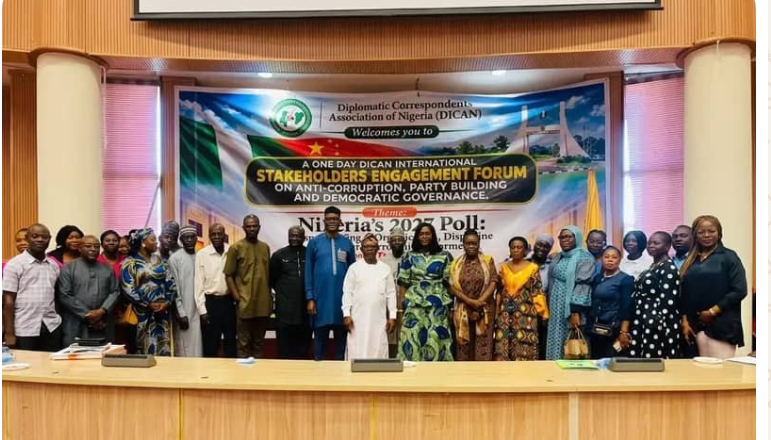
The call was made at an International Stakeholders Engagement Forum on Anti-Corruption, Party Building and Democratic Governance, organised by the Diplomatic Correspondents Association of Nigeria (DICAN) at the Rotunda Hall, Ministry of Foreign Affairs, Abuja.
The forum, held on Wednesday, November 18, 2026, examined lessons Nigeria could draw from China’s governance experience, particularly its approaches to political party organisation, internal discipline, leadership accountability and the fight against corruption.
With the theme, “Nigeria’s 2027 Poll: Promoting Party Organisation, Discipline and Anti-Corruption Reforms: Lessons from Xi Jinping Thought,” participants identified weak party structures, candidate imposition, monetisation of politics, vote buying, poor accountability and declining public confidence as challenges requiring urgent attention ahead of the next electoral cycle.
The Minister of State for Foreign Affairs, Amb. Sola Enikanolaiye, represented by the Ministry’s Assistant Director of Administration, Mahmud Aliyu, described anti-corruption and effective party building as essential pillars of democratic governance.
He maintained that democracy should not be measured solely by the conduct of elections but also by the protection of fundamental freedoms, institutional checks and balances, respect for the rule of law and the ability of government to serve the people.
Enikanolaiye linked the discussions to Nigeria’s 4-Ds foreign policy priorities of Demography, Development, Diaspora and Democracy, noting that strong democratic institutions provide the foundation for stability and accountability, while development translates diplomatic engagements into tangible economic and social benefits.
He also highlighted the importance of Nigeria’s population and diaspora in expanding economic opportunities, attracting investments and accessing global expertise.
“Public office is not a prize to be captured. It is a public trust,” he declared.
Representing the Embassy of the People’s Republic of China in Nigeria, Counsellor Dong Hairong highlighted China’s experience in party discipline and its sustained campaign against corruption.
She drew attention to the Fifth Plenary Session of the 20th Central Committee of the Communist Party of China (CPC), held in Beijing from October 26 to 29, 2026, which adopted a resolution on full and rigorous Party self-governance.
According to her, the resolution outlined measures to strengthen internal discipline, improve leadership accountability and sustain the party’s governing capacity.
Hairong disclosed that China’s anti-corruption campaign, which commenced in 2012, had recorded 8.1 million cases, with 7.92 million officials subjected to disciplinary and administrative penalties, including more than 900 officials at vice-ministerial level and above.
She further claimed that public support for the campaign had reached 97.4 per cent, maintaining that strict supervision of public officials remained central to China’s governance strategy.
The Chinese diplomat acknowledged that corruption remained a complex challenge but assured that her country would sustain its efforts against the practice.
She also expressed China’s readiness to share its governance experience with Nigeria through bilateral exchanges, inter-party cooperation and the existing China-Nigeria Comprehensive Strategic Partnership.
Providing an academic perspective, the Founding Executive Director of the African Centre for Leadership, Strategy and Development (Centre LSD), Dr. Otive Igbuzor, identified structural weaknesses within Nigeria’s political parties as a major obstacle to democratic development.
Igbuzor argued that many political parties remained dependent on influential individuals, wealthy financiers and elected officeholders rather than strong membership structures, clear ideologies and sustainable institutional arrangements.
He identified candidate imposition, manipulation of party primaries, delegate inducement, excessive nomination fees, factional disputes and weak enforcement of party constitutions as practices undermining internal democracy.
He warned that monetisation of politics, illicit campaign financing, vote buying and abuse of incumbency could turn political office into an investment opportunity, encouraging elected officials to recover campaign expenses through patronage, inflated contracts and other corrupt practices.
Drawing lessons from China’s governance experience under President Xi Jinping, Igbuzor highlighted the importance of ideological clarity, institutional discipline, leadership development and sustained anti-corruption measures.
He, however, cautioned against transplanting China’s political arrangement into Nigeria, stressing that the country’s constitutional multiparty democratic framework must be protected.
“The appropriate lesson from China is not one-party rule. It is the importance of building political institutions capable of sustaining coherent policies, enforcing ethical standards and implementing long-term development programmes,” he said.
Igbuzor called for transparent party primaries, credible disciplinary committees, independent appeal mechanisms, disclosure of political donations and campaign expenditure, as well as stronger oversight institutions.
He also advocated connecting political party reforms to national development through policies capable of addressing unemployment, poverty, inequality and inadequate social services.
Also contributing, the Campaign Spokesperson of the National Democratic Congress (NDC), Dr. Chiogo Constance Ikokwu, questioned the state of internal democracy in Nigeria’s political system, drawing from her experience as a former journalist and political contestant.
Ikokwu, who spent more than two decades covering politics across radio, television and print before contesting for the House of Representatives in Idemili North and South Federal Constituency of Anambra State, said her transition from journalism to active politics had exposed her to challenges within the political system.
She argued that democracy must be assessed by how political power is acquired and exercised, as well as whether those entrusted with public office can be held accountable.
The NDC spokesperson challenged political parties to respect their constitutions and guarantee members’ democratic rights, insisting that party discipline should not be confused with unquestioning loyalty to political godfathers.
She also expressed concern over growing voter apathy and public cynicism ahead of 2027, warning that Nigerians must not lose confidence in the electoral process or perceive election outcomes as predetermined.
Ikokwu called for an independent and accountable Independent National Electoral Commission (INEC), a credible voter register, reliable electoral technology, transparent procedures and institutions capable of resolving disputes fairly.
On corruption, she urged stakeholders to move beyond public declarations and establish systems that would make the diversion of public resources difficult and accountability unavoidable.
She further advocated greater representation of women in political leadership and decision-making, arguing that women should not be restricted to mobilising electoral support but must participate in determining how political power is distributed and exercised.
According to her, the 2027 elections should focus on critical national issues, including employment, security, economic development, education, healthcare and the quality of public institutions.
Earlier, DICAN Chairman, Idehai Frederick, said the forum was convened to encourage constructive engagement and identify practical approaches to strengthening democratic institutions, political party organisation and accountability.
Frederick explained that examining China’s governance experience was not an endorsement of its political system but an opportunity for Nigeria to identify useful practices that could be adapted to its own constitutional realities.
He noted that China’s experience in economic transformation, poverty alleviation, infrastructure development, long-term strategic planning and anti-corruption had attracted international attention and offered opportunities for comparative policy learning.
He further emphasised that journalists had an important responsibility to promote informed public discourse, transparency and accountability through accurate and balanced reporting.
The DICAN chairman clarified that China’s political framework operates under the leadership of the Communist Party of China, with other legally recognised political parties participating in consultation and policymaking, unlike Nigeria’s constitutional multiparty arrangement.
He stressed that the purpose of the engagement was to encourage mutual learning while preserving political competition, electoral choice, citizen participation and the rule of law in Nigeria.
Frederick urged political leaders, democratic institutions, civil society organisations and the media to place national interest above partisan considerations and work towards strengthening public confidence in governance.
He maintained that the credibility of the 2027 elections would depend not only on activities on election day but also on the institutional foundations established before the polls.
The forum attracted government representatives, diplomats, political actors, academics, civil society organisations, anti-corruption advocates, development partners and members of the media, who deliberated on reforms capable of strengthening Nigeria’s democratic institutions and improving governance.