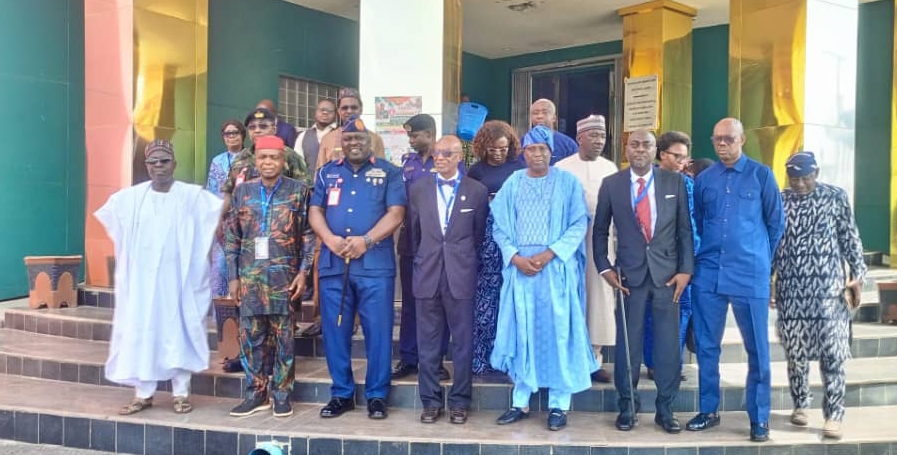
AIRS Unveils New Security Framework, Targets 188 Communities Across Nigeria
Alex Joseph
The African Institute of Resilience Studies (AIRS), has announced plans to assess the vulnerability and security preparedness of 188 communities across six South-West states as part of efforts to develop sustainable solutions to Nigeria’s growing security challenges.
The initiative is one of four flagship programmes unveiled by the institute during its inauguration, alongside plans to strengthen community policing, develop community-based security models and improve the livelihoods of women and young people affected by insecurity.
The institute said the programmes would promote evidence-based policymaking, strengthen local security structures and equip communities with the capacity to withstand and recover from terrorism, kidnapping, economic shocks, displacement and other emerging threats.
Speaking at the inauguration, Chairman of the Board of Directors, Prof. Rowland Ndoma-Egba, said the increasing complexity of security threats required a shift from conventional security approaches towards a broader framework that integrates security with societal resilience.
Ndoma-Egba explained that while security institutions focus on preventing and responding to threats, resilience ensures that communities, institutions and essential services can withstand disruptions, adapt and recover from crises.
He described the institute as a continental centre for research, policy, practice and impact, established to strengthen civil society resilience and promote effective security and protection policies.
He disclosed that AIRS had submitted a proposal to the Federal Government committee reviewing the 2019 National Security Strategy, recommending that the document be renamed the National Security and Resilience Strategy to reflect the growing importance of resilience in national protection.
According to him, the proposed framework would establish clear institutional responsibilities, measurable objectives and indicators, supported by regular monitoring and annual progress reports.
In his keynote address, Professor Tobi Alabi of the Nigerian Defence Academy, Kaduna, identified community participation, effective security institutions and responsive governance as critical pillars for addressing Nigeria’s security challenges.
Speaking on the theme, “Building Resilience in an Era of Emerging Risks: Integrating Community Security and Governance into National Protection,” Alabi maintained that security agencies could not effectively combat insecurity without building public trust and establishing functional relationships with the communities they serve.
He identified traditional rulers, community associations, women and youth groups as important sources of intelligence and early-warning information, calling for improved engagement, training, motivation and information-sharing between communities and security agencies.
The security expert also linked insecurity to unemployment, economic hardship and social vulnerability, urging government to expand economic opportunities and support systems, particularly for young people.
He stressed the need for coordinated intelligence gathering and security operations that respect fundamental human rights, noting that fragmented institutional responses had weakened efforts to tackle emerging threats.
Meanwhile, Major General A.T. Umaru (Rtd), PhD, a member of the institute’s Board of Directors, formally unveiled the four flagship programmes.
They include Community Policing Research, Community-Based Security Model, Women and Youth Livelihood Initiative, and the Community Resilience Index.
Under the Community Policing Research programme, AIRS will examine how traditional institutions, police officers, civil society organisations and community groups can establish practical early-warning, referral and response mechanisms while maintaining human rights standards and accountability.
The Community-Based Security Model will undertake a comparative assessment of existing community security arrangements, including the Civilian Joint Task Force in Borno State, Amotekun in the South-West, Kaduna State Community Watch Corps, Kano State Neighbourhood Watch Corps and Zamfara State Community Protection Guards.
The objective, according to the institute, is to identify the strengths, weaknesses and legal safeguards of the different structures and develop adaptable models for the country’s six geopolitical zones.
The Women and Youth Livelihood Initiative will focus on improving the economic resilience of vulnerable women and young people, particularly those affected by insecurity, displacement, drought and other crises.
The Community Resilience Index, considered one of the institute’s major research interventions, will provide government and development partners with measurable data on community vulnerability, preparedness and capacity to recover from disruptions.
AIRS said its first-year activities would include developing a toolkit based on seven pillars and 35 indicators, supported by a mobile data collection application and training manual.
It also plans to conduct more than 4,000 household surveys across 188 communities in the six South-West states, develop a Resilience Atlas identifying vulnerable local government areas and submit a policy brief to the Nigeria Governors’ Forum, the Office of the National Security Adviser and the National Institute for Policy and Strategic Studies.
Beyond the four programmes, the institute announced plans to establish the Africa Journal of Resilience Management and Governance and a Resilience Leadership Academy.
The academy is expected to train at least 100 security officers, traditional rulers, women leaders and local government officials during its first year.
Speaking on behalf of the Special Guest of Honour, the Chief of Defence Intelligence, Lieutenant General Emmanuel Undiandeye, Air Vice Marshal B.R. Mamma welcomed the establishment of the institute, describing research, policy formulation and practical solutions as essential components of the country’s security architecture.
He said the armed forces and other security institutions could not address Nigeria’s security challenges in isolation, stressing the importance of reliable data, evidence-based policies and effective collaboration with communities.
He identified terrorism, kidnapping, child trafficking and organised crime among the threats requiring coordinated responses involving government, security agencies, researchers and local communities.
Mamma also called for stronger partnerships among government institutions, academia, civil society and development partners, urging AIRS to preserve its independence, integrity and commitment to research-driven solutions.
Earlier, reviewing the book, Governance and Resilience in the Age of Complexity: An African Perspective, Prof. Emmanuel Abolo, Group Managing Director and Chief Executive Officer of Risk Management Academy Limited, described the publication as a significant contribution to contemporary debates on governance, security and resilience in Africa.
Abolo said the book challenged the tendency to assess African governance exclusively through institutional failures, arguing that the continent’s experiences offered valuable lessons on anticipating, absorbing and adapting to complex crises.
He highlighted the publication’s exploration of interconnected challenges, including insecurity, epidemics, economic shocks, climate-related disasters, violence and institutional weaknesses.
According to him, the book presents five essential dimensions of resilience: robustness, resistance, recovery, adaptation and transformation.
He commended its intellectual depth, balanced analysis, reliance on African scholarship and practical recommendations for policymakers and practitioners, while identifying areas requiring further research, including digital violence, geographical coverage and the evaluation of community-based security arrangements.
The inauguration signals AIRS’s ambition to bridge the gap between security research, policymaking and community-level interventions, with a broader objective of strengthening institutional capacity and building more resilient societies across Nigeria and the African continent.