FG Unveils 2026–2030 Action Plan to Eliminate Child Labour, Urges Stakeholders to Move from Commitment to Action
Oru Leonard
The Federal Government has unveiled the reviewed National Policy on Child Labour and National Action Plan for the Elimination of Child Labour (2026–2030), declaring the fight against child labour a major national development priority.
The Minister of Labour and Employment, Dr Muhammad Maigari Dingyadi, made the declaration in Abuja on September 16, 2026, at the National Dialogue on “Advancing the Implementation of Nigeria’s National Policy on Child Labour and National Action Plan towards 2030: From Commitment to Action.”
The two-day dialogue, held at the ECOWAS Commission Auditorium, formed part of Nigeria’s activities marking the 2026 World Day Against Child Labour.
Dingyadi said child labour remained a major obstacle to human dignity, social justice and sustainable development because it deprives children of childhood, education, healthcare and opportunities to realise their full potential.
He said findings from Nigeria’s National Child Labour Survey showed that millions of children remain engaged in labour, with many exposed to hazardous work in sectors including agriculture, mining, domestic service, street trading and construction.
According to the minister, the Federal Government considers the situation a matter of utmost seriousness and is committed to enforcing the Labour Act, Child Rights Act, the Trafficking in Persons (Prohibition) Enforcement and Administration Act, as well as relevant international labour standards, particularly ILO Conventions 138 and 182.
Dingyadi said the reviewed policy and five-year action plan provide a framework for prevention, protection, enforcement, rehabilitation, institutional coordination and accountability in the campaign against child labour.
He linked the government’s renewed effort to the objectives of the Renewed Hope Agenda, particularly its focus on economic growth and job creation, food security, education and human capital development, social welfare and poverty reduction, youth empowerment and good governance.
The minister also recalled Nigeria’s participation in the Sixth Global Conference on the Elimination of Child Labour in Marrakech, Morocco, earlier in 2026, saying the country was translating its international commitments into concrete national action.
He noted that the new framework would support Nigeria’s efforts towards achieving Sustainable Development Goal Target 8.7, which calls for effective measures to eradicate forced labour, modern slavery, human trafficking and the worst forms of child labour.
Dingyadi stressed that eliminating child labour would require a whole-of-government and whole-of-society approach.
He therefore called on state governments to domesticate and implement the National Policy and Action Plan, while urging the Nigeria Governors’ Forum and Nigeria Governors’ Spouses Forum to champion child protection initiatives at the state level.
He also appealed to the National Assembly to strengthen legislation protecting children and support initiatives addressing the welfare of children and vulnerable families.
Employers, he said, must ensure their businesses and supply chains are free from child labour, while workers’ organisations should continue promoting decent work for adults.
The minister further called on development partners to sustain technical and financial support, while urging community leaders, civil society organisations and faith-based groups to intensify advocacy and public awareness.
Parents and guardians, he added, must prioritise education and protect children from exploitative labour.
“As we commence this National Dialogue today, I urge every participant to move beyond discussions and make concrete commitments,” Dingyadi said, calling for stronger institutions, improved enforcement of labour laws, expanded social protection coverage and better access to quality education.
He also emphasised the importance of responsible business conduct and decent work for adults, saying families should be able to thrive without depending on child labour.
The minister commended the ECOWAS Commission, the International Labour Organisation (ILO), the Government of the Kingdom of the Netherlands and other development partners for supporting Nigeria’s child labour elimination efforts. He also acknowledged the contribution of the National Bureau of Statistics to the generation of data used in policy formulation.
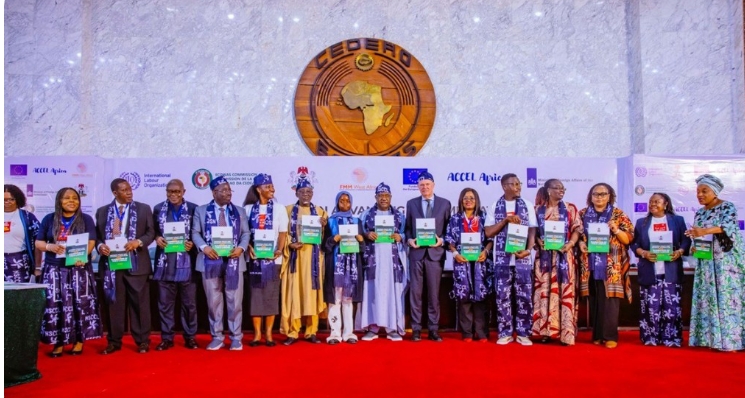
The dialogue also featured the official launch of the 2024 National Child Labour Survey Report, the National Policy on Child Labour and the National Action Plan for the Elimination of Child Labour (2026–2030). The documents were formally unveiled by President Bola Ahmed Tinubu, who was represented by the Secretary to the Government of the Federation, Senator George Akume.
Tinubu subsequently directed federal ministries, departments and agencies, state governments and other stakeholders to fully implement the new framework, reinforcing the government’s position that child labour is not merely a labour-sector issue but one that affects education, poverty reduction, economic growth, food security, human capital development and national Security.
The Federal Government’s new five-year framework is expected to guide coordinated efforts towards protecting Nigerian children from exploitation and creating conditions that enable them to remain in school and develop their potential.