NCoS, Military Intelligence Strengthen Partnership on Intelligence Sharing, Custodial Security
Oru Leonard
The Nigerian Correctional Service (NCoS) and the Nigerian Army Intelligence Corps (NAIC) have moved to deepen collaboration on intelligence sharing, custodial security and other measures aimed at strengthening Nigeria’s national security architecture.
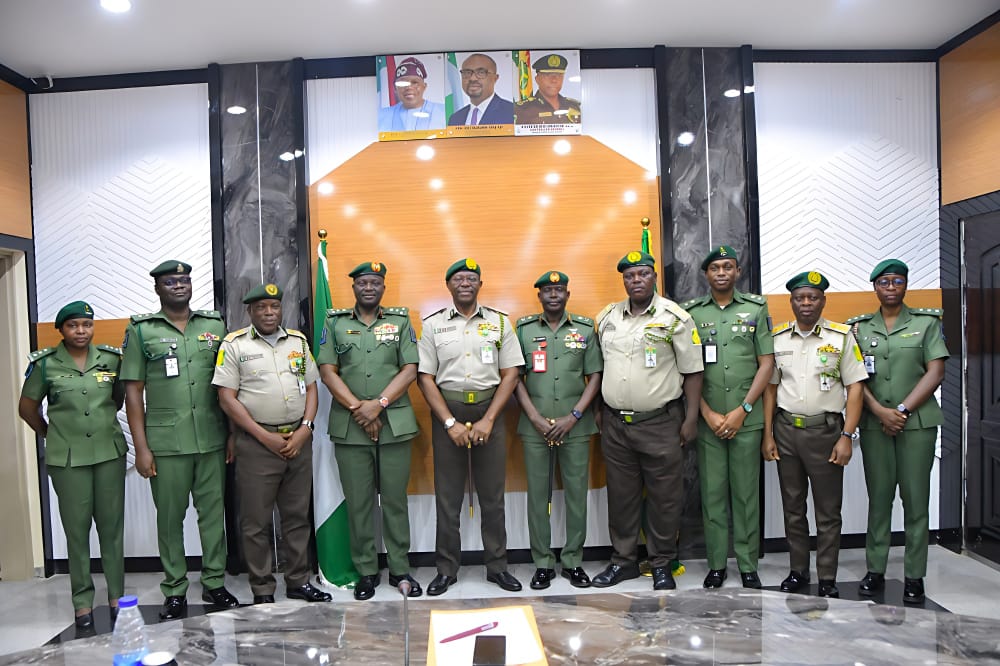
The Controller-General of Corrections, Sylvester Ndidi Nwakuche, MFR, mni, pcc, made this commitment when the Chief of Military Intelligence (Army), Major General RE Hedima, led a delegation on a courtesy visit to the NCoS National Headquarters in Abuja.
Nwakuche described the visit as a demonstration of the longstanding partnership between the two security institutions, stressing that the increasingly complex nature of contemporary security threats requires stronger inter-agency cooperation and intelligence-led responses.
He said security was a shared national responsibility, adding that timely intelligence sharing and coordinated action among security agencies had become increasingly important in protecting custodial centres.
The Controller-General disclosed that the NCoS currently manages an inmate population of about 81,000, with approximately 65 per cent awaiting trial and more than 4,000 inmates on death row.
He also commended officers and personnel of the Service who had made sacrifices while defending custodial centres against attacks and containing security breaches.
Beyond custodial security, Nwakuche highlighted the Service’s ongoing efforts in inmate reformation and rehabilitation, including education, vocational skills acquisition, deradicalisation programmes for violent extremists and specialised programmes for juveniles in Borstal Training Institutions.
He described rehabilitation as an important component of national security, noting that successful reintegration of offenders contributes to safer communities.
Earlier, Hedima said the visit was aimed at consolidating the longstanding relationship between the Nigerian Army Intelligence Corps and the Nigerian Correctional Service while identifying practical areas for enhanced security cooperation.
He commended the NCoS for its role in securing custodial facilities and reforming offenders, while acknowledging the dedication of correctional officers working under increasingly challenging security conditions.
The Chief of Military Intelligence advocated institutionalised joint training for personnel of both agencies, the designation of intelligence focal officers and the prompt exchange of actionable and time-sensitive intelligence.
He stressed that the evolving nature of security threats required continuous adaptation of the country’s custodial security architecture and stronger coordination among security agencies.
Responding, the Controller-General welcomed the proposals, expressing optimism that enhanced cooperation between the two institutions would improve intelligence coordination, strengthen custodial security and contribute to Nigeria’s broader national security objectives.
The visit ended with an exchange of souvenirs and a reaffirmation of the commitment of both institutions to deepen collaboration in the interest of national peace, public safety and the protection of Nigeria’s correctional system.