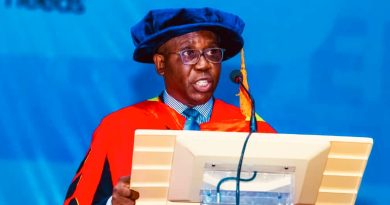
Nigerian universities must rethink campus safety to survive insecurity– Prof. Na-Allah.
By Njideka Ozoalor
The rising wave of banditry and kidnapping across Nigeria has left parents and university administrators deeply concerned. With academic environments increasingly becoming targets, many schools now operate in fear of invasion by armed attackers.
In this interview, Professor Abdelrasaq Na-Allah, an award-winning lecturer at the Department of Economics, University of Abuja, and immediate past Director of the Centre for Entrepreneurship Development, speaks on what must be done to secure Nigerian campuses. He also shares his views on other pressing national issues in this interview by Njideka Ozoalor in Abuja. Excerpts.
Sir, What would you say was the biggest achievement of the Centre for Entrepreneurship Development and your biggest challenge as the Director of the Centre? What lessons should current university leaders take from your experience?
I would say the biggest achievement was that we fundamentally changed the direction of the Centre. When I assumed office, my vision was to move entrepreneurship education beyond simply teaching students vocational skills to cultivating an entrepreneurial mindset that empowers them to identify opportunities, solve problems, and create values. That vision informed virtually everything we did. Perhaps the most visible milestone was securing an international development grant from the German Government through GIZ, the first such grant in the Centre’s history. Beyond the financial value, it demonstrated that the Centre has become a credible partner in international development. We also introduced a new entrepreneurship curriculum approved by Senate, strengthened collaboration with industries through initiatives such as the Guest Lecture Series and Global Entrepreneurship Week, established the Entrepreneurship League Competition, introduced business registration for students, created an Entrepreneurship Fund, articulated an Intellectual Property Rights (IPR) Policy and laid the foundation for a mini innovation hub. Collectively, these initiatives repositioned the Centre from being a classroom-based unit to becoming a platform that connects the University with industry, government, development partners, and the broader entrepreneurial ecosystem.
I must also acknowledge that none of these achievements would have been possible without the exceptional leadership of the then Vice Chancellor, Professor AbdulRasheed Na’Allah. His uncommon vision for the University, unwavering commitment to innovation, and admirable support for new ideas created an enabling environment in which the Centre could thrive. He consistently encouraged us to think beyond conventional boundaries, pursue strategic partnerships, and build institutions that would have a lasting impact. I remain deeply grateful for the confidence he reposed in me and the support he extended throughout my tenure.
The biggest challenge was not a lack of ideas but the institutional constraints that often accompany public universities. We had to contend with limited infrastructure, shortages of qualified entrepreneurship specialists, funding bottlenecks, and bureaucratic processes that sometimes slowed implementation. For example, while we introduced compulsory business registration to encourage students to formalise their ventures before graduation, processing thousands of registrations proved difficult because of capacity challenges outside the University. These experiences reinforced my belief that innovation requires not only vision but also efficient institutional systems that can translate good ideas into tangible results.
The most important lesson I would share with current university leaders is that leadership is about building institutions, not merely managing them. Universities should not wait for resources before pursuing excellence; they should actively seek partnerships, compete for international grants, engage industry, and create opportunities that benefit students and society. Equally important is the need to create an environment where innovation is encouraged and unnecessary bureaucracy is reduced.
When leaders provide a clear vision, empower their teams, and support bold initiatives, as Professor AbdulRasheed Na’Allah consistently did, remarkable things become possible. My experience at the Centre has strengthened my conviction that transformational leadership, backed by collaboration and perseverance, can produce enduring institutional change.
Nigerian public universities have long struggled with funding, ASUU strikes, and government intervention. How can universities achieve real academic autonomy without collapsing financially?
Academic autonomy and financial sustainability are two sides of the same coin. A university that depends almost entirely on government subventions can hardly exercise full autonomy because financial dependence inevitably limits institutional independence. At the same time, expecting universities to become completely self-financing is neither realistic nor desirable, given their public mandate to provide accessible, high-quality education and generate knowledge for national development.
The way forward is to adopt a balanced funding model. Government must continue to provide predictable and adequate funding because higher education is a public good. However, universities must also become more entrepreneurial by diversifying their revenue sources. This means competing for research and development grants, strengthening endowment funds, commercialising research outputs, forging partnerships with industry, attracting philanthropic support, and developing well-managed income-generating ventures that align with their academic mission. The objective is not to commercialise the university but to build financial resilience.
One area that deserves far greater attention is the commercialisation of research. Nigerian universities produce a wealth of knowledge and innovation, but too little of it is translated into products, services, or enterprises that create economic value. During my tenure as Director of the Centre for Entrepreneurship Development, we took what I consider a foundational step in this direction by articulating, for the first time in the University’s history, an Intellectual Property Rights (IPR) Policy.
The policy was designed to provide a framework for protecting, managing, and commercialising the intellectual outputs of our researchers and innovators. Although this is only the beginning of a longer journey, it reflects my conviction that universities must create institutional mechanisms that enable research to move beyond academic publications and generate tangible social and economic impact.
Equally important is granting universities greater operational autonomy. Governing Councils and university management should have sufficient flexibility in areas such as staff recruitment, financial management, curriculum innovation, and strategic partnerships, while remaining accountable through transparent governance and measurable performance standards. Autonomy should therefore go hand in hand with responsibility and accountability.
The recurring cycle of industrial actions also calls for a more institutionalised approach to engagement between government and university unions.
Rather than relying on crisis-driven negotiations, there should be structured and continuous dialogue, with agreements implemented faithfully and funding issues addressed through long-term planning rather than ad hoc interventions.
Stability is essential if our universities are to compete globally. I also believe that universities must redefine their role in national development. They should not be seen merely as centres for teaching and awarding degrees but as engines of innovation, entrepreneurship, research, policy solutions, and economic transformation. Institutions that consistently demonstrate relevance are more likely to attract funding, partnerships, and public confidence.
Ultimately, real academic autonomy is not simply about reducing government control; it is about creating universities that are financially resilient, professionally governed, academically innovative, and publicly accountable. If we can build institutions that generate knowledge, protect intellectual property, commercialise research, attract partnerships, and remain accountable to society, we will have universities that are not only autonomous in principle but sustainable in practice.

With rising student numbers and pressure for more admissions, how do we balance expanding access to university education with maintaining academic standards and research output?
This is one of the defining challenges of higher education in Nigeria today. Expanding access to university education is essential because our youthful population represents one of our greatest national assets.
However, access must never come at the expense of quality. Producing more graduates without equipping them with the right knowledge, skills, and values ultimately does a disservice to the students, employers, and the nation.
The solution is not to choose between access and quality but to pursue both through deliberate planning and sustained investment. Expansion in student enrolment must be matched by corresponding investments in academic staff, teaching facilities, laboratories, digital infrastructure, libraries, student accommodation, and research funding. Universities should admit students based on their carrying capacity, and that carrying capacity should be expanded strategically rather than simply increasing admission quotas.
Technology also has a significant role to play. Digital learning platforms, blended learning, virtual laboratories where appropriate, and modern learning management systems can improve access while enhancing the quality of teaching and learning. However, technology should complement, not replace the human interaction and mentorship that remain central to university education.
Research must also remain at the heart of the university system. A university that focuses exclusively on teaching gradually loses its relevance because research is what drives innovation, informs public policy, and contributes to economic development. Government, industry, and development partners therefore need to invest much more in research funding, while universities should create stronger incentives for interdisciplinary research and collaboration with industry.
My experience at the Centre for Entrepreneurship Development reinforced my belief that universities must become more innovative in the way they educate students. We redesigned entrepreneurship education to focus on the real thing: developing an entrepreneurial mindset rather than merely teaching vocational skills. We strengthened engagement with industry through guest lectures, entrepreneurship competitions, and strategic partnerships, ensuring that learning extended beyond the classroom. We also developed the University’s first Intellectual Property Rights Policy to lay the foundation for research commercialisation, because quality education is ultimately measured not only by the number of graduates we produce but also by the knowledge, innovations, and solutions our universities contribute to society. Finally, quality assurance should be viewed as a continuous institutional culture rather than a periodic accreditation exercise. Universities should regularly review their curricula, strengthen staff development, embrace innovation in teaching and assessment, and benchmark themselves against leading institutions globally. At the same time, government should support the establishment and expansion of more universities—including specialised institutions—so that growing demand for higher education can be accommodated without overstretching existing universities.
In the end, the real measure of success is not how many students we admit but how many competent graduates, impactful researchers, ethical leaders, and successful entrepreneurs we produce. Access is important, but quality is what gives access its true value.
As a professor, how do you view the intersection of campus life and national politics? Should universities be neutral spaces, or do they have a duty to shape political consciousness?
Universities have never been, and should never become, isolated from the realities of the societies they serve. They are centres of knowledge, critical inquiry, and leadership development. As such, they have an important responsibility to shape political consciousness, not in a partisan sense, but in a civic and intellectual sense.
There is a clear distinction between political education and partisan politics. Universities should never become platforms for partisan mobilisation or ideological indoctrination. Their primary obligation is to provide an environment where ideas can be freely debated, evidence can be rigorously examined, and diverse viewpoints can coexist with mutual respect. That is the essence of a true university.
At the same time, universities have a duty to produce graduates who are informed, responsible, and actively engaged citizens. Our students should understand the Constitution, democratic institutions, public policy, governance, and the responsibilities that come with citizenship. They should leave the university not only with professional qualifications but also with the ability to think critically, challenge assumptions, solve public problems, and contribute meaningfully to national development.
As an economist, I also believe universities should play a much stronger role in shaping public policy. Our researchers generate valuable evidence on issues such as economic growth, education, healthcare, energy, agriculture, security, and governance.
Too often, however, that knowledge remains confined to academic journals instead of informing government decisions. We need stronger institutional linkages between universities and policymakers so that research can have a greater impact on national development.
My experience in university administration reinforced this perspective. At the Centre for Entrepreneurship Development, one of our objectives was to produce graduates who could become innovators, job creators, and problem-solvers rather than simply job seekers. That philosophy extends beyond entrepreneurship. Universities should nurture citizens who possess integrity, creativity, and a strong sense of public responsibility because those qualities are essential for building strong democratic institutions and sustainable economies. Ultimately, the greatest contribution universities can make to politics is not by endorsing political parties or candidates but by producing citizens who value truth over propaganda, evidence over emotion, dialogue over intolerance, and national interest over personal gain. If our universities succeed in doing that, they will have fulfilled one of their most important responsibilities to society.
Student unions were once a major voice in Nigeria’s democratic struggle. Do you think today’s students are still politically engaged enough, and why has the culture changed?
Student activism has always been an important part of the history of Nigerian universities and, indeed, of our nation’s democratic evolution. Student unions were once among the most influential voices in advocating for social justice, accountability, and democratic governance. Many of the country’s political leaders, public intellectuals, and civil society actors developed their leadership skills through student activism.
Today’s students are certainly not indifferent to national issues, but their engagement has changed in both form and focus. Previous generations operated in a period when university campuses were the primary platforms for political mobilisation and public debate. Today’s students live in a digital era where much of that engagement has shifted to social media and other online platforms. While digital platforms have made it easier to express opinions and mobilise support, they have also made activism more fragmented and, at times, less organised and less sustained.
There are also broader socioeconomic realities to consider. Many students are understandably preoccupied with completing their studies under difficult economic conditions, concerns about employability, and the rising cost of living. These pressures inevitably influence the kind of engagement they have with public affairs. In addition, the expansion of higher education has changed the composition of the student population, making it more diverse in interests and aspirations than it was several decades ago.
That said, I believe our universities should do more to cultivate responsible student leadership. Student unions should be seen not merely as welfare organisations but as training grounds for democratic leadership, constructive engagement, and public service.
Universities should encourage debate, civic education, volunteerism, policy dialogues, and leadership development while ensuring that student activism remains peaceful, responsible, and focused on advancing the common good.
During my tenure as Director of the Centre for Entrepreneurship Development, one of the principles that guided our reforms was the belief that universities should produce graduates who are not only academically competent but also capable of identifying problems, mobilising people, and creating solutions. Whether in business, public service, or civil society, leadership requires initiative, critical thinking, resilience, and a commitment to improving society. These are the same qualities that responsible student activism should help to develop.
Ultimately, I do not think the issue is that today’s students care less about Nigeria. Rather, they express their concerns differently and face a very different social and economic environment from previous generations. Our responsibility as university leaders is to provide platforms where that energy can be channelled into informed dialogue, responsible leadership, innovation, and constructive participation in the democratic process. If we can achieve that, student activism will continue to serve as a vital force for national development, even if it looks different from what earlier generations experienced.
Universities often generate research that could guide government policy, but that link seems weak in Nigeria. How can we strengthen the bridge between academia and policymakers?
The gap between academia and public policy is one of the greatest missed opportunities in Nigeria’s development. Our universities produce a wealth of research on the economy, education, agriculture, health, energy, security, climate change, and governance, yet too much of this knowledge remains within academic journals and conference proceedings instead of informing public policy and national decision-making. Bridging that gap requires effort from both sides. Universities must move beyond seeing research solely as an academic exercise for promotion and publication. We need to place greater emphasis on policy-relevant research, produce concise policy briefs alongside academic papers, communicate our findings in language that policymakers can readily understand, and engage consistently with government institutions, the private sector, and civil society. Good research should not only advance knowledge; it should also solve real-world problems.
Government, on its part, must institutionalise the use of evidence in policymaking. Ministries, departments, and agencies should establish stronger partnerships with universities, commission research on priority national issues, and involve academics much earlier in the policy formulation process rather than consulting them only after decisions have been made. Universities should be regarded as strategic partners in governance, not simply as institutions that train graduates.
I also believe that universities themselves should create stronger structures for knowledge transfer and innovation. During my tenure as Director of the Centre for Entrepreneurship Development, we laid the foundation for the commercialisation of research by developing the University’s first Intellectual Property Rights (IPR) Policy. The objective was to ensure that research outcomes could be protected, translated into innovations, and eventually commercialised for the benefit of society and the economy. We also secured the Centre’s first international development grant from the German Government through GIZ and built strategic partnerships with industry and development organisations.
These experiences reinforced my conviction that when universities actively engage external stakeholders, research becomes more relevant, attracts greater investment, and has a better chance of influencing policy and practice.
Another important step is to recognise and reward policy engagement within the university system. Academic excellence should continue to be measured by high-quality publications, but we should also value policy briefs, patents, technology transfer, advisory roles, industry collaboration, and demonstrable contributions to solving national problems. When the incentive structure changes, researchers will naturally devote more attention to producing work with practical impact.
Ultimately, universities should be viewed not merely as centres for teaching and research but as national think tanks that generate ideas, evaluate policies, and provide evidence-based solutions to society’s most pressing challenges.
Nigeria has no shortage of intellectual capacity. The real challenge is creating stronger institutional bridges that connect the knowledge generated in our universities with the decisions made in government. When that happens, public policy will become more evidence-based, universities will become more relevant, and the country as a whole will benefit.
Campus security appears to be weakening: We have seen cases of kidnapping and insecurity around universities, secondary and primary schools including those on major highways. What structural gaps left our schools especially universities vulnerable, and what should have been done differently, sir?
The growing insecurity around our educational institutions is deeply troubling because universities, schools, and colleges should be places where learning thrives in an atmosphere of safety and freedom. When students, staff, and parents begin to worry more about security than education, the very purpose of our educational system is undermined.
The vulnerability of many Nigerian universities is the result of a combination of structural factors. First, many campuses were originally designed at a time when the security environment was far less complex than it is today. They were conceived as open academic communities rather than fortified institutions. Over the years, however, the security landscape has changed dramatically, while the infrastructure and security architecture of many universities have not evolved at the same pace. Second, many universities occupy vast expanses of land with multiple entry points, inadequate perimeter fencing, poor lighting, insufficient surveillance technology, and limited security personnel. In many cases, the internal security units are overstretched and under-equipped to deal with sophisticated criminal threats. Beyond the campus itself, many institutions are located in communities where insecurity has become a broader societal challenge, making universities vulnerable to the same criminal networks operating in surrounding areas.
Third, security is too often approached as the responsibility of the university alone. In reality, protecting educational institutions requires close collaboration among university authorities, host communities, security agencies, state governments, and the Federal Government. Intelligence gathering, rapid response systems, and community policing should be integral components of campus security rather than afterthoughts. I believe we also need to rethink security from a preventive rather than reactive perspective. Universities should undertake regular security risk assessments, deploy modern surveillance technologies, strengthen access control, improve emergency communication systems, and invest in the training of campus security personnel. At the same time, security agencies should treat educational institutions as critical national assets deserving of dedicated protection and continuous intelligence support.
However, we should not lose sight of the fact that campus insecurity is ultimately a reflection of the broader security challenges facing the country. Universities cannot become islands of safety in an environment where surrounding communities are themselves insecure. Addressing youth unemployment, poverty, drug abuse, weak law enforcement, and the proliferation of criminal networks is therefore just as important as strengthening physical security on campus. Sustainable security requires both effective policing and sound socioeconomic policies.
As an economist, I would add that investment in education and investment in security are not competing priorities—they reinforce one another. A nation that cannot guarantee the safety of its schools risks undermining its future human capital development. Protecting our educational institutions should therefore be seen not merely as a security obligation but as a strategic investment in Nigeria’s long-term economic growth, social stability, and national development. Our universities should remain open spaces for learning, innovation, and intellectual exchange, but they must also become safer environments where students and staff can pursue knowledge without fear.
Parents sending their children to school today, have fear of kidnapping, which is real. What practical measures can universities, government, and communities put in place to make campuses safer without turning them into fortresses?
The fears of parents today are real and understandable. When families send their children to a university, they should be thinking about academic success and personal development, not whether their children will return home safely.
Restoring confidence in the safety of our educational institutions must therefore become a national priority.
The first point is that campus security should not be viewed solely as the responsibility of the university. It requires a coordinated approach involving university management, government, security agencies, host communities, and even students themselves. Safety is most effective when it is built on partnership rather than isolated efforts.
For universities, the priority should be to invest in smart security systems rather than simply increasing the number of security personnel. This includes strengthening perimeter security where necessary, improving lighting, installing modern surveillance systems, introducing electronic access control to sensitive areas, establishing well-equipped emergency response centres, and ensuring that students and staff can report security concerns quickly through dedicated communication channels.
Regular security audits and emergency preparedness exercises should become part of university culture.
Government also has a critical responsibility. Educational institutions should be recognised as strategic national assets deserving of dedicated security support. Intelligence gathering around campuses should be strengthened, rapid-response capabilities improved, and greater investment made in the training and equipment of campus security personnel. Equally important is addressing the wider security challenges in the communities surrounding our universities, because no campus can remain completely secure if the environment around it is unstable.
Host communities also have a vital role to play. Universities and their neighbouring communities should see themselves as partners with a shared interest in peace and development. Strong community engagement, local intelligence, and mutual trust can often prevent security threats before they escalate. Many successful security interventions begin with timely information from community members who understand their environment. I believe that Kogi State’s relative success in addressing insecurity can largely be attributed to the government’s strong focus on leveraging community actors.
Students themselves should also be part of the solution. Security awareness programmes should be incorporated into student orientation so that students understand basic personal safety measures, know how to report suspicious activities, and appreciate the importance of complying with campus security protocols. Security works best when everyone sees it as a shared responsibility.
Ultimately, however, we must recognise that the safety of our campuses is inseparable from the safety of our nation. Kidnapping, banditry, and violent crime are symptoms of broader economic and governance challenges, including unemployment, poverty, weak law enforcement, and the proliferation of criminal networks. As an economist, I believe that improving security requires not only effective policing but also sustained investment in inclusive economic growth, job creation, and opportunities for young people. A society that creates hope is far less likely to produce crime.
Our universities should remain open environments that encourage learning, innovation, and the free exchange of ideas. The goal is not to turn them into fortresses but to make them intelligently secure places where modern technology, effective collaboration, community partnership, and proactive leadership provide protection while preserving the openness that is essential to academic life. Parents deserve the confidence that when they entrust their children to our universities, those children will learn, thrive, and return home safely.
On the bigger picture: Do you see kidnapping around schools as purely a security problem, or is it also tied to unemployment, poverty, and the breakdown of the social structures? How should education policy respond?
I do not see kidnapping around schools as merely a security problem. It is certainly a security challenge, but it is also a symptom of deeper structural issues within our society. When criminality becomes a means of livelihood for some people, it tells us that we are dealing not only with failures in law enforcement but also with failures in economic opportunity, social inclusion, and governance.
As an economist, I believe insecurity and underdevelopment reinforce each other. High unemployment, particularly among young people, widespread poverty, growing inequality, and social dislocation create conditions that criminal groups can exploit. This does not excuse criminal behaviour, individuals are responsible for their actions, but it reminds us that lasting security cannot be achieved through policing alone. We must also address the underlying conditions that make crime more attractive or easier to sustain.
Education policy therefore has a critical role to play. Our universities must do more than produce graduates; they must produce problem-solvers, innovators, ethical leaders, and entrepreneurs who create opportunities for themselves and for others. This was the philosophy that guided my tenure as Director of the Centre for Entrepreneurship Development. We deliberately shifted entrepreneurship education from a narrow focus on skill acquisition to the development of an entrepreneurial mindset, strengthened partnerships with industry, and introduced practical programmes that prepared students to identify opportunities and build sustainable enterprises. One initiative that I am particularly proud of was the establishment of a tripartite partnership involving the University of Abuja’s Centre for Entrepreneurship Development, the Abuja Chamber of Commerce and Industry (ACCI) BEST Centre, and Innovo Crescentia. Through a development grant from the German Federal Ministry for Economic Cooperation and Development (GIZ), we launched the Farm-to-Table Agricultural Innovation Project (F-TAIP). The project is designed to serve as a one-stop digital innovation hub for micro, small, and medium-sized enterprises (MSMEs), particularly those owned by women and young people across the North-Central Zone of Nigeria. Its objective is to equip these businesses with digital skills, business development support, market access, and innovation tools that will enhance their competitiveness, productivity, and long-term growth.
To me, this project represents more than a successful partnership; it reflects my enduring belief that universities should not limit themselves to teaching and research. They should actively contribute to enterprise development, innovation, and job creation within their communities. By supporting SMEs, universities can help stimulate local economies, expand employment opportunities, reduce poverty, and address some of the socioeconomic conditions that often fuel insecurity and criminality. In other words, universities should be part of Nigeria’s development architecture, not passive observers of it.
Of course, education alone cannot solve the problem. It must be complemented by sound economic policies that promote inclusive growth, create decent jobs, support small and medium-sized enterprises, and reduce regional inequalities. Governments at all levels must also invest in quality basic education, technical and vocational training, healthcare, and social protection. Strong communities are built when citizens have hope, opportunity, and confidence that hard work will be rewarded. At the same time, we must strengthen our value system. Education should not only equip young people with technical knowledge but also cultivate integrity, respect for the rule of law, civic responsibility, and a sense of national purpose. A society that neglects character formation while pursuing academic achievement risks producing educated individuals without a corresponding commitment to the common good.
Ultimately, I believe our response must be comprehensive. We need effective security agencies to protect lives and property, but we also need an economy that creates opportunities, institutions that inspire confidence, and an education system that prepares young people to become productive citizens rather than vulnerable recruits for criminal networks. When security policy, economic policy, and education policy work together—and when universities embrace their broader role as catalysts for entrepreneurship, innovation, and community development—we stand a much better chance of addressing not only the symptoms of insecurity but also its root causes. That, in my view, is the sustainable path to building a safer, more prosperous, and more inclusive Nigeria.
Advice: Looking forward, if you were to be a VC today with the current security situation, what would be the first three things you would do differently to protect students, staff, and the academic continuity?
If I were appointed Vice-Chancellor today, security would be one of my highest priorities because a university cannot fulfil its academic mission in an atmosphere of fear and uncertainty. My approach would be guided by the principle that security is not just about protecting lives and property; it is about safeguarding the continuity of learning, research, and innovation.
The first thing I would do is undertake a comprehensive security audit of the entire university. Every campus has its unique vulnerabilities, and effective security must be based on evidence rather than assumptions. The audit would examine physical infrastructure, access points, perimeter security, lighting, surveillance systems, emergency response mechanisms, student hostels, student transportation, staff residences, and the security of off-campus environments where many students live. The findings would form the basis of a modern, technology-driven security strategy that includes CCTV surveillance, electronic access control, emergency communication systems, and a well-trained campus security workforce working closely with national security agencies.
Second, I would institutionalise a strong security partnership involving the university, security agencies, host communities, alumni, parents, and student representatives. Universities cannot secure themselves in isolation. Experience has shown that community engagement and timely intelligence are often more effective than reactive measures. I would establish a standing security advisory committee that meets regularly to assess emerging threats, coordinate responses, and ensure that security planning remains proactive rather than reactive.
Third, I would strengthen institutional resilience to ensure that academic activities continue even during periods of disruption. The COVID-19 pandemic taught us that universities must be prepared for unexpected crises, whether they arise from public health emergencies or security challenges. That means investing in robust digital learning infrastructure, strengthening blended learning, protecting research data through secure digital systems, and developing clear business continuity and emergency response plans. Academic continuity should never depend solely on physical access to campus.
Ultimately, leadership in today’s universities requires thinking beyond the campus gates. A Vice-Chancellor must ensure that students and staff are protected through effective security systems, while also positioning the university as a partner in solving the wider social and economic challenges confronting the nation. In the long run, the safest campuses will be those located within communities that are themselves more prosperous, more inclusive, and more secure.