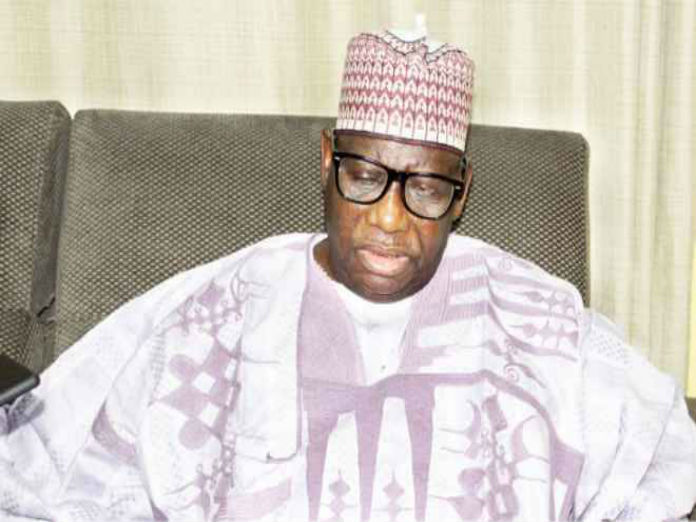
SOLDIER ON, NDUME
Nick Dazang
Mohammed Ali Ndume has served as Senator, representing Borno South, since 2014. From 2003 to 2011, he had served as a member of the House of Representatives for Chibok/Damboa/Gwoza.
As a member of the National Assembly, Senator Ndume has moved or sponsored a record seventy six(76) bills. Notable among them is the landmark Amendment Bill that enabled Internally Displaced Persons (IDPs) to vote in the 2015 General Elections.
For good measure, Senator Ndume has facilitated more than sixty(60) intervention projects across the nine Local Government Areas(LGAs) of his Senatorial District.
This writer’s path with Senator Ndume’s crossed between 2011 and 2016. Ahead of the two election cycles, during those circles and in their aftermath, this writer’s remit, was to, among others, communicate succinctly to stakeholders the policies of the Independent National Electoral Commission(INEC); to elicit for it a salubrious image; and to educate Nigerians about the electoral process.
The remit was tall and onerous. It also required drive, passion, hard work and inordinate steadfastness. The tasks were however made easier by the unwavering support of the Commission and my colleagues in the media.
In the course of this writer’s assignment, he observed the near frequent and ubiquitous sorties and presence of Senator Ndume, especially in the studios of the BBC at Maitama. This period coincided with a time when the Boko Haram insurgency was at its peak and Borno State was its epicenter. Worse, 276 school girls at Chibok(in Ndume’s constituency) were abducted on the night of 14-15th April 2014.
Apart from using his bully pulpit as Senator to call attention to the plight of his constituents, who have been killed, maimed or abducted by Boko Haram, Senator Ndume was not done: He found recourse in the media, and particularly the BBC Hausa Service, which is avidly listened to in the North.
In addition to his resort to the media to bring to the world the sordid plight of his constituents, Senator Ndume, a non-security expert, but who has interfaced with our troops in the field on many occasions, going by his interviews, had fashioned out an acronym, TEAM, which he thought our government could deploy.
By his explanation, TEAM stands for:Training, Equipment, Ammunition and Motivation. No doubt, this acronym, which he canvasses, must resonate with those who have been following the travails of our troops.
The Senator, who had always wished that the war on terror was won, and over with, as soon as it reared its ugly head in 2009, has also argued for the bombing of the insurgents in their dens at the Sambisa Forest and Mandara Mountain. It is from there, he believes, that they egress and attack the vulnerable and vast expanse of the Timbuktu Triangle.
However, following the recent attack at one of the military bases at Ngoshe, Southern Borno, in which not less than 400 people were abducted by the insurgents, Senator Ndume, had in an interview with the BBC Hausa, begun to sound despondent.
He alleged that he was on account of his passion for the war against insurgency, being presented by his traducers as a rabble rouser and busy body. He further alleged that to his dismay, even some of his colleagues in the National Assembly were referring to him as a rebel for daring to urge the government to give our troops robust support and motivation.
Certainly, the recent reversals being suffered and the attacks being received by our troops must daunt and discourage even the stoutest and the most zealous fighter against insurgency. But such relapses and snide comments should not drive us to despair. After all, such reverses go with the territory of asymmetrical warfare or any challenging endeavor.
In 1979, Majuli Island, near Kolalmukh in Assam, India, was severely flooded and eroded. Then Jadav Paneng, a resident of the Island, was a sixteen year old teenager. Other residents left in droves. Payeng remained, against all odds and taunts.
For forty years, he did the unimaginable and miraculous: On a daily basis, Payeng tirelessly and single-handedly planted trees. He nurtured these trees thereby transforming a desert-like area into a lush 1,360-acre forest, known as the Molai Forest.
This forest has since become a sanctuary for tigers, rhinos, elephants, monkeys and different species of birds. Payeng, who was once ridiculed by his compatriots, was honored as the FOREST MAN OF INDIA by the Indian Institute of Forest Management in 2012. He was awarded the PADMA SHRI Award, India’s fourth highest civilian honor, in 2015.
His eventful story has inspired books such as THE BOY WHO GREW A FOREST:THE TRUE STORY OF JADEV PAYENG and several television documentaries.
Winston Churchill, former British Prime Minister, who referred to Nazi Germany, in a speech to the House of Commons on May 13th 1940, as “a monstrous tyranny, never surpassed in the dark, lamentable catalogue of human crime”, galvanized America and the Soviet Union into an alliance to defeat Germany in World War II.
Senator Ndume, rather than despairing or giving in to the antics of those who thrive on sour grapes, should find enormous comfort in the philosopher, Arthur Schopenhauer, who once wrote:”All truth passes through three stages. First, it is ridiculed. Second, it is violently opposed. Third, it is accepted as being self-evident.”
Even if his colleagues cast him as a rebel, he should rejoice in the knowledge that he is a rebel with a high-minded cause – a cause that resonates with his constituents and all right thinking Nigerians.
He should be fortified by the fact that majority of Nigerians, who are either diminished or decimated by insurgency, stand, shoulder to shoulder, with him and our gallant troops. He should soldier on, regardless, and until we see the end of these monstrous and wicked insurgents and terrorists.
He should, as Churchill, who once showed stalwart determination against fascism, “Never, never, never give up!”