Nigeria, EU Deepen Strategic Ties at 8th Ministerial Dialogue in Abuja
Oru Leonard
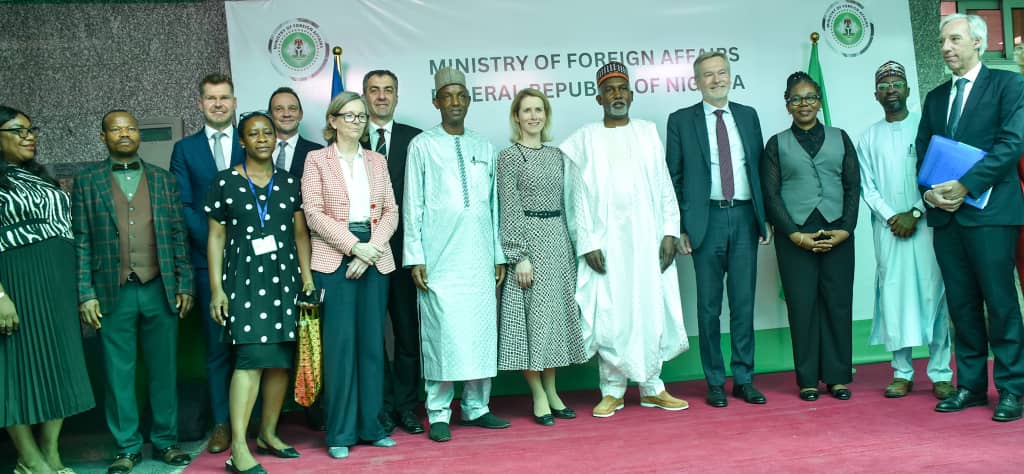
ABUJA — The Federal Government of Nigeria and the European Union have reaffirmed their resolve to strengthen bilateral relations and expand cooperation across key sectors following the 8th Nigeria–EU Ministerial Dialogue held in Abuja.
The high-level meeting, which took place at the Ministry of Foreign Affairs on March 23, 2026, brought together top officials from both sides to assess the progress of their partnership and outline new areas of collaboration.
Nigeria’s delegation was led by the Minister of Foreign Affairs, Yusuf Maitama Tuggar, while the EU team was headed by Kaja Kallas, who also serves as Vice-President of the European Commission.
Speaking at the opening session, Tuggar highlighted the long-standing and strategic nature of Nigeria–EU relations, noting that the partnership is rooted in shared values, mutual respect, and a commitment to multilateral cooperation. He said the dialogue, themed “Partnership for Sustainable Development and Security,” underscores a joint focus on delivering measurable benefits to citizens.
Kallas, in her remarks, described Nigeria as a vital strategic partner for the EU in Africa and reaffirmed the bloc’s commitment to deepening collaboration in critical areas such as security, trade, climate action, digital innovation, and migration.
Deliberations on security focused on counterterrorism, maritime safety in the Gulf of Guinea, and stability in the Sahel region. Nigeria commended EU support for regional security efforts, including assistance to the Multinational Joint Task Force, and welcomed moves to institutionalise a structured EU–Nigeria dialogue on peace, security, and defence.
On the economic front, both parties reaffirmed the EU’s position as one of Nigeria’s leading trade and investment partners, with hundreds of European companies operating in the country. They agreed to diversify cooperation into sectors such as agriculture, manufacturing, digital technology, and industrial development. The EU also highlighted investments under its Global Gateway initiative targeting infrastructure, healthcare, energy, and agriculture.
Discussions on climate and energy transition stressed the importance of balancing renewable energy goals with development needs. Nigeria reiterated its climate commitments while expressing concerns about the potential effects of the EU’s Carbon Border Adjustment Mechanism on developing economies. Both sides agreed to continue engagement on climate financing, technology transfer, and fair transition frameworks.
The dialogue further underscored Nigeria’s emergence as a digital innovation hub, with both sides calling for stronger collaboration in areas such as research, fintech, startup funding, and participation in programmes like Horizon Europe.
Migration issues also featured prominently, with both parties advocating humane and balanced approaches. Progress was recorded on the Nigeria–EU Readmission Agreement, alongside discussions on legal migration pathways, labour mobility, and joint efforts to curb human trafficking and irregular migration.
Nigeria also expressed appreciation for EU humanitarian support to internally displaced persons, while both sides pledged to enhance cooperation in humanitarian response and long-term resilience building.
At the close of the meeting, Nigeria and the EU reaffirmed their commitment to advancing cooperation in priority areas including security, trade, governance, migration, and sustainable development, pledging to translate dialogue outcomes into concrete actions.
The 8th Ministerial Dialogue marks another milestone in the evolving Nigeria–EU partnership, with both sides expressing optimism about future collaboration aimed at promoting stability and shared prosperity.