Nigeria, Angola Agree to ease movement of Diplomats and Government officials
Oru Leonard
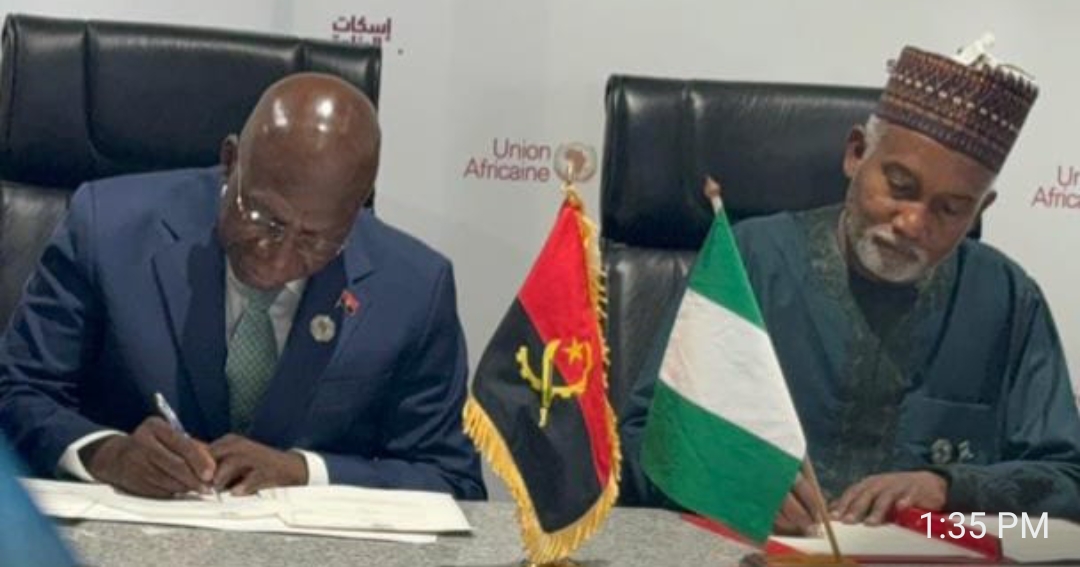
The draft Agreement between the Government of the Federal Republic of Nigeria and the Government of the Republic of Angola on Visa Exemption for Holders of Diplomatic and Official/Service Passports was formally signed by both parties on 15th February, 2026, on the margins of the 39th Ordinary Session of the Heads of State and Government of the African Union in Addis Ababa. The Nigerian delegation was headed by the Honourable Minister of Foreign Affairs, Ambassador Yusuf Maitama Tuggar, while the Angolan delegation was led by the Minister of International Relations, Ambassador Tete Antonio.
In his brief remarks, Ambassador Yusuf Maitama Tuggar expressed satisfaction at the eventual signing of the Agreement, noting that the initiative had been long overdue and represented a timely step in strengthening bilateral engagement. He emphasized that the Agreement would significantly enhance diplomatic and official relations between the two brotherly countries by easing travel procedures for holders of diplomatic and official/service passports. According to him, the visa exemption arrangement will facilitate smoother official exchanges, deepen institutional cooperation, and create broader opportunities for joint initiatives, dialogue, and partnership by enabling authorized government officials from both sides to move more freely and efficiently without administrative hindrances.
He further informed the gathering that relations between Nigeria and Angola are rooted in a long and shared history, dating back to the period of ideological conflict between the National Union for the Total Independence of Angola (UNITA) and the Popular Movement for the Liberation of Angola (MPLA) in Angola. He recalled Nigeria’s principled and outspoken role during that era, highlighted by the landmark statement delivered by former Nigerian Head of State, General Murtala Muhammed, titled “Africa Has Come of Age.” The Honourable Minister reiterated that the historic address represented a firm declaration of African independence in decision-making and demonstrated Nigeria’s unequivocal support and solidarity with the people of Angola in their struggle, laying an enduring foundation for the strong diplomatic and political ties that continue between both countries today.
In his remarks, Ambassador Tete Antonio conveyed profound appreciation for the enduring and historic bond between Angola and Nigeria, particularly recalling the period of anti-colonial struggle and the quest for national independence across the continent. He underscored Nigeria’s principled leadership role in West Africa and noted that it stood firmly with frontline States, providing strong diplomatic and political backing that contributed meaningfully to Angola’s liberation efforts.
He stressed that this legacy of solidarity laid the foundation for the robust bilateral relationship enjoyed today. Ambassador Antonio described the newly signed Agreement as a practical and forward-looking milestone that will further consolidate the long-standing historical and diplomatic ties between both countries, while opening new avenues for closer official engagement and cooperation.
It is instructive to note that, in light of the well-established historical ties and record of mutual solidarity between Nigeria and Angola, the signing of this Agreement can rightly be regarded as long overdue. Its conclusion represents not merely a procedural diplomatic development but a substantive reaffirmation of the shared values, cooperation, and trust that have characterized relations between both countries over the years.
The Agreement will, ipso facto, reinvigorate and modernize the long-tested diplomatic partnership by removing administrative barriers to official travel and engagement. By facilitating easier movement for holders of diplomatic and official/service passports, it is expected to strengthen mutual understanding, enhance policy coordination, and foster a stronger working chemistry between relevant institutions and authorities on both sides, thereby translating historic goodwill into more practical and sustained collaboration.
The statement is signed by Kimiebi Imomotimi Ebienfa
Spokesperson,
Ministry of Foreign Affairs