Tinubu Urges Diaspora Nigerians to Move Beyond Remittances, Invest in Nigeria
Oru Leonard
President Bola Ahmed Tinubu has urged Nigerians living abroad to move beyond sending remittances and become active participants in Nigeria’s economic transformation through investment, expertise, technology transfer and access to international markets.
Tinubu made the call in a keynote address delivered on his behalf by the Chief of Staff to the President, Rt. Hon. Femi Gbajabiamila, CFR, at the Nigeria Diaspora Economic Conference (NIDEC) 2026, held at the Apollo Convention Centre in Toronto, Canada, from August 13 to 15.
The conference, which had the theme “Thrive Abroad, Invest Nigeria,” brought together Nigerian professionals, entrepreneurs, investors and other stakeholders in the diaspora.
The President said the prosperity of Nigerians abroad should be connected to Nigeria’s development, stressing that diaspora wealth, knowledge and networks could become major drivers of national growth.
“Nigeria sees you, Nigeria values you, and Nigeria needs you in the work of building the country we all desire,” Tinubu said.
Represented by Gbajabiamila, the President noted that Nigerians should be encouraged to thrive wherever they live, but their achievements abroad should also create new opportunities for Nigeria through investment, skills, innovation and international connections.
Gbajabiamila also highlighted the relationship between economic power and political influence, arguing that economic strength gives individuals, communities and nations greater access to decision-making platforms.
He said the theme of the conference was particularly relevant at a time when many Nigerians were seeking opportunities to invest outside the country, stressing that investment and economic power could ultimately translate into greater political influence.
The President used the occasion to defend the economic reforms of his administration, saying the Renewed Hope Agenda was designed to build a productive, competitive and inclusive Nigerian economy.
According to him, the objective is to create a country that earns foreign exchange from what it produces, grows and exports rather than depending excessively on the extraction of natural resources.
Gbajabiamila acknowledged that the reforms had created significant pressures for households and businesses but maintained that postponing necessary reforms would have worsened the country’s economic problems.
He said Tinubu inherited an economy characterised by costly fuel subsidy arrangements, multiple foreign exchange windows, weak public revenues and heavy debt-servicing obligations.
“President Tinubu chose a different course. He chose reform over postponement, candour over pretence and long-term national strength over short-term applause,” he said.
Gbajabiamila cited several economic indicators as evidence that the reforms were beginning to produce results, including real GDP growth of 3.89 per cent in the first quarter of 2026, manufacturing growth of 3.29 per cent and a non-oil sector contribution of more than 96 per cent of total output.
He also cited Nigeria’s foreign reserves of $45.4 billion at the end of 2025, improved exchange-rate stability and sustained trade surpluses.
The International Monetary Fund’s projected 4.1 per cent economic growth for Nigeria in 2026 and the World Bank’s acknowledgement of progress in macroeconomic stability were also cited in support of the administration’s reform direction.
However, Gbajabiamila admitted that the country still faced serious challenges.
“This does not mean that all our problems have disappeared. They have not,” he said, stressing that the gains must now translate into more jobs, lower living costs, stronger local industries and improved living standards.
A major focus of the address was the need to change the traditional relationship between Nigeria and its diaspora.
Gbajabiamila acknowledged the enormous contribution Nigerians abroad have made through remittances, which have supported families, education, healthcare, housing and small businesses.
However, he argued that remittances should be regarded as only the beginning of diaspora engagement with Nigeria.
“Remittances sustain consumption. Investment expands production. Expertise builds institutions. Networks open markets. Nigeria now needs all four,” he said.
He therefore encouraged Nigerians abroad to invest in sectors including agro-processing, healthcare, technology, energy, housing, logistics, mining, education, creative industries and export manufacturing.
He also urged diaspora investors to take advantage of Nigeria’s position as a gateway to the wider African market through the African Continental Free Trade Area.
Gbajabiamila called on diaspora investors to organise themselves into professionally managed investment clubs, sector-specific funds, co-investment vehicles, venture networks and institutional partnerships.
He advised investors to pool capital, demand audited accounts, insist on sound corporate governance, conduct due diligence and engage credible professional advisers.
The President also stressed that diaspora contributions should not be measured only in financial terms.
According to him, Nigerians abroad possess enormous intellectual and professional resources which could be deployed to strengthen institutions and develop human capacity in Nigeria.
Gbajabiamila urged diaspora professionals to mentor Nigerian entrepreneurs, establish research partnerships, improve healthcare institutions, connect Nigerian businesses to foreign markets and transfer international standards and systems.
“The question should not only be, ‘How much did I send?’ It should also be, ‘What capability did I help Nigeria build?’” he said.
He argued that while money could purchase equipment, professional expertise could create the systems needed to make such investments productive and sustainable.
Government Promises Continued Better Investment Environment
Gbajabiamila said the Federal Government also had a responsibility to earn the confidence of Nigerians abroad.
He said government must provide predictable regulations, transparent investment opportunities, credible business partners, efficient consular services, stronger property rights, faster dispute resolution and protection from fraud and bureaucratic extortion.
He highlighted the Non-Resident Nigerian Ordinary Account, Non-Resident Nigerian Investment Account and non-resident Bank Verification Number as practical measures aimed at making it easier for Nigerians abroad to participate in the Nigerian financial system.
He also proposed expanding the concepts of “Nigeria First” and “Local Content” to deliberately recognise Nigerians in the diaspora who invest in the country.
Tinubu Warns Against Undermining Nigeria.
The President further urged Nigerians in the diaspora to be responsible ambassadors of the country.
While acknowledging the importance of criticism in a democracy, he cautioned against misinformation, falsehoods and actions capable of damaging Nigeria’s reputation or stability.
“Criticism that illuminates is patriotic. Falsehood that inflames is not,” he said.
With Nigeria entering another period of political contestation, Tinubu urged Nigerians to distinguish between political disagreements and the national interest.
“Elections will produce winners and losers; Nigeria must always win,” he declared.
He warned against supporting instability, economic sabotage or actions aimed at deliberately weakening the Nigerian economy for political reasons.
“You may oppose a government; you must never wish the country to fail merely to prove your politics right,” he said.
Gbajabiamila said the Tinubu administration considers Nigerians in the diaspora strategic partners in nation-building rather than merely a source of remittances.
He challenged the NIDEC participants to ensure that the conference produces measurable results rather than speeches and resolutions.
“Let it be measured by commitments: one enterprise funded; one institution strengthened; one young Nigerian mentored; one export route opened; one research partnership established; one community transformed,” he said.
Reflecting on Nigeria’s history, Gbajabiamila recalled the unity slogan associated with former Head of State, General Yakubu Gowon, that keeping Nigeria one was a task that must be done.
He proposed a new national aspiration: “Making Nigeria great is a task that must be done.”
He said the Nigerian diaspora must play a major role in achieving this objective.
Quoting reggae legend Bob Marley, Gbajabiamila said: “In the abundance of water the fool is thirsty,” arguing that Nigeria possesses enormous natural and human resources capable of generating prosperity.
He cited the country’s oil and mineral resources, arable land and vast intellectual capacity as assets that must be converted into productive economic opportunities.
He concluded with a direct appeal to Nigerians abroad: “Thrive abroad. Invest Nigeria. Speak of Nigeria with truth. Correct her with love. Build her with confidence.”
The message from NIDEC 2026 was therefore clear: Nigeria’s diaspora is not merely a source of remittances but a strategic national asset whose capital, expertise, networks and global experience can help transform the country into a stronger, more productive and globally competitive economy.
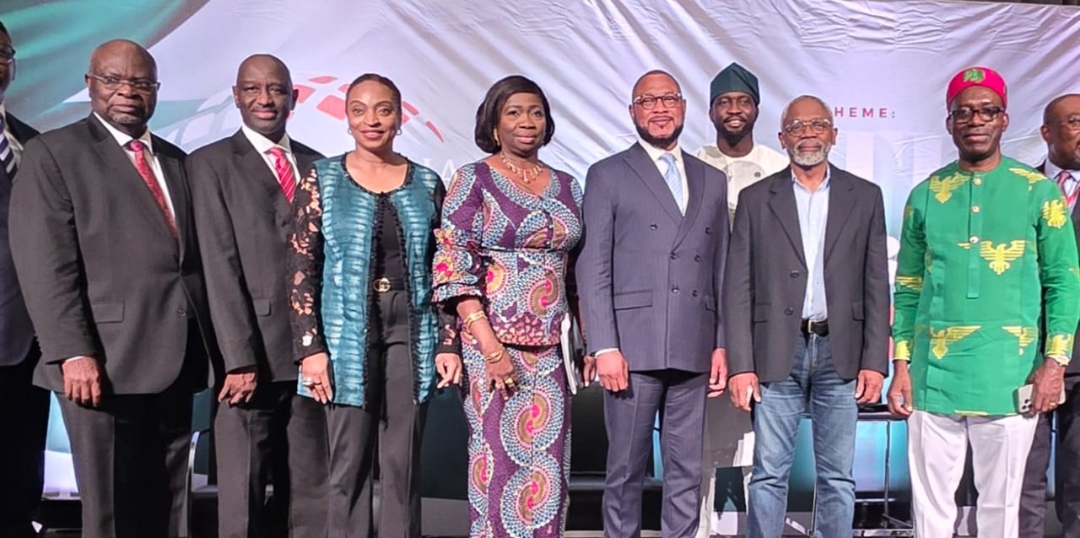
Cover Photo Caption, L-R : Dr Segun Aina, Chair, LOC NIDEC, Amb. Abba Zanna, Ag Nigeria High Commissioner to Canada, Dr Olajumoke Oduwole, Minister of Industry, Trade and Investment, Hon. Abike Dabiri-Erewa, Chairman, NIDCOM, Gov. Dauda Lawal of Zamfara State, Hon. Femi Gbajabiamila, COS to President Bola Ahmed Tinubu and Prof. Charles Soludo, Governor of Anambra State during the opening ceremony of the first ever Nigeria Diaspora Economic Conference (NIDEC) 2026 held at Apollo Convention Centre, Toronto, Canada.