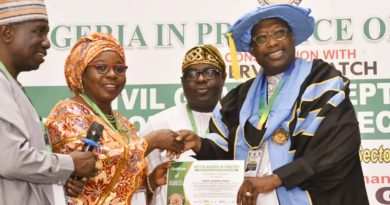
Rafsanjani Takes Helm at CAPPA, Warns Nigeria Against “New Resource Curse” in Solid Minerals Sector
Maryam Aminu
Africa’s foremost accountability watchdog, Corporate Accountability and Public Participation Africa (CAPPA), has named veteran civil rights leader Auwal Musa Rafsanjani as the new Chairman of its Advisory Board a move the organisation describes as a renewed mandate to defend civic space, public resources, and democratic governance across the continent.
Announcing his appointment after a weekend board election, CAPPA said Rafsanjani’s emergence marks “a strengthened resolve to amplify citizen voices against corruption, inequality, and reckless exploitation of natural resources.”
Rafsanjani, a leading figure in Nigeria’s civil society space, currently serves as Executive Director of the Civil Society Legislative Advocacy Centre (CISLAC) and Head of Transparency International Nigeria. He also chairs the Board of Trustees of Amnesty International Nigeria, leads the Zero Corruption Coalition, and co-convenes the Say No Campaign — all roles underscoring his deep-rooted activism in governance reform and human rights.
With over three decades of advocacy experience, Rafsanjani has played key roles in extractive sector transparency and anti-corruption reforms across West Africa, including serving as the Sub-Saharan Africa representative on the UN Convention Against Corruption (UNCAC) Civil Society Coalition.
Other members of the newly constituted CAPPA Advisory Board include Akinbode Oluwafemi (Executive Director/Secretary), Evelyn Nkanga Bassey (Treasurer), Scott Pegg, Kayode Ogunbunmi, Betty Abah, and Doifie Buokoribo a diverse team bringing decades of experience in rights advocacy, environmental justice, and community defence.
Speaking after his election, Rafsanjani pledged to strengthen CAPPA’s institutional focus and deepen its work in public health advocacy, extractive justice, democratic rights, and protection of public services.
“Our mission is to anchor CAPPA as a fearless watchdog for public good one that stands firmly with communities against the commercialisation of public resources and shrinking civic freedoms,” he said.
In a strong policy statement accompanying the announcement, the CAPPA Board warned that Nigeria’s current push for rapid mining expansion could spark “a new resource curse” reminiscent of the Niger Delta tragedy.
The organisation noted that while the government celebrates the mining sector’s rise to 4.6% of GDP, this growth has been shadowed by land grabs, forced displacement, environmental destruction, and concession-style politics in host communities.
“Unless the government enforces strong regulation, guarantees community consent, and ensures transparent governance, Nigeria risks repeating history replacing oil’s curse with a minerals curse,” the board cautioned.
CAPPA further urged policymakers to adopt a people-centred resource framework, ensuring that land, water, culture, and livelihoods are treated as more than commodities for investment.
“There is no just transition if communities do not share in its gains,” the statement warned. “We must reject any development model that enriches a few while displacing many.”
Reaffirming its continental vision, CAPPA pledged to expand alliances with labour unions, youth groups, women’s movements, and grassroots defenders, noting that the struggle for accountability and participation can only be won through unified action.
“The fight for public accountability is one struggle that cannot be won by scattered voices,” CAPPA stated.
The statement was signed by Akinbode Oluwafemi, Executive Director of CAPPA.