Osun Poll Shows Majority Expect Peaceful Governorship Election Despite Deep Security Concerns- CLEEN FOUNDATION
Oru Leonard
A new pre-election risk perception survey has revealed that while most residents of Osun State expect the forthcoming governorship election to be peaceful, widespread concerns persist over security, political thuggery, electoral integrity and misinformation.
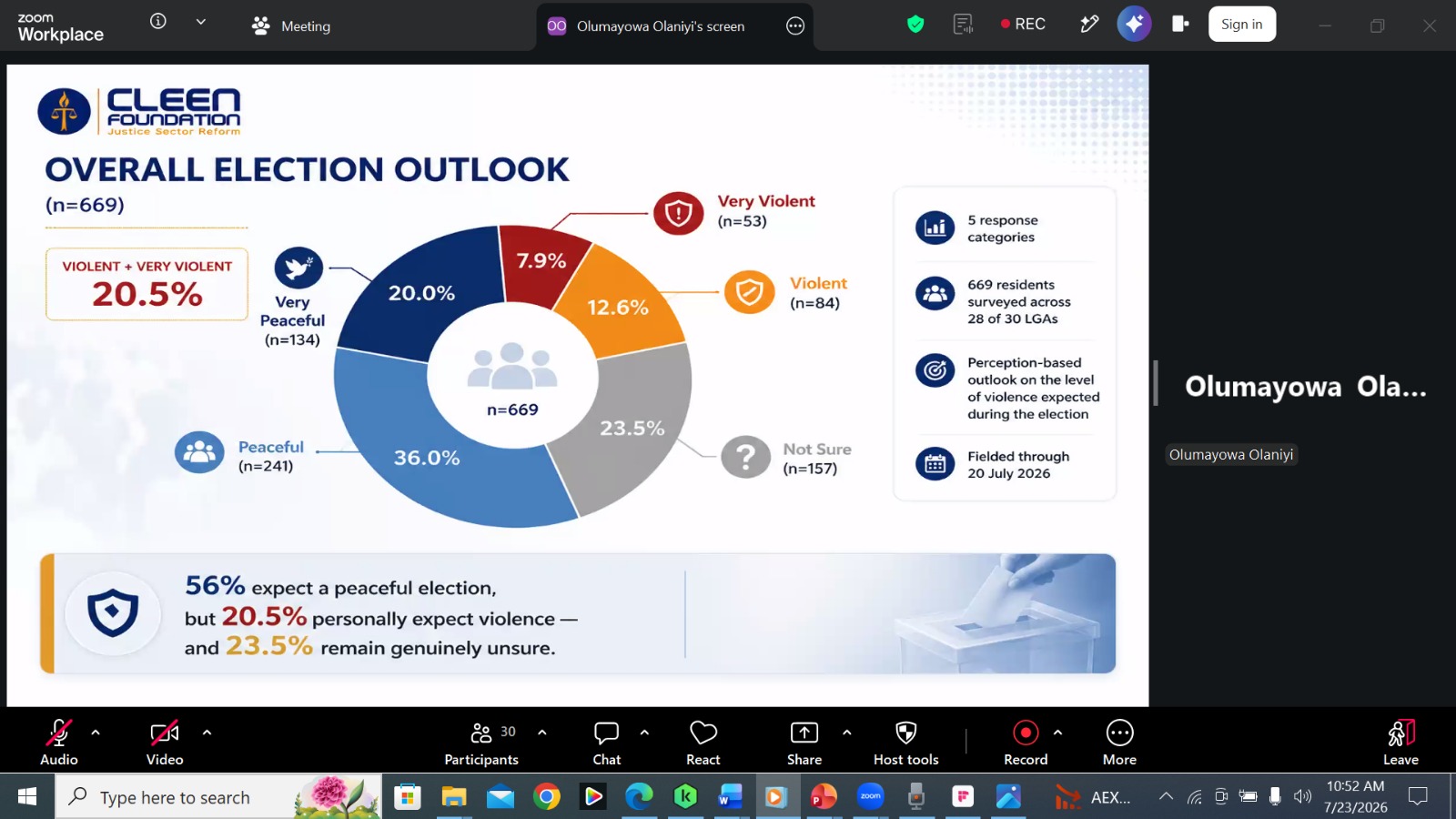
The survey, conducted by ESTA, analysed 669 valid responses from consenting participants across 28 of the state’s 30 Local Government Areas (LGAs), following a data-cleaning process that excluded late submissions and non-consenting respondents.
According to the report, 56 percent of respondents believe the election will be peaceful, with 20 percent describing it as “very peaceful” and 36 percent as “peaceful.” However, 23.5 percent remain uncertain about the outcome, while 20.5 percent expect the election to be violent or very violent.
The findings indicate that respondents are optimistic about the overall conduct of the poll but remain worried about structural risk factors that could trigger violence.
Among the strongest concerns identified were the conduct of security agencies. More than 90 percent of respondents agreed that aggressive or excessive use of force by security personnel could fuel election violence, while 88.8 percent cited perceived partiality by security agencies as a major risk. Poor professionalism, inadequate coordination among security agencies and weak collaboration with election officials also ranked highly.
Political actors were also identified as significant drivers of potential violence. Activities of party thugs topped the political risk indicators, with 88.3 percent of respondents expressing concern, followed by intimidation by party agents (81 percent), godfatherism, defections and weak internal party democracy.
On electoral administration, respondents highlighted fears over the neutrality of election officials, with 89.5 percent expressing concern about possible bias. Technical failures involving the Bimodal Voter Accreditation System (BVAS), inadequate preparedness of election officials and failure to prosecute electoral offenders were also ranked among the highest threats to a credible election.
The survey further found that respondents considered armed non-state actors, including political thugs, as the leading underlying cause of election violence, with 82.5 percent identifying them as a major risk. Youth unemployment, which respondents believe makes young people vulnerable to recruitment as political thugs, followed closely at 80 percent. Drug abuse, cult activities and social exclusion also featured prominently.
Vote buying remains another major concern. While 78.5 percent identified vote buying by candidates and political parties as a risk, an even larger proportion—84.8 percent—believed the failure of security agencies to enforce laws against the practice posed a greater threat to election credibility.
Media-related risks also featured strongly, with respondents identifying hate speech, abuse of social media, fake news and partisan reporting as significant factors capable of escalating tensions during the election period.
The survey identified Osogbo as the LGA most frequently nominated by respondents as a potential election violence hotspot, followed by Ede North, Irewole, Boripe and Ife Central.
However, when only the opinions of residents within each LGA were considered, Atakunmosa West, Irepodun, Egbedore, Ede South and Irewole recorded the highest proportions of respondents expecting violence.
Researchers noted that Irewole and the Ede axis appeared consistently across both statewide and local assessments, suggesting they deserve close monitoring by election stakeholders.
The report also found that nearly one-quarter of respondents who were initially unsure about the election outcome leaned towards optimism when asked directly whether they believed the election would be peaceful. Even so, many of them acknowledged that their communities had experienced electoral violence in the past, suggesting that uncertainty stems more from concern about whether history could repeat itself than from a lack of opinion.
Overall, the survey concludes that while public confidence in a peaceful election remains relatively high, significant concerns over security conduct, political violence, electoral management and misinformation underscore the need for proactive interventions by election management bodies, security agencies, political parties and civil society groups to ensure a credible and peaceful governorship election in Osun State.