“Nigeria Tax Act, 2025 will harmonize fragmented tax laws, reduce compliance burdens…”- RMAFC Chairman
Oru Leonard
Revenue Mobilisation Allocation and Fiscal Commission (RMAFC) Chairman, M.B. Shehu, has emphasized the need for fiscal efficiency and revenue growth under the Nigeria Tax Act, 2025, stating it will harmonize fragmented tax laws, reduce compliance burdens, and create a predictable fiscal environment.
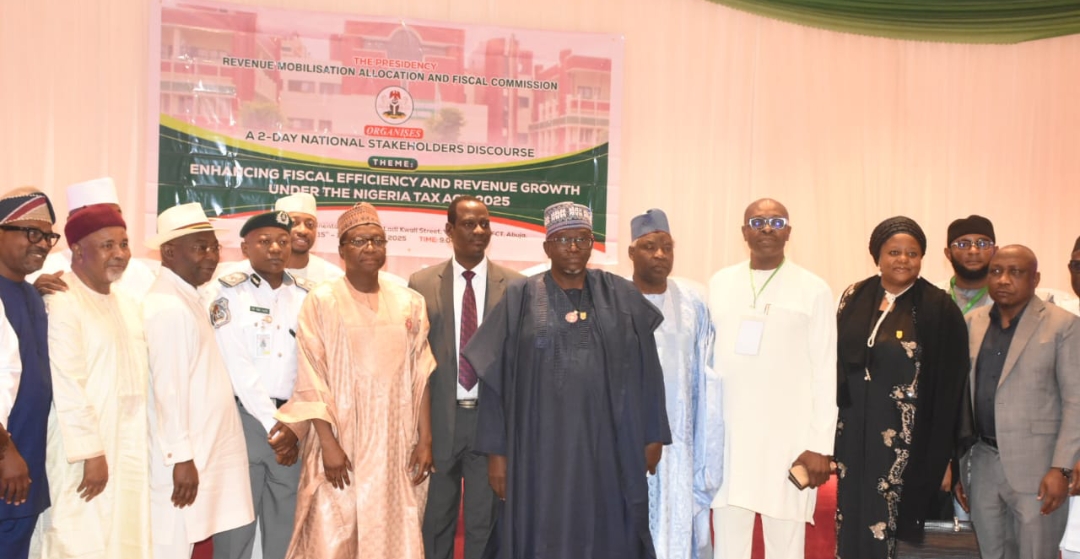
Shehu made this statement at a 2-day National Stakeholders’ Discourse in Abuja, highlighting the Act’s benefits, including eliminating duplication, obsolete provisions, and regional tax administration differences.
According to him, “the Nigeria Tax Act, 2025 has harmonised previously fragmented tax laws, reduced duplication and obsolete provisions, and enhanced the ease of doing business.”
He disclosed that the Commission convened the Discourse in line with its constitutional mandate, stressing that “Paragraph 32(c) of Part I of the Third Schedule of the 1999 Constitution mandates the Commission to advise the Federal, State and Local Governments on fiscal efficiency and methods by which their revenue can be increased.”
Highlighting recent fiscal outcomes, the Chairman noted that, “The growth in Federation Account inflows reflects the impact of fiscal reforms, stronger audits, digital tracking and improved coordination among revenue agencies, which have expanded the revenue pool available for allocation to the three tiers of government.”
In his keynote address, Professor Taiwo Oyedele, Chairman of the Presidential Fiscal Policy and Tax Reforms Committee, described the reform as “long-overdue but necessary,” emphasizing that incremental fixes were no longer sufficient.
While speaking the Nigerian Association of Chambers of Commerce, Industry, Mines and Agriculture (NACCIMA), Engr. (Dr.) Jani Ibrahim, lauded the enactment, emphasizing the importance of a modern, efficient, and equitable tax system for economic growth. NACCIMA has expressed readiness to collaborate with relevant fiscal institutions to support reforms.
The new tax framework is designed to:
– Protect Low-Income Earners: Exempting individuals earning below ₦800,000 annually from personal income tax
– Support Small Businesses: Raising the threshold for small company classification to ₦100 million turnover
– Simplify Tax Laws: Consolidating multiple tax laws into a single legislation
– Enhance Transparency: Implementing digital tax administration and e-invoicing
– Broaden Tax Base: Expanding revenue base across all tiers of government
The reforms aim to create a more predictable environment, restore investor confidence, and translate macro gains into tangible benefits for citizens. Stakeholders, including the Central Bank of Nigeria and Nigeria Customs Service, have expressed support for the reforms, highlighting their potential to promote fiscal stability and equitable taxation.
The Nigeria Tax Act, 2025, is part of President Bola Ahmed Tinubu’s fiscal reforms, aimed at improving revenue collection and allocation to Federal, State, and Local Governments.
Cover Photo Caption, 7th from L: RMAFC Chairman, Dr. Mohammed Bello Shehu OFR, while standing besides him is NACCIMA President, Engr. (Dr.) Jani Ibrahim, FNSE, FAEng., mni, OON, in a group photograph with RMAFC Members and Distinguished guests at the National Discourse.