INEC Seeks National Peace Committee’s Backing to Restore Public Confidence Ahead of 2027 Polls
Oru Leonard
The Independent National Electoral Commission (INEC), has appealed to the National Peace Committee (NPC), and other key stakeholders to intensify efforts at rebuilding public trust and strengthening peaceful participation in Nigeria’s electoral process ahead of the 2027 General Election.
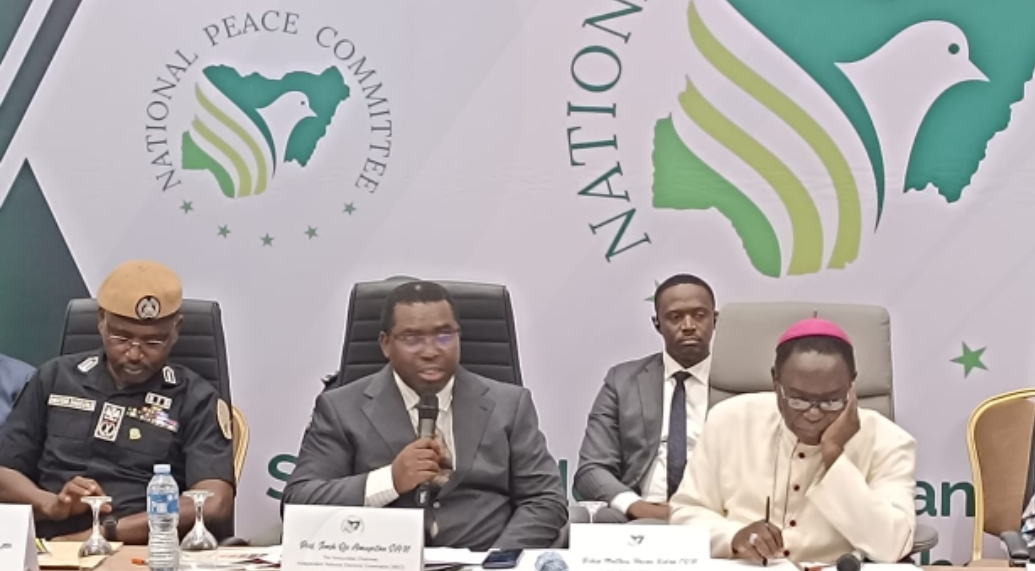
INEC Chairman, Prof. Joash Amupitan, SAN, made the appeal on Monday, March 2, 2026, during the Stakeholder Briefing and Presentation of the Annotated Peace Accord organised by the NPC at the Abuja Continental Hotel.
The high-level engagement brought together leaders of political parties, heads of security agencies, and civil society organisations, underscoring a broad-based commitment to credible and peaceful elections. Former Head of State and Chairman of the Committee, Abdulsalami Abubakar, was represented by the Convener of the Peace Committee, Mathew Hassan Kukah.
In his remarks, Prof. Amupitan stressed the urgency of restoring confidence in the electoral system, describing the prevailing trust deficit as a major concern.
“So for us, we appeal to the National Peace Committee to help us in the area of building trust. The trust deficit is such that anywhere you go, it’s palpable. If voters will not participate, then whoever emerges… it is also in our own interest that everybody continues to participate. We’ll get it right one day,” he said.
He noted that virtually all members of the Commission—except those unavoidably absent—as well as directors and senior management staff were present at the engagement, signaling the seriousness INEC attaches to democratic consolidation.
Prof. Amupitan described Nigeria’s electoral terrain as diverse, complex, and highly competitive, emphasizing that democratic growth must be anchored not only on legality but also legitimacy.
“Let the process be so transparent that whoever emerges will not only have legality but legitimacy,” he stated, adding that the Commission remains open to scrutiny and constructive criticism.
“Constitutionally, INEC is the custodian of Nigerian democracy and elections. Whatever comments are made, we don’t get angry. We take them, process them and see how we can improve,” he added.
Shared Responsibility for Credible Elections
The INEC Chairman emphasized that credible elections cannot rest solely on the Commission. He urged political parties to strengthen internal discipline and voter mobilisation, stressing that sustained civic engagement is vital to reversing declining voter turnout.
He expressed concern over low participation in recent elections, noting that broad-based public confidence is essential for democratic legitimacy.
Prof. Amupitan highlighted steps taken to improve results management and transparency. While withholding specific operational details, he disclosed that additional safeguards have been introduced to ensure consistency and accuracy in results handling, with recent elections serving as testing grounds.
On misinformation, he warned that false narratives during elections undermine public confidence and inflame tensions. He revealed that the Commission collaborates with security agencies and relevant institutions to counter disinformation and ensure accurate reporting of electoral processes.
Addressing electoral offences—particularly vote trading—the INEC Chairman reiterated that such practices remain criminal under Nigerian law and must be dealt with decisively. He called on law enforcement agencies to expedite investigations and pursue prosecution where necessary.
He also disclosed that the Commission is prioritising the sanitisation of the voter register, acknowledging concerns about duplications and outdated records. Ensuring an authentic and credible register, he said, remains foundational to credible elections.
On Ekiti, Osun Governorship Polls Critical to 2027, Prof. Amupitan described them as key milestones on the road to 2027.
He revealed that INEC is considering additional technology testing, including mock exercises in selected polling units, to further strengthen operational preparedness.
The Chairman also appealed for the timely release of election funds in line with amended legal provisions, stressing that early access to resources is critical for procurement, logistics, and comprehensive planning.
In a welcome address delivered on his behalf, General Abdulsalami reaffirmed the Committee’s commitment to providing a neutral platform for dialogue, mediation, and confidence-building. He noted that since 2015, the Peace Accord has served as a stabilising instrument in Nigeria’s electoral process and described the Annotated Peace Accord as a strengthened framework designed to provide clarity, guidance, and preventive engagement among stakeholders.
“The responsibility of safeguarding our democracy rests with all of us,” he stated, calling for sustained collaboration, restraint, and responsible conduct from political actors, institutions, and citizens.
Participation in the stakeholder briefing forms part of Prof. Amupitan’s ongoing engagements aimed at deepening cooperation among electoral stakeholders, reinforcing peaceful conduct, and strengthening public confidence as preparations intensify toward the 2027 General Election.
(INEC Media)