FG Moves to Strengthen Social Work Practice in Nigeria
Oru Leonard
The Federal Government of Nigeria has reaffirmed its commitment to strengthening and professionalising social work practice in Nigeria through the operationalisation of the Nigerian Council for Social Work.
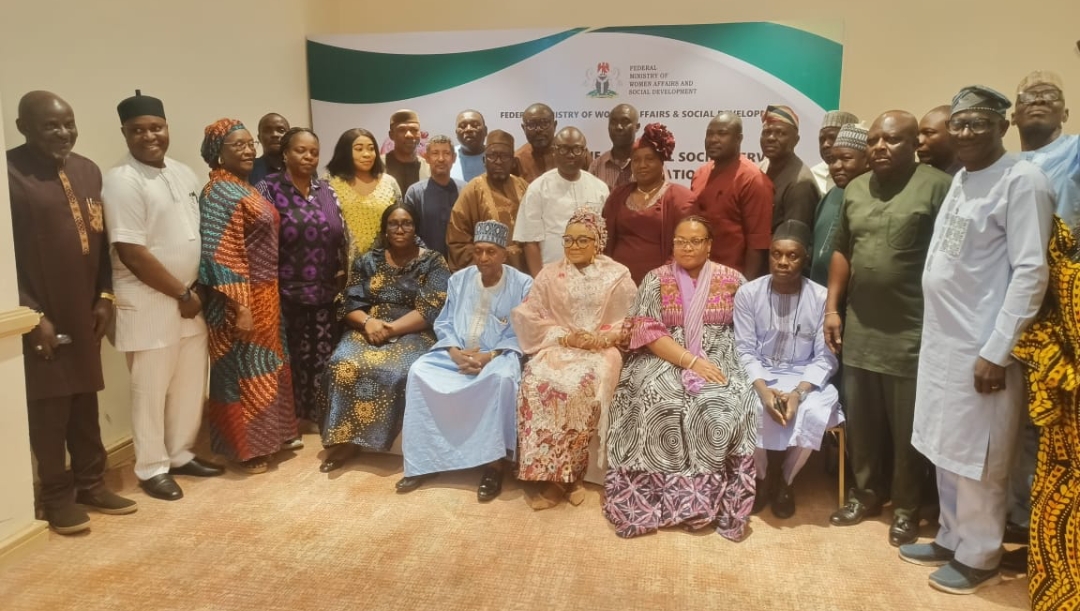
The Minister of Women Affairs and Social Development, Imaan Sulaiman-Ibrahim, gave the assurance during a high-level Strategic Dialogue and National Social Service Workforce Coordination meeting held at the Abuja Continental Hotel.
The meeting brought together key stakeholders from government institutions, development partners, professional associations, academic institutions and civil society organisations to deliberate on the future of social work regulation and service delivery in Nigeria.
Delivering the keynote address, the Minister described the gathering as a defining moment for the future of social work in the country, stressing the need for unity, reconciliation and institutional collaboration to strengthen the profession and improve services for vulnerable groups.
According to her, the meeting was convened because the institutionalisation of social work in Nigeria had become imperative.
“A house divided cannot regulate a profession. If we carry our divisions forward, we risk failing the very people we are meant to serve: the child in need of protection, the woman facing violence, the elderly without care, and persons with disabilities seeking dignity,” she stated.
The Minister noted that the Federal Ministry of Women Affairs and Social Development remains the coordinating institution for social development in Nigeria, adding that the Renewed Hope Agenda of President Bola Ahmed Tinubu places social development at the centre of national transformation.
She said President Tinubu had declared 2026 a year for delivering tangible results to Nigerians, while assuring stakeholders that the Ministry would continue to support the establishment of a unified and professional social work system capable of addressing growing social challenges.
The Minister also pledged the Ministry’s political will to ensure that the Nigerian Council for Social Work is founded on legitimacy, professionalism and trust, urging professional associations and institutions to nominate credible representatives in line with the provisions of the Act.
Speaking on behalf of UNICEF Nigeria, Child Protection Manager, Mona Aika, commended the Ministry for driving the operationalisation process of the Council.
She described the initiative as a major step toward building a strong and accountable social service workforce capable of responding effectively to the needs of vulnerable populations, especially children.
Aika observed that although the Social Work Act was passed in 2022, delays in implementing the framework had continued to create gaps in regulation, standards and service delivery.
“Addressing this gap is not only urgent; it is foundational to strengthening child protection systems and improving outcomes for children and families across Nigeria,” she said.
She added that investment in the social service workforce remains one of the most effective ways to prevent violence against children, strengthen family-based care systems and ensure coordinated social services.
Earlier, the Permanent Secretary of the Ministry, Mrs. Esuabana Nko Asanye, represented by the Director of Gender Affairs, Mr. Adamu Ismaila, said the meeting of the National Social Service Workforce Coordination Group provided a critical platform for collaboration towards establishing a functional and sustainable Nigerian Council for Social Work.
According to her, the Council would serve as a cornerstone for professional regulation, ethical compliance, standard setting and capacity development within the sector.
She called on stakeholders to move beyond policy discussions to actionable steps that would ensure the effective operationalisation of the Council and the fulfilment of its statutory mandate.
The two-day strategic engagement is expected to produce actionable recommendations aimed at accelerating the establishment of the Nigerian Council for Social Work and strengthening institutional frameworks for the protection and welfare of vulnerable persons nationwide.
Also speaking at the event, Deputy Director of the Gender Affairs Department and focal person for the Nigerian Council for Social Work, Okesa Benjamin Obiajulu, highlighted the efforts made by the Ministry and stakeholders toward achieving a legal framework for the professionalisation of social work practice in Nigeria.