CHRISTOPHER MUSA’S SECOND CHANCE
Nick Dazang
General Christopher Musa’s spell-binding story must rank as the classical case of “the stone which the builders rejected has become the chief corner stone”.
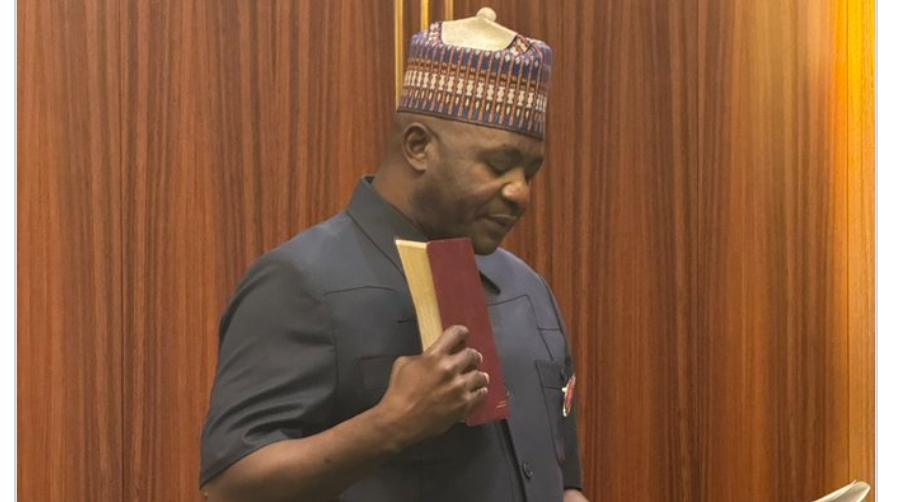
Consider: In a notable game of musical chairs, and chairs for the music, General Christopher Musa, as Chief of Defense Staff(CDS), as he then was, was removed with others, to “strengthen the national security architecture”. Barely six weeks after, the President, Chief Bola Ahmed Tinubu, made a intriguing about face: He appointed General Musa as the country’s Minister of Defence.
Between his ouster and his return, four pivotal events occurred: Nigeria was designated a Country of Particular Concern(CPC) by the United States; President Donald Trump, on two occasions, alleged genocide of Christians in Nigeria; pressure was brought to bear, chiefly by the American government, on Nigeria to address its worsening insecurity and wanton killings by terrorists; and there was an escalation of insecurity as hall marked by an uptick of abductions and acts of terror across the country.
One or two of these events, that unfolded, pell-mell, must have occasioned the return of General Musa to the commanding heights of the country’s security ecosystem. And contrary to the government’s claim that General Musa’s prior removal was informed by the need to strengthen the country’s security architecture, it must have been inspired by differences in strategy in the on-going war on terror. This came out in stark relief in the course of the screening that preceded General Musa’s swearing-in as Minister of Defense. His refrain, during the screening, was that the government must not negotiate with bandits – a refrain which did not, and is likely not to, sit well with the thoughts of some members of the security establishment.
Assuming General Musa was previously ousted as CDS because he held stoutly to this view, which was at odds with the strategy of some members of our security architecture, would its members now bend over and make common cause with his resolve not to negotiate with terrorists? Would his advent as Defense Minister not cast him as setting the cat among the pigeons? To what extent do constituents of the security architecture – including the Commander-in-Chief at its apex – share in his vision and mission? Would their ships sail in the same direction?
Apart from building a cohesive and coherent team, and at short notice, how does General Musa intend to proceed with the war on terror? Does he intend to go on with the tokenism witnessed in the past or plunge headlong? Does he intend to search, dismantle and destroy the terrorists? Does he intend to identify their enclaves and then take the war to them? Does he intend to go on a surge of boots on the ground? How does he intend to optimize and deploy the resources in the Services, and with immediate impact? How does he intend to leverage technology and critical intelligence outside the domicile of our Services?
In addition to the aforementioned, Nigerians must ask themselves two compelling questions: Could it be that General Musa is merely being brought back to serve as some window dressing and to appease the Americans who are reportedly “breathing down the neck” of the Nigerian leadership? Could it be that arising from this, General Musa is being set up to fail?
These questions are crucially important given the fact that in spite of our dire security straits the President’s overarching quest to get re-elected in 2027 continues apace. Bar a number of presidential orders and the shutting down of schools, we do not see a serious or laser focused attention being paid on heightened insecurity. Yet this heightened insecurity threatens to up-end the country as we know it.
There is no doubt about it that General Musa comes to the job with the right professional bonafides, exposure and tremendous goodwill from Nigerians. Rarely has one been prepared to pull the chestnut out of the fire or to carry out a salvage operation. Rarely, too, has fate generously dealt one a second chance to prove his mettle.
The Defense Minister should view his appointment as a propitious opportunity to make our Armed Forces right with Nigerians by winning the war on terror. That way, he will etch himself in the hearts of Nigerians and his professional colleagues who have put their faith in his ability and leadership.
To accomplish his mission, he will do well to learn lessons from his previous watch as CDS. He will need to persuade his colleagues in the security ecosystem to subscribe to his vision and strategies. He will need to be measured and sparing in his pronouncements.
On his watch as CDS, he famously declared that one of the terrorists, Bello Turji, was a dead man walking. Turji not only outlived him as CDS, he exacts and collects suffocating taxes from the helpless citizens of Zamfara State. General Musa too had a penchant for being boorish and speaking down at his betters – Generals who served this country with distinction and when he was probably in diapers.
Beyond this, for General Musa to succeed, he will need the unwavering support of his Commander-in-Chief and the Legislative Branch. Unless, of course, General Musa is being presented merely as a veneer with which to ingratiate with certain interests, the President must delegate to him some of his martial powers. By the same token, the Legislative Branch, working with the Executive, must make resources available to the Defense Minister. They must make laws that do not spare perpetrators of terror and those who enable and abet them.
Thankfully, from his pronouncements during the Senate screening, General Musa appears to have informed himself of this sobering reality.