ABUJA Hosts ITF World Tennis Tour J30 Amid Sponsorship and Infrastructure Challenges
Oru Leonard
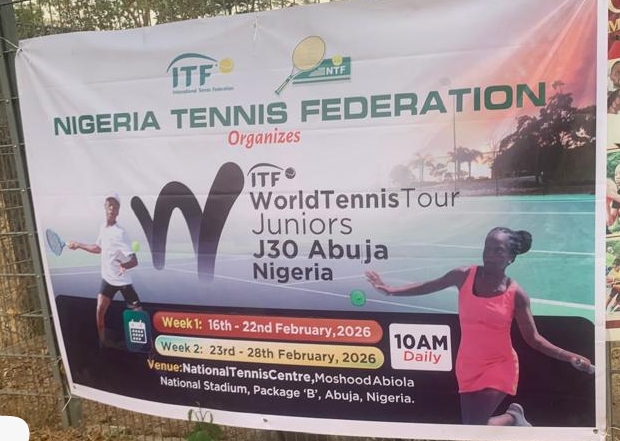
The vibrant city of Abuja is currently playing host to the prestigious ITF World Tennis Tour J30 tournament at the Package B of the Moshood Abiola National Stadium, drawing young tennis talents from across the globe despite notable sponsorship and infrastructure challenges.
The much-anticipated tournament, which commenced on February 18, has entered its second week, with participation from 17 countries. In its opening week, 18 countries were represented, underscoring the global appeal of the competition and the sport of tennis.
Players from the United States, Egypt, India, Morocco, Portugal, Cameroon, Switzerland, Great Britain, Hong Kong, Ghana, Lebanon, Chinese Taipei, Czech Republic, and several other nations have converged on Nigeria’s capital to compete for valuable international ranking points under the ITF World Tennis Tour Junior Circuit (J30 category).
Speaking on the tournament, the Technical Director of the Nigeria Tennis Federation (NTF), Mr. Saidu Musa, expressed satisfaction with the turnout, particularly in light of prevailing economic and logistical constraints.
However, participation slightly declined in the second week due to the $70 weekly registration fee—equivalent to approximately ₦90,000 to ₦94,000. This financial obligation has posed challenges for many players, especially those from less affluent backgrounds.
In a bid to encourage greater local participation, the NTF reduced the entry fee for Nigerian players to $45 per week. While this concession enabled more local athletes to compete and earn international ranking points, many young Nigerian players and their families continue to grapple with the financial demands of the sport.
Additionally, the mandatory $70 annual International Player Identification Number (IPIN) fee remains a prerequisite for participation in any ITF-sanctioned event, further compounding the financial strain.
The tournament also encountered operational challenges on February 21 due to movement restrictions within the city, which led to temporary match disruptions and rescheduling. Nevertheless, tournament organisers demonstrated resilience and adaptability, ensuring the smooth continuation of the competition.
Infrastructure limitations, particularly inconsistent power supply at the stadium complex, have necessitated reliance on generators, thereby increasing operational costs.
“We are also dealing with power supply issues at the stadium. We have to rely on generators, and that increases our expenses significantly,” Musa stated.
He further noted that the NTF is currently the sole sponsor of the tournament, covering transportation, accommodation, water supply, and officials’ allowances—an undertaking that has proven financially demanding.
A total of 46 players from 18 countries featured in the main draw during the first week, while 49 players from 17 countries are competing in the ongoing second week. This participation reflects the tournament’s growing international profile and reinforces the urgent need for sustained sponsorship and corporate support to nurture emerging Nigerian talents.
Musa appealed to individuals and corporate organisations to support young Nigerian players competing in the ITF World Tennis Tour J30 Abuja, emphasizing that such assistance would significantly contribute to the development of grassroots tennis and help promising athletes realise their dreams.
Despite the financial and infrastructural hurdles, the tournament continues to showcase exceptional talent, resilience, and sportsmanship, further positioning Abuja as a growing hub for international junior tennis competitions.
(NSC Media)