Power Minister Inaugurates Four New TCN Transformers in Bauchi, Targets 75,600 Households
Oru Leonard
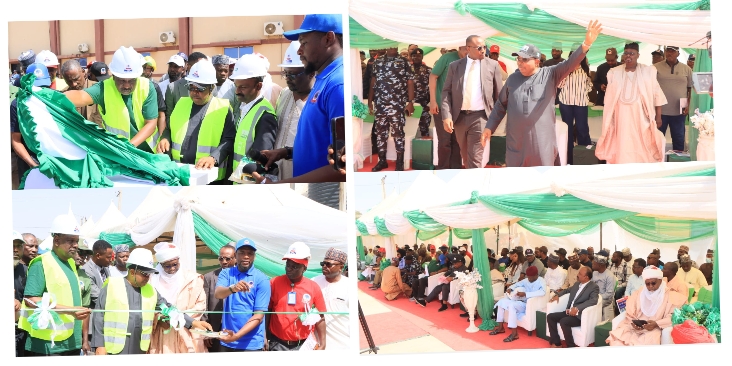
The Minister of Power, Joseph Tegbe, has inaugurated four newly installed transformers at the Bauchi Transmission Substation in Bauchi State, as part of efforts to strengthen electricity supply, improve grid stability and expand transmission capacity in the region.
The project, which also involved the upgrade of the facility to a 330/132/33kV transmission substation, is expected to improve bulk electricity supply and benefit an estimated 75,600 additional households across Bauchi and neighbouring communities.
The inauguration ceremony attracted electricity consumers, community leaders and other stakeholders who witnessed the commissioning of the upgraded infrastructure.
Speaking at the event, Tegbe explained that the intervention was necessary to address growing electricity demand and inadequate transmission capacity at the facility.
According to him, the substation was originally a 132/33kV facility with an installed capacity of 112.5MVA, comprising 22.5MVA, 30MVA and 60MVA transformers.
He noted that increasing electricity demand had overwhelmed the existing capacity, resulting in significant suppressed load.
The Minister disclosed that the upgrade involved the installation of two 150MVA, 330/132kV transformers, providing an upstream transformation capacity of 300MVA.
He added that the existing 22.5MVA and 30MVA transformers had been replaced with two 60MVA units, while the existing 60MVA transformer was retained, bringing the downstream transformation capacity to 180MVA.
Tegbe said the investments would improve operational flexibility, strengthen the transmission network and provide a more reliable platform for electricity delivery to communities in the Bauchi subregion.
He stressed that the Federal Government was strengthening transmission infrastructure across the country, particularly along economic corridors where businesses and other productive activities depend on reliable electricity.
The Minister also emphasised the need to align investments across electricity generation, transmission and distribution to ensure that infrastructure development translates into measurable economic and social benefits.
He, however, called on community leaders and residents to protect electricity infrastructure against vandalism and other forms of sabotage.
“I make a direct appeal: help us keep this facility safe. The cost of vandalism is felt in interrupted trade, lost working hours and disrupted family life. Public infrastructure serves all of us, and its protection requires the vigilance of all of us,” he said.
Earlier, the Managing Director and Chief Executive Officer of the Transmission Company of Nigeria (TCN), Engr. Sule Abdulaziz, said the project had strengthened bulk power supply to the Jos Electricity Distribution Company (JEDC) by providing additional capacity at the transmission-distribution interface.
He explained that the improved infrastructure would support electricity distribution to Ningi, Dass, Bauchi GRA, Yankari, Nabordo, Dabo Farm and Gubi, subject to available electricity generation and downstream network capacity.
Abdulaziz disclosed that the project was awarded in January 2021 and completed in June 2026.
He said it was executed by a joint venture of MBH Power Limited and Shreem Electric Limited, with funding support from the World Bank.
The TCN boss acknowledged the contributions of the World Bank, project contractors, consultants and TCN engineers towards the successful completion of the project.
While describing the commissioning as a significant milestone, Abdulaziz stressed that the company’s responsibility extended beyond infrastructure delivery to ensuring proper operation, maintenance and management of the facilities.
He reaffirmed TCN’s commitment to expanding and reinforcing the national transmission network through strategic infrastructure investments, improved operational practices and measures to reduce transmission constraints.
He added that the Bauchi substation upgrade represented another step in the company’s ongoing efforts to improve the capacity and efficiency of Nigeria’s electricity transmission system.