IMPI: Nigeria Squandered Oil Boom Gains Between 1999 and 2015, Records Structural Economic Turnaround Under Recent Reforms
Oru Leonard
The Independent Media and Policy Initiative (IMPI) has criticised successive Nigerian administrations between 1999 and 2015 for failing to convert the country’s oil windfall into sustainable economic development, while highlighting what it described as a structural economic turnaround driven by reforms introduced from 2023.
The organisation made this assessment in its Policy Statement 046, which examined Nigeria’s foreign investment dynamics, trade balances and fiscal management between 1999 and 2026.
The statement, signed by IMPI Chairman, Dr Omoniyi Akinsiju, compared what it described as a consumption-driven, commodity-dependent economic model between 1999 and 2015 with the structural realignment and market-oriented reforms pursued between 2015 and 2026.
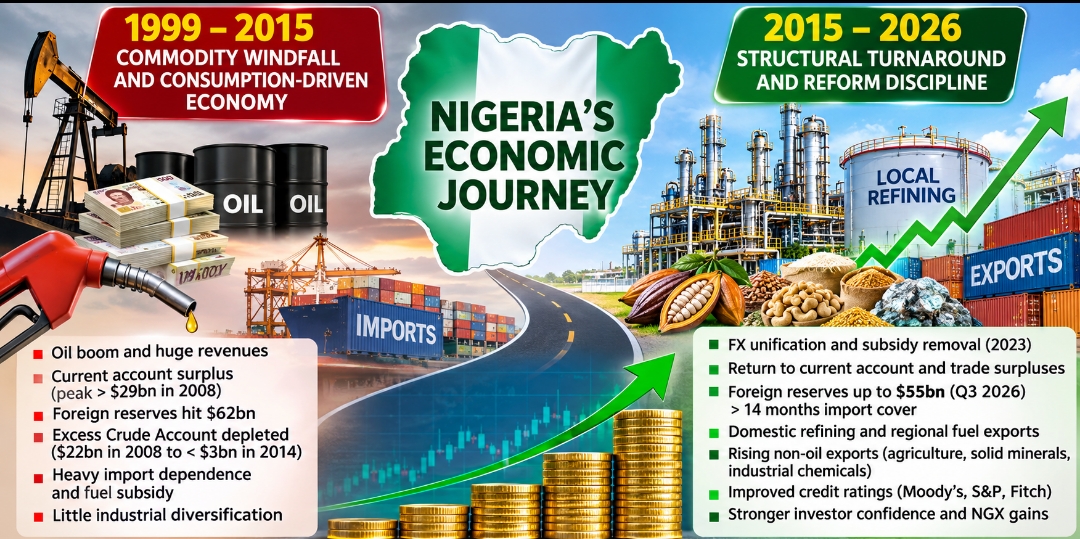
According to IMPI, Nigeria experienced significant economic gains during the global commodity boom between 2000 and 2014, recording substantial current account surpluses that peaked at over $29 billion in 2008, while foreign reserves rose to an unprecedented $62 billion.
However, the organisation argued that successive governments failed to transform the enormous oil revenues into sustainable industrial development, infrastructure and diversified non-oil economic activities.
It noted that much of the surplus was channelled into short-term consumption, debt repayment and funding arrangements that lacked adequate institutional protection.
IMPI particularly cited the Excess Crude Account (ECA), which reportedly accumulated $22 billion in 2008 but declined to less than $3 billion by 2014 following repeated withdrawals.
The organisation observed that the depletion of the account significantly weakened Nigeria’s capacity to withstand external economic shocks, as much of the funds went into recurrent government expenditure rather than productive infrastructure.
It also faulted the foreign exchange management policy of the period, arguing that the Central Bank of Nigeria (CBN) used foreign exchange earnings to sustain an artificial naira exchange rate, encourage cheap imports and finance imported refined petroleum products despite the poor condition of domestic refineries.
According to the policy statement, the collapse in global oil prices in late 2014 exposed these weaknesses, pushing Nigeria into a currency crisis and recession in 2016, alongside a significant increase in poverty levels.
The organisation further noted that Nigeria subsequently experienced persistent current account deficits, which reached approximately $17 billion in 2019 and $15.8 billion in 2020.
However, IMPI argued that the economic policy direction changed significantly in 2023 under President Bola Ahmed Tinubu’s administration, with the introduction of foreign exchange market reforms and the removal of petrol subsidies.
Although the reforms initially triggered inflationary pressures and significant currency depreciation, the organisation maintained that they helped reposition Nigeria’s external accounts and improve its capacity to withstand economic shocks.
It stated that Nigeria had moved from recurring external deficits to sustained current account and merchandise trade surpluses.
IMPI also reported that the country’s gross foreign reserves increased from $45 billion to $55 billion by the third quarter of 2026, providing more than 14 months of import cover.
“The current policy regime has taken the harder, necessary path—dismantling unsustainable subsidies and market distortions to build a self-sustaining economy backed by real productivity and robust external buffers,” the organisation stated.
Highlighting other indicators of economic recovery, IMPI identified increased domestic refining capacity as a major development, noting that Nigeria had transitioned from being a net importer of refined petroleum products to supplying refined products to markets across West Africa.
It also pointed to significant growth in non-oil exports, particularly agricultural produce, solid minerals and industrial chemicals.
The policy statement further cited improved sovereign credit ratings and outlooks by international rating agencies, including Moody’s, Standard & Poor’s and Fitch, as evidence of improving investor confidence and the potential for reduced international borrowing costs.
It added that the improved economic outlook had contributed to significant capital gains on the Nigerian Exchange (NGX).
IMPI maintained that Nigeria’s economic experience over the past two decades demonstrated the dangers of depending excessively on commodity revenues without building strong institutions, productive capacity and sustainable fiscal buffers.
The organisation argued that the ongoing reforms, despite their immediate economic and social costs, represented a necessary departure from the consumption-driven model of the past towards a more productive and market-oriented economy.
Source: IMPI