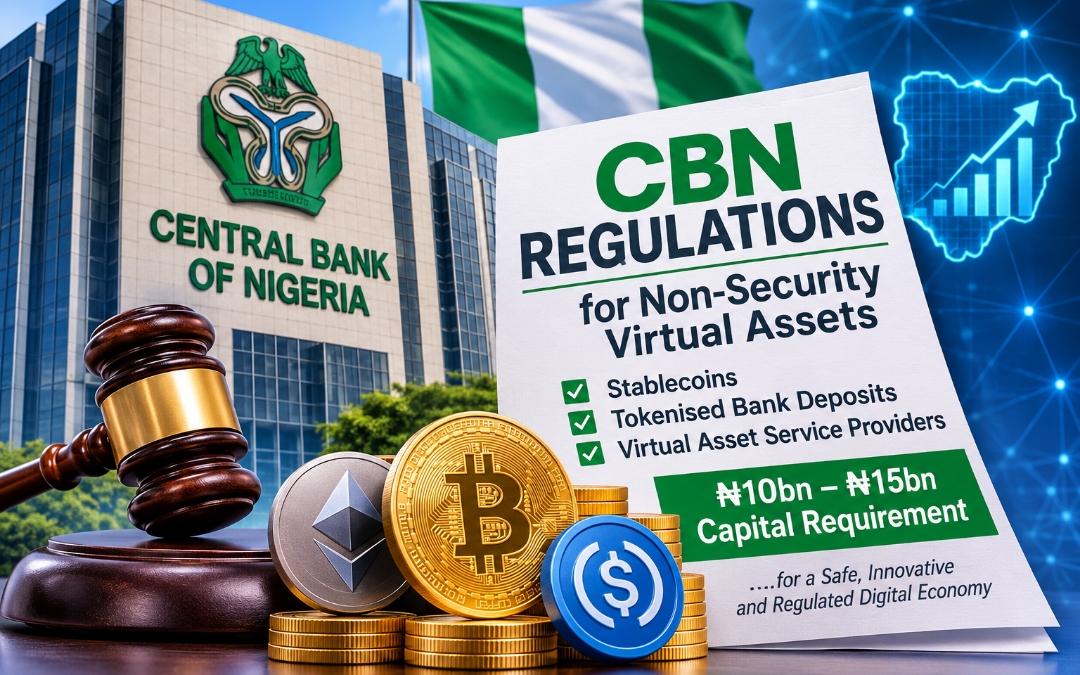
CBN Introduces New Licensing Rules for Stablecoin Operators, Sets ₦15bn Capital Requirement
Oru Leonard
The Central Bank of Nigeria (CBN) has introduced a new regulatory framework governing non-security virtual assets, establishing licensing and operational requirements for stablecoin issuers, digital asset service providers and other businesses operating in the sector.
The regulations, which came into effect on November 5, 2026, provide a formal regulatory structure for stablecoins, tokenised bank deposits and virtual asset services, including transactions involving payments, transfers, exchanges and settlements.
Under the new framework, companies seeking to issue naira-backed stablecoins must maintain a minimum paid-up capital of ₦10 billion, while issuers of foreign currency-referenced stablecoins are required to have at least ₦15 billion.
Other providers of non-security virtual asset services are required to maintain a minimum paid-up capital of ₦1 billion.
The apex bank also prohibited algorithmic stablecoins and those backed primarily by other virtual assets, insisting that approved stablecoins must be fully supported by eligible reserve assets.
It further stipulated that stablecoin holders must have legally enforceable rights to redeem their tokens at par value, while issuers must maintain sufficient reserves to match or exceed the value of tokens in circulation and comply with prescribed liquidity and reporting obligations.
The framework categorises stablecoins into two groups: naira-referenced and foreign-currency-referenced stablecoins.
It also provides that foreign currency-backed stablecoins can only operate in Nigeria through locally incorporated companies with valid CBN licences and token approval, subject to existing foreign exchange regulations.
In another significant provision, the CBN has authorised licensed Deposit Money Banks to issue Deposit Money Tokens (DMTs), representing existing naira-denominated bank deposits.
However, banks must obtain prior approval from the apex bank before issuing such tokens.
The new regulations also accommodate platform-based peer-to-peer virtual asset transactions, provided operators secure specific CBN approval and comply with customer identification, anti-money laundering, sanctions screening, transaction monitoring and reporting requirements.
According to the CBN, the framework is designed to encourage financial innovation while protecting the stability of the financial system, safeguarding consumers, strengthening payment infrastructure and ensuring effective foreign exchange management.
It is also expected to reinforce Nigeria’s compliance with anti-money laundering and counter-terrorism financing standards.
The framework further defines the regulatory boundaries between the CBN and the Securities and Exchange Commission (SEC) in overseeing activities within the digital asset ecosystem.
While the CBN will supervise non-security virtual assets used for payments, settlements and value transfers, the SEC will retain regulatory authority over security tokens and virtual assets classified as investment products or securities.
The development marks a significant step in Nigeria’s efforts to establish clearer regulatory oversight of the expanding virtual asset market while creating a framework for responsible innovation and financial sector stability.