NPERA UNVEILED: Oyetola Moves to Strengthen Port Regulation, Accelerate Maritime Sector Reforms
Oru Leonard
The Federal Government has intensified efforts to reform Nigeria’s maritime sector, with the unveiling of the Nigeria Ports Economic Regulatory Agency (NPERA) Act, 2026, marking a significant step towards transparent port regulation, improved service delivery and increased investor confidence.
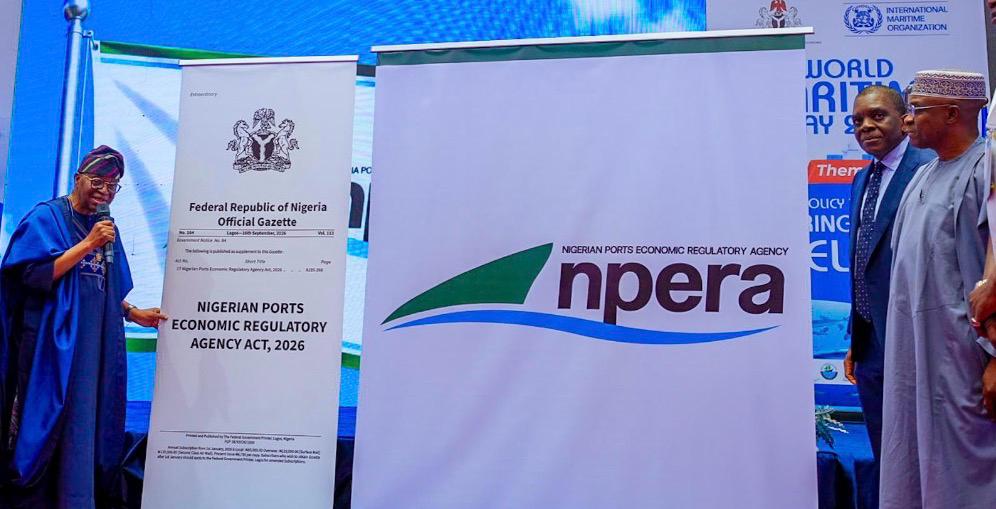
The Minister of Marine and Blue Economy, Dr Adegboyega Oyetola, unveiled the newly gazetted Act alongside the agency’s official logo during the Third Quarter 2026 Citizens’ and Stakeholders’ Engagement of the Federal Ministry of Marine and Blue Economy in Victoria Island, Lagos.
The development signals a new phase in the government’s drive to establish a stronger regulatory framework for the nation’s ports, promote fair competition and create a more attractive environment for maritime investment.
Oyetola said the Act, which received President Bola Ahmed Tinubu’s assent in June 2026, provides a statutory foundation for port economic regulation following nearly two decades of efforts to institutionalise the function.
As part of the transition, the minister disclosed that he had directed the immediate constitution of a ministerial committee to oversee the transfer of responsibilities from the Nigerian Shippers’ Council, which has operated as the interim port economic regulator since 2014, to the newly established agency.
Under its mandate, NPERA will regulate port tariffs and charges, promote competition, enforce service standards, resolve commercial disputes and safeguard the interests of port users.
The minister stressed that the effectiveness of the agency would depend on its independence, impartiality and ability to discharge its responsibilities without conflicts of interest.
He therefore charged the regulator to operate as an impartial institution capable of ensuring fairness, accountability and confidence among port operators, investors, shipping companies and other stakeholders.
Beyond regulatory reforms, the Federal Government is pursuing an extensive port modernisation programme aimed at improving infrastructure, strengthening operational efficiency and expanding Nigeria’s capacity to compete in regional and international maritime trade.
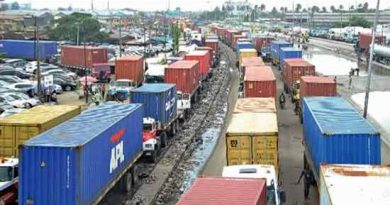
Oyetola identified Apapa, Tin Can Island, Onne, Rivers, Delta and Calabar ports among the facilities targeted for modernisation, assuring stakeholders that the programme would promote balanced development across the country’s maritime corridors.
He emphasised that ports outside Lagos would receive attention, noting that their development was critical to expanding economic opportunities, facilitating trade and promoting regional development.
The minister also disclosed that the Federal Government had approved the development of the Ibom, Bakassi, Agge, Gateway, Ondo and Bonny Deep Seaports.
The proposed projects are expected to expand port capacity, create new investment opportunities and strengthen Nigeria’s ambition to become a major logistics and maritime hub in West and Central Africa.
Oyetola also highlighted improvements in maritime security, attributing Nigeria’s record of zero piracy incidents in its territorial waters to interventions under the Deep Blue Project.
He described the lifting of the United States Coast Guard’s 12-year Condition of Entry restrictions on vessels arriving from Nigeria in August 2026 as an important achievement for the country’s maritime industry.
According to him, the development reflects progress in maritime security and compliance with the International Ship and Port Facility Security Code.
Improved security and regulatory compliance are expected to strengthen confidence among international shipping operators and support the country’s efforts to attract greater maritime traffic and investment.
Government Moves to Support Indigenous Shipping
The minister reaffirmed the Federal Government’s commitment to strengthening indigenous shipping capacity, particularly through improved access to financing for qualified Nigerian shipowners.
He disclosed that he had directed the Nigerian Maritime Administration and Safety Agency (NIMASA) to collaborate with approved Primary Lending Institutions to accelerate the processing and disbursement of the Cabotage Vessel Financing Fund (CVFF) to eligible applicants.
The fund is intended to support the development of indigenous vessel ownership and enhance Nigerian participation in domestic shipping operations.
Effective implementation could help address financing challenges facing local operators, strengthen the domestic shipping industry and reduce dependence on foreign-owned vessels.
The minister further underscored the importance of international cooperation in advancing Nigeria’s marine and blue economy, citing the country’s election to Category C of the International Maritime Organization (IMO) Council in November 2025.
He identified ongoing engagements with Denmark, India, Norway and the United Kingdom as part of Nigeria’s efforts to promote investment, technology transfer, knowledge exchange and sustainable maritime development.
The engagement, themed “Building Strategic Bilateral Partnerships for Sustainable Growth, Investment, and Technology of Nigeria’s Marine and Blue Economy,” brought together government officials, industry leaders, development partners and other stakeholders.
A key highlight was a presentation by Denmark’s Ambassador to Nigeria, Jens Ole Bach Hansen, on “Denmark’s Experience in Building a Sustainable Blue Economy: Lessons for Strategic Partnerships, Investment and Technology Transfer with Nigeria.”
The presentation provided an opportunity to explore how international experience and cooperation could support Nigeria’s ambitions in sustainable maritime development.
Oyetola maintained that Nigeria’s international partnerships must produce tangible benefits, particularly in building local capacity, attracting investment and delivering sustainable economic outcomes.
With the establishment of NPERA, plans for port modernisation, renewed attention to indigenous shipping and deeper international partnerships, the Federal Government is positioning regulatory reform as a critical component of efforts to unlock the economic potential of Nigeria’s marine and blue economy.