Public accountability: Finally, the Senate vindicates SEDC
By Emmanuel Nzomiwu
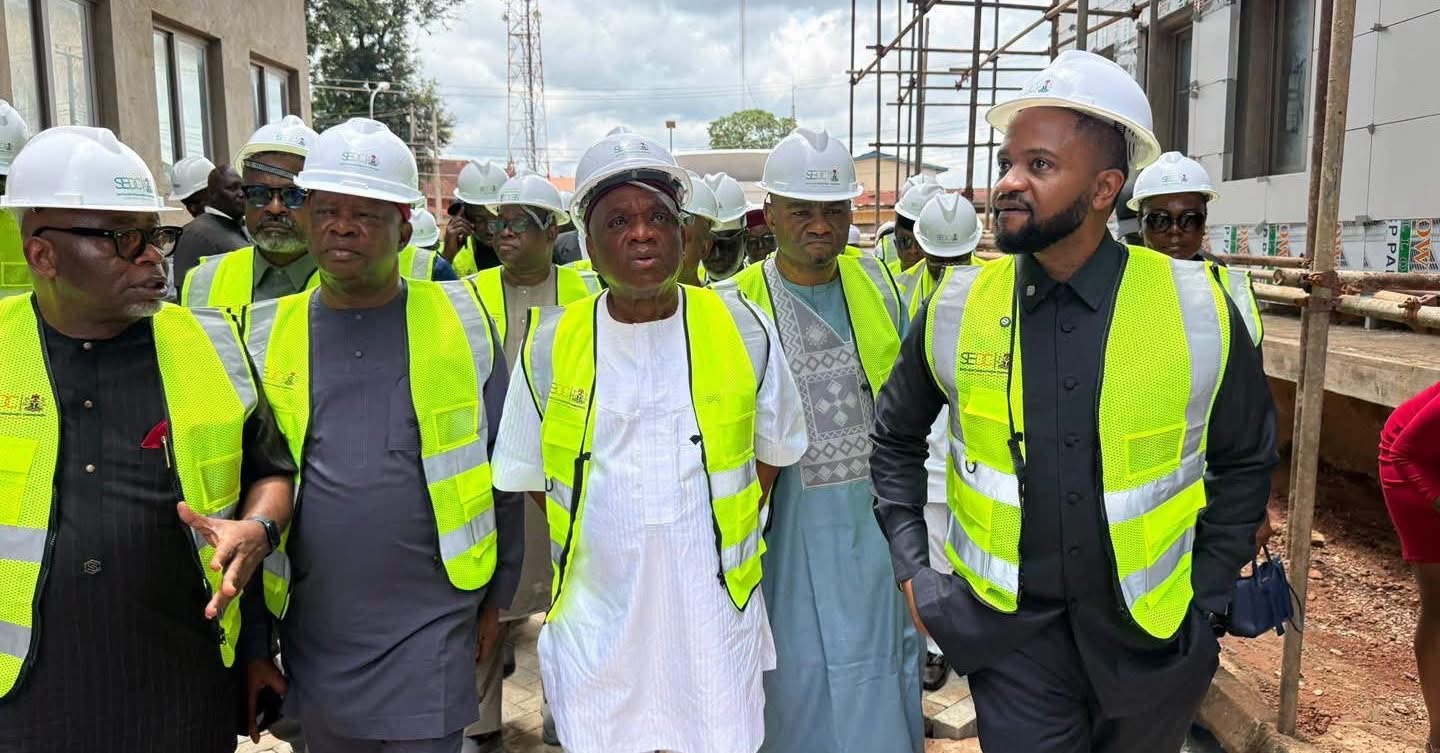
On Monday, October 12, 2026, Senator Orji Uzor Kalu led the Senate Committee on the South East Development Commission (SEDC) on an oversight visit to inspect the ongoing construction of the commission’s headquarters in Enugu. After the inspection, Senator Kalu who is the Chairman of the Committee, delightfully posted a terse message on his official Facebook account.
Quoting him: As the Chairman of the Senate Committee on the South East Development Committee (SEDC), I led members of the committee on an oversight visit to inspect the ongoing construction of the commission’s headquarters in Enugu, Enugu State.
“I am impressed with the level of work and progress recorded so far on the project. I commend the leadership of the commission for its commitment and efforts towards ensuring the successful execution of this important project.
“We will continue to provide necessary legislative oversight and support to ensure that the commission deliver’s on its mandate for the development of the South East geo-political zone.”
What makes this message posted by the Senator representing Abia North senatorial district remarkable? In June this year, the same Senate Committee led by Kalu announced a probe of alleged accountability issues in SEDC. Let me not go into the details because it may not be of much use any longer.
What matters today is that SEDC has been vindicated by no less a person than Senator Kalu himself. The confession of the former Abia State Governor on Facebook is significant for two reasons. One, it speaks volumes about the high level of accountability in the commission. Secondly, it is an indication that the management of the commission led by Mark Okoye (jnr.) has been very prudent in the utilisation of resources.
The commission did not award a new contract for the completion of its permanent headquarters donated by the Enugu State Government. Rather, it brought back the original contractor that handled the four-storey building to do an assessment of what it would cost to make the building ready for use.
Based on the assessment done by the contractor, the Management decided to fund the completion of the headquarters from federal government disbursements to the commission. As of the time of writing this article, the building is nearing completion. The management has been doing everything possible to conserve the resources of the commission.
Prior to now, SEDC had received series of endorsements for its planned, systematic, purpose-driven and result-oriented approach to regional development. Many stakeholders, including the South East Governors and the Federal Ministry of Regional Development, have commended the 25-year roadmap of the commission.
The strategic objectives of the roadmap include collaboration with state governments, private sector, development partners and development finance institutions, among others, to pursue transformative high-impact projects in different sectors for catalyzing regional development. The commission’s target is to achieve a $200 billion economy for the South East by 2035, leveraging on key sectors, such as agriculture, agro-business, infrastructure, energy, technology and creative economy.
The initiatives of the commission align with the priority areas of the Renewed Hope Agenda of President Bola Ahmed Tinubu, which includes strengthening national security, boosting agriculture, diversification of the economy through industrialisation and unlocking natural resources. The Minister of Regional Development, Abubakar Momoh has severally recommended SEDC’s coordinated approach, strategic planning and partnerships as the blueprint for transforming other geo-political zones in the country.
Beyond rhetoric, the efforts of the commission have started yielding tangible fruits across the South East region. On September 22, 2026, the commission took a giant stride towards restoring Eastern Nigeria’s agro-economy with the flag-off of a 200 hectare pilot integrated model farm at Nomeh Unateze in Nkanu East Local Government Area of Enugu State.
The agro-development programme aims at boosting agricultural productivity, strengthening food security and stimulating agro-industrialisation. The flag-off in Enugu State marks the roll out of the programme across the South East. This historic achievement is seen as a giant stride towards restoring the lost glory of Eastern Nigeria.
The project is part of the South East Agro-Development Programme (SEADP) of the SEDC. The agro-development programme is a major component of the 25-year roadmap of the commission to transform the South East through investments, public-private sector partnership and innovative financing.
The programme is the first regional, multi-state, commission-led integrated agro-development programme in Nigeria since the end of the Nigerian civil war in 1970. Until setback of the civil war, the Eastern Region under Okpara ranked among the fastest growing economies in the world. Okpara leveraged on the abundant agricultural potential of Eastern Region to accelerate economic growth in the region in the 1950s and early 60s. The defunct Eastern region covered the current states of South East and South South Nigeria.
Speaking at the flag-off of the pilot integrated farm at Nomeh Unateze, the Executive Director, Natural Resources, Agriculture and Rural Development (NRARD), Dr. Cliff Ogbede reiterated the commitment of the commission towards reviving the agro-industrial revolution that once placed the Eastern Region among the fastest growing economies in the world between 1954 and 1966. According to Ogbede, the facilitator of the programme, at the conception stage the commission retrieved Okpara’s blueprint from the archives, cleaned it up and brought experts to bring the document up to date, before projecting into the future.
Besides Agriculture, SEDC is also set to roll out community social impact programmes targeting rural communities in the South East. The commission has commenced sensitization and awareness campaigns across the South East for the social impact programmes, to identify areas where the intervention will have the greatest impact.
One of the campaigns took place at Ngbo, Ohaukwu Local Government of Ebonyi State recently. The participants included traditional rulers, town union executives, religious leaders and other stakeholders across the South East. The programmes are going to be rolled out under Renewed Hope Community Advancement Programme (REHCAP).
To conclude, the vindication of SEDC by the Senate Committee is a welcome development. The commission needs all the necessary political support it can muster, to achieve its mission of correcting decades of infrastructure decay, economic marginalisation and environmental degradation in the South-East region.
Nzomiwu, a public affairs analyst, writes from Enugu.