Japanese Ambassador’s Cup: KFN Records Growth, Eyes Stronger Nigeria-Japan Karate Partnership
Oru Leonard
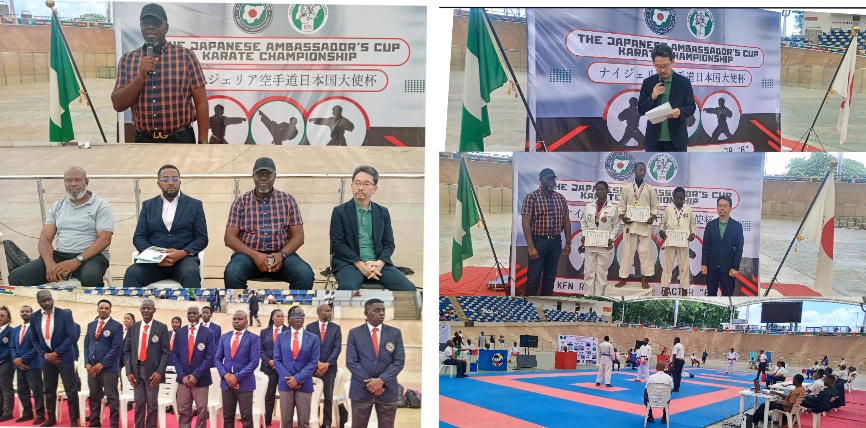
The fifth edition of the Japanese Ambassador’s Cup Karate Tournament has ended in Abuja, Nigeria with the Karate Federation of Nigeria (KFN), describing the championship as a major boost to the development of karate and the sporting relationship between Nigeria and Japan.
The three-day tournament, held from August 20 to 22, 2026, at the Velodrome of the Moshood Abiola National Stadium, brought together cadet, junior and senior athletes who competed in various categories.
Beyond the competition, the championship highlighted the core values of karate, including discipline, integrity, respect, perseverance and self-control.
President of the Karate Federation of Nigeria, Dr Chukwudi Dimkpa, said the tournament had continued to grow in stature, pointing to the increased participation and larger venue compared with last year’s edition.
“Karate started in Japan, so this is not just a tournament. It showcases and instills what we have learned over the years: discipline and integrity,” Dimkpa said.
He charged athletes to uphold discipline and sportsmanship, assuring that the federation was committed to providing a safe and fair environment for competitors.
According to him, the growth recorded by the fifth edition was evident in the increased attendance, noting that the previous tournament was held in a hall while this year’s championship moved to the larger Velodrome.
Dimkpa also commended the Embassy of Japan for its continued partnership with the federation, stressing the need for deeper cooperation to create more opportunities for Nigerian karatekas to train, compete and gain international exposure.
The KFN president disclosed that the federation’s board had approved plans to establish a Nigerian Karate League as part of efforts to address limited spectator interest and create regular competitive activities.
He explained that the proposed league would operate throughout the year in a round-robin format, giving athletes more opportunities to compete while creating a platform capable of attracting sponsors and increasing the visibility of karate.
“Once you have something going on all year round, that attracts the spectators you’re looking for. The sponsors will also come in, and that visibility also gives the sport the viability it needs,” he said.
Speaking at the opening ceremony, Japanese Ambassador to Nigeria, Suzuki Hideo, described the tournament as an important platform for strengthening the friendship between Nigeria and Japan.
Suzuki said the competition had grown into an important event for Nigeria’s karate community, while demonstrating how sport could serve as a bridge between countries and cultures.
He commended the organisers, officials and athletes for sustaining the championship and congratulated the competitors for their commitment, training and perseverance.
The ambassador noted that karate went beyond physical strength, saying its principles of discipline, respect, self-control and continuous improvement were values that could benefit individuals and society.
He further described sports diplomacy as an effective means of bringing people and nations closer together, particularly by creating opportunities for interaction beyond linguistic and cultural differences.
Suzuki expressed optimism that the Japanese Ambassador’s Cup would continue to expand and encourage more young Nigerians to embrace karate, with the ultimate objective of producing athletes capable of excelling on the international stage.
For the athletes, the championship offered another opportunity to assess their progress and compete at a high level.
Senior kata competitor Mariam Gimba expressed satisfaction with her performance, describing the outing as one of her best in the category in recent times.
“It feels very good. I feel very happy and very excited,” Gimba said.
She pledged to intensify her training in order to maintain her position and continue improving her performance.
Nigeria’s number-one male karateka, Olorulbe Oluwaseun, also stressed the importance of consistency in sustaining success.
“It is very easy to climb up, but it’s not easy to stay up. It takes consistency and hard work,” he said.
Oluwaseun attributed his progress to the support of his coach and teammates, while identifying technical refinement and a deeper understanding of kata as essential to his continued development.
He urged athletes to concentrate on mastering the fundamentals and continuously improving their techniques.
The successful conclusion of the fifth Japanese Ambassador’s Cup has renewed calls for increased investment, regular competitions and stronger institutional support for karate in Nigeria.
The championship also provided an important competitive platform for athletes preparing for the 2026 African Karate Championship scheduled to take place in Algiers, Algeria, from September 6 to 13.
With the proposed Nigerian Karate League and continued cooperation with Japan, the KFN is seeking to consolidate the gains recorded at the tournament and establish a stronger foundation for the growth of karate in Nigeria.