Nigeria’s Economic Scorecard: Information Minister, Idris Says Fuel Subsidy Reform Created Fiscal Space
Maryam Aminu
The Federal Government says the removal of petrol subsidy and other economic reforms introduced by the Bola Ahmed Tinubu administration have strengthened Nigeria’s fiscal position, improved economic stability and created resources for investments in infrastructure, security, human capital and social protection.
Minister of Information and National Orientation, Mohammed Idris, stated this on Wednesday in Abuja during a press conference to present the Federal Government’s “Nigeria’s Reform Scorecard: The Benefits, Costs and Harms Prevented.”
Idris said the scorecard was designed to provide Nigerians with a transparent account of the resources generated through the removal of fuel subsidy and the unification of the foreign exchange market, as well as the broader effects of the reforms on the economy.
According to him, subsidy removal was one of the most difficult economic decisions taken by the Tinubu administration, acknowledging that the policy had imposed significant costs and adjustments on households, businesses and communities.
He, however, maintained that the reform was necessary to redirect resources from an unsustainable subsidy regime towards investments capable of delivering greater and more lasting benefits to Nigerians.
“Citizens have a right to know what resources have been freed up, what these resources mean for the Federation, and how the benefits of reform are being translated into tangible improvements in their lives,” Idris said.
He described the scorecard as part of the administration’s commitment to transparency and accountability, noting that government must not only announce policies but also explain their implications, account for their outcomes and demonstrate how difficult decisions are shaping a stronger economy.
Presenting the scorecard, Finance Minister and Coordinating Minister of the Economy, Dr. Taiwo Oyedele, said the Federal Government’s reform scorecard was aimed at providing an honest assessment of the costs, benefits and harms prevented by the economic reforms.
He disclosed that between June 2023 and December 2025, subsidy savings generated ₦15.8 trillion for the Federation, with ₦5.4 trillion accruing to the Federal Government and ₦10.4 trillion shared among states and local governments. The Federal Government also generated ₦3.1 trillion in additional revenue and ₦11.9 trillion through incremental borrowing, bringing total additional resources to ₦20.4 trillion, against expenditure of ₦30.64 trillion.
Oyedele said the reforms contributed to improvements in inflation, foreign reserves, market capitalisation and GDP growth. Headline inflation stood at 15.91 per cent in June 2026, foreign reserves reached $52.5 billion, while real GDP growth rose to 3.89 per cent.
Minister of Budget and Economic Planning, Senator Abubakar Bagudu, said the reforms were necessary to address fiscal weaknesses, reduce leakages and create resources for infrastructure, security and human capital.
The government said its next priority is translating macroeconomic gains into improved welfare and living standards for Nigerians.
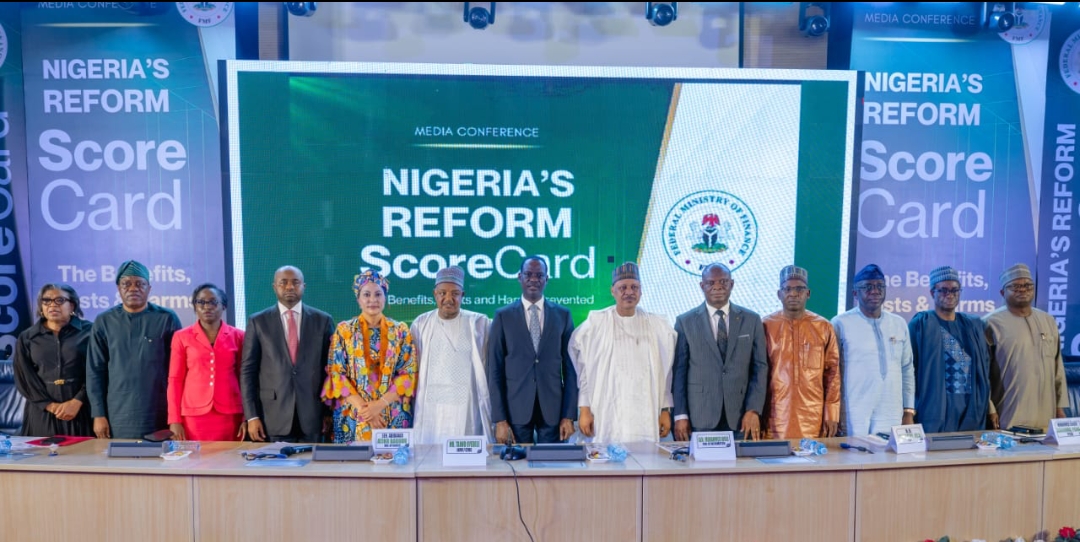
Cover Photo Caption, L–R: Director-General, Debt Management Office (DMO), Patience Oniha; Statistician-General of the Federation, Prince Semiu Adeyemi Adeniran; Permanent Secretary, Federal Ministry of Budget and Economic Planning, Dr. Deborah Bako Odoh; Executive Chairman, Nigeria Revenue Service (NRS), Dr. Zacch Adedeji; Minister of State for Finance, Dr. Doris Nkiruka Uzoka-Anite; Minister of Budget and Economic Planning, Abubakar Atiku Bagudu; Minister of Finance and Coordinating Minister of the Economy, Taiwo Oyedele; Honourable Minister of Information and National Orientation, Mohammed Idris, fnipr; Permanent Secretary, Federal Ministry of Finance, Mr. Raymond Omenka Omachi, FCA; Permanent Secretary, Policy Support and Special Duties, Federal Ministry of Finance, Mohammed Sanusi Danjuma, FCNA; Accountant-General of the Federation, Mr. Shamseldeen Babatunde Ogunjimi; Director-General, Budget Office of the Federation, Mr. Tanimu Yakubu; and Director-General, National Orientation Agency (NOA), Mallam Lanre Issa-Onilu, during the presentation of Nigeria’s Reform Scorecard: The Benefits, Costs & Harm Prevented, hosted by the Federal Ministry of Finance on August 19, 2026, in Abuja. Photo: Khalid Ahmed/FMINO.