THE EXAMPLE OF MOSHE DAYAN
Nick Dazang
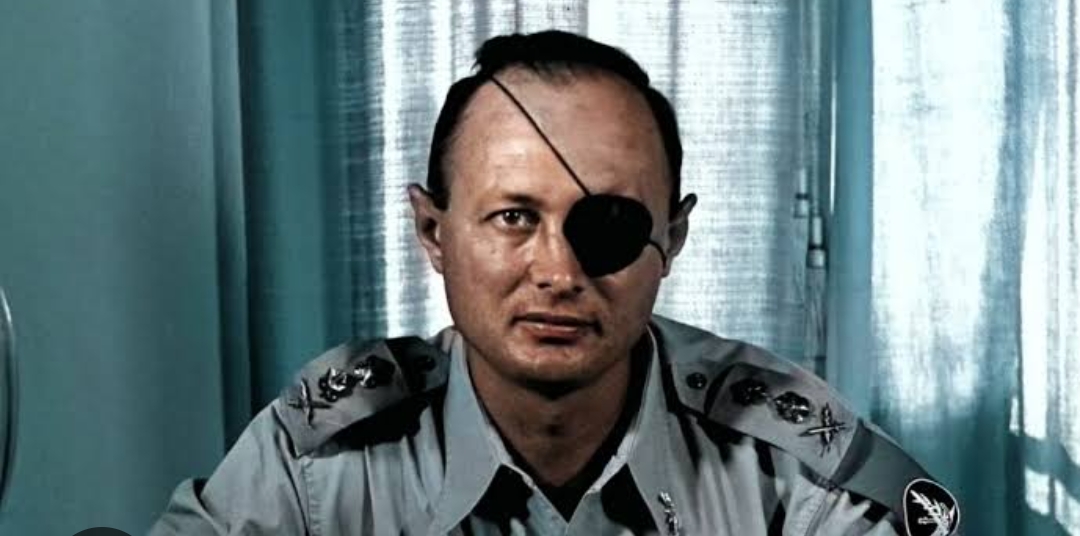
Moshe Dayan was distinguished by an eyepatch, courtesy of a sniper’s shot during World War II.
Dayan was also distinguished as a Soldier, General and Statesman. His storied career epitomized the birth pangs and early struggles of the State of Israel.
He was variously Commander of the Jerusalem Front in 1948, during the Arab-Israel War; Chief of the General Staff during the Sinai War of 1956; Defense Minister during the 1967 Six Day War and Yom Kippur War of 1973. He joined Menachem Begin’s Likud Party, from Labour, to negotiate a peace treaty with Egypt.
What was remarkable was Dayan’s autobiography, STORY OF MY LIFE, written in the evening of his earthly existence. Unlike most autobiographies which strive to justify past deeds and glorify the self, Dayan was candid to a fault.
Beyond candor, Dayan reiterated, for the umpteenth time, and for the record, that no monument, public space or street in the State of Israel should be named after him.
His reasons, three-pronged, are compelling. First, Dayan argued that no public structure should be named after living individuals, including himself.
He reasoned, strongly, that naming streets or erecting monuments for living political or military persons tended to create an artificial and self-serving legacy.
Third, he further argued, history is unpredictable, and that a living person’s actions can change public perception thereby making memorials in advance inappropriate.
To underscore these cogent positions, and until his death in 1981, Dayan always emphasized his humble roots as a farmer. He also preferred to be remembered for what he considered as the tangible results of his military and diplomatic efforts.
Moshe Dayan may have set the standard rather too high in the stratosphere. But other societies have noble traditions for celebrating and remembering their former Presidents and Statesmen/Stateswomen.
For instance, the United States Navy has a long tradition of naming aircraft carriers after former Presidents and Statesmen/Stateswomen. Hence, you have aircraft carriers such as:USS Abraham Lincoln, USS Franklin D. Roosevelt, USS Dwight D. Eisenhower, USS Ronald Reagan etc.
In the same vein, international and regional airports in the United States are named after former Presidents and Statesmen. Thus, you have: John F. Kennedy International Airport, New York; and the Ronald Reagan Washington National Airport.
Contrast these instances – Dayan’s self-sacrificing case and the U.S. tradition – with Nigeria’s in the era of President Bola Ahmed Tinubu.
Since his advent to office on May 29th 2023, six monuments have, thus far, been named after President Tinubu. The floodgate of these namings was opened by Governor Mohammed Umar Bago of Niger State. He christened the Minna Airport after the President.
Other monuments or centers named after President Tinubu are: the National Assembly Library, which was renamed Senator Bola Ahmed Tinubu Building; the Nigeria Immigration Service (NIS), Command and Control Center in Abuja, which was renamed the Bola Ahmed Tinubu Technology Innovation Complex in December 2024; the military barracks at Asokoro, Abuja, which was named after the President by the Nigerian Army in January 2025; the establishment of the Federal Polytechnic at Gwarimpa, Abuja, in June 2025, which was immediately named after the President; and the Lagos-Calabar Coastal Highway, which David Umahi, the Minister of Works, recently said was named after the President.
Since the President has neither disclaimed nor halted the naming and re-naming of the aforementioned monuments after his esteemed self, we are compelled to conclude that he welcomes them and that he relishes such christenings.
Assuming he derives joy and fulfillment in them, decent folks must find these christenings offensive, if not egregious.
The Airport at Minna was initially named after Abubakar Imam, a foremost and respected writer whose works resonate with and impact millions of Nigerians. Why remove it at all? Besides, if Governor Bago had other compelling reason(s) to drop Imam’s name, surely there are others in his State who are deserving when you consider that Niger State boasts of two former Heads of State, many brilliant academics and renowned writers.
Also, except the Lagos-Calabar Coastal Highway, most of these monuments or centers named after the President were built before he assumed office. The International Conference Center, Abuja, for example, was commissioned in 1991. It was used to host the OAU Heads of State Delegates Conference in July of that year.
Even in the instance of the Lagos-Calabar Coastal Highway, which was greeted with frenzied controversy as to its true cost, the project is yet to be fully completed. Would it not have been more appropriate if it was fully completed and commissioned before the government contemplated re-naming it? In any case what is wrong with the appellation,
LAGOS-CALABAR COASTAL HIGHWAY?
This writer’s sense and appreciation, and I suspect, that of all decent folks, is that monuments ought to be named after persons, in remembrance of their accomplishments and to the extent that they have touched lives or impacted their compatriots or humanity positively.
As it is, this writer has profound doubt if the Tinubu administration has arrived at, or crossed, these thresholds, and that it truly deserves the accolades which it seems to be administering and showering on itself.
As at now, and by World Bank accounting, 63% of Nigerians live in poverty with an estimated 79% classified as poor or vulnerable to falling into poverty. Of all these, 33% of Nigerians are further categorized as ultra-poor, and facing insecurity based on abysmally low caloric intake.
This unfortunate state of affairs has forced millions of Nigerians to adopt a curious eating regime in which they skip meals. Worse, the security situation is so dire that if one commutes from point A to B without being abducted by bandits, he has to embark on an elaborate thanksgiving.
With a country in such dire straits, and with a leadership with precious little to show for its over three years in office, there is something vain, if not obscene, about naming edifices and Centers after oneself. Not even President Donald Trump, considered one of the most narcissistic and vain leaders of the modern world, has deigned to name a structure after himself. Even the token one named after him followed a long-held tradition and after he had served a first presidential term in office.
In addition to its being vain, the naming of edifices after the President fosters a culture of sycophancy and non-delivery of good governance. Witness that the entire charade was begun by a Governor whose performance is anything but stellar. Shortly after, he was emulated by other public officials serving at the pleasure of the President.
The President owes us, and himself, the responsibility of halting this sickening sycophancy. Otherwise, we shall become the butt of cruel and coarse jokes by more serious citizens of the world. And otherwise, the dignity and sacredness of the presidency will suffer diminution.
Cover Photo: Image of MOSHE DAYAN (1915 – 1981)
Cover Credit: Setteotobre