“Naija No Dey Carry Last?” — Truth Be Told, We Don Carry Last
By Citizen Bolaji O Akinyemi
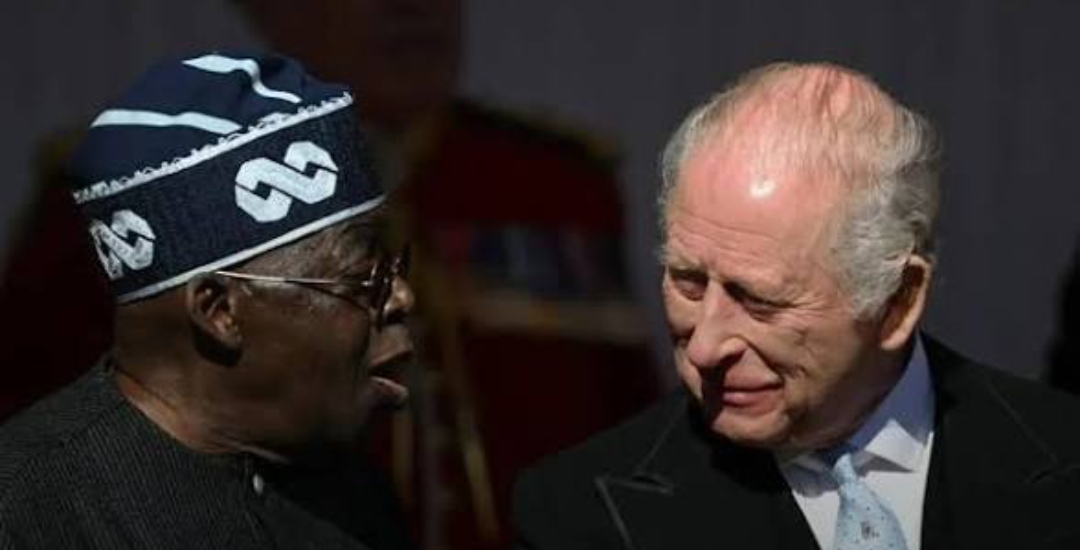
When Charles III said “Naija no dey carry last” in the presence of Bola Ahmed Tinubu, it was not a statement of fact—it was an act of diplomacy. The kind that oils egos, not systems. Because if truth had been invited into that room, it would have disrupted the laughter with a brutal correction: Naija don carry last—and we know it.
This is not pessimism. It is not unpatriotic. It is evidence.
A country where millions go to bed hungry, where darkness powers the economy, where education is abandoned and security is negotiated, is not competing globally—it is struggling for survival. Yet we have mastered the dangerous art of celebrating comforting lies while postponing necessary truths. And that is how nations decay—not suddenly, but politely.
But let us move away from emotion and into evidence.
Because the danger of a statement like “Naija no dey carry last” is not in what was said—it is in what we choose to believe after it has been said. Nations do not decline because they are insulted; they decline because they are comforted in error.
So let us suspend pride for a moment. Let us set aside diplomacy, politics, and patriotic slogans. Let us ask a simple question:
Where exactly does Nigeria stand when measured—not by hope—but by hard numbers?
Start with poverty—it is always the most honest mirror.
Because when nearly half of your population is trapped at the lowest rung of human existence, every other achievement becomes a footnote. Nigeria, by global estimates, hosts one of the largest populations of people living in extreme poverty anywhere in the world. This is not a projection. It is not opposition rhetoric. It is a statistical reality acknowledged by global development institutions.
And poverty is not just about income—it is about access:
Access to food.
Access to healthcare.
Access to education.
Access to dignity.
When a nation fails at this level, it is not “developing”—it is enduring.
From there, the pattern does not improve—it deepens.
Take electricity.
A country of over 200 million people generating barely enough power to serve a fraction of its needs is not simply underperforming—it is structurally disabled. Homes improvise. Businesses self-generate. Industries relocate. The economy adjusts not to growth, but to survival.
Darkness is not just the absence of light in Nigeria—it has become an economic system.
Then education.
The future of any nation sits in its classrooms. But what happens when the classrooms are empty—or worse, when they exist without learning? With millions of children out of school, Nigeria is not just failing the present; it is mortgaging the future.
A nation that abandons its children cannot negotiate its place among serious nations.
Healthcare follows the same script.
When citizens must travel abroad to stay alive, when hospitals lack basic infrastructure, when the ratio of doctors to patients reflects scarcity rather than service, what you have is not a healthcare system—it is a survival lottery.
At this point, the pattern is no longer coincidental—it is systemic.
From poverty to power, from education to healthcare, the same story repeats itself:
underperformance masked by resilience, failure softened by rhetoric.
And that is where the real danger lies.
Because Nigerians are resilient—exceptionally so. But resilience, when overburdened, becomes a tool of oppression. It allows a broken system to continue functioning just enough to avoid collapse, but never enough to deliver progress.
So when we say “Naija don carry last,” it is not a statement of defeat—it is a statement of diagnosis.
And no nation can begin recovery until it is honest about its condition.
But this is not where the story must end.
Because acknowledging that “Naija don carry last” is not a confession of weakness—it is the beginning of strength. Nations do not rise because they are praised; they rise because they are provoked—by truth, by necessity, by the refusal to continue as they are.
The real tragedy is not that Nigeria is behind.
The real tragedy would be if we know we are behind—and choose to remain there.
This moment must take us beyond party lines, beyond the language of All Progressives Congress or Peoples Democratic Party, beyond the endless cycle of blame and defence.
Because poverty does not ask for your party card.
Darkness does not recognise political affiliation.
Insecurity does not vote.
Reality is not partisan.
If we are serious about moving from the back row to where we belong, then the conversation must shift from who is in power to what power is doing.
We must demand:
Measured leadership—where performance is tracked by data, not defended by propaganda
Functional institutions—where systems work regardless of who is in office
Human capital priority—where education, healthcare, and dignity are non-negotiable
Power as a foundation—because no nation develops in darkness
Security as sovereignty—because without it, nothing else stands
This is not reform for comfort. This is reform for survival.
We must also confront ourselves.
Because part of the reason this illusion survives is that we have, as a people, learned to celebrate potentials as though they were achievements.
We say:
“Nigeria is blessed.”
Yes, we are.
But blessings that are not converted to systems become burdens. Natural endowments without national discipline only deepen frustration.
“Naija no dey carry last” should not be a slogan we hide behind.
It should be a standard we work toward.
A future where:
Our schools produce thinkers, not survivors.
Our hospitals heal, not refer.
Our power sector powers industry, not generators.
Our economy creates prosperity, not just statistics.
So let us be clear—without anger, without apology:
We have carried last.
But we are not condemned to remain there.
The distance between the back and the front of the line is not destiny—it is decision.
And that decision begins with truth.
Not diplomatic truth.
Not political truth.
But uncomfortable, data-backed, nation-building truth.
Final Take Away
The day we stop clapping for “Naija no dey carry last,” and start demanding proof, is the day Nigeria will finally begin to move forward.