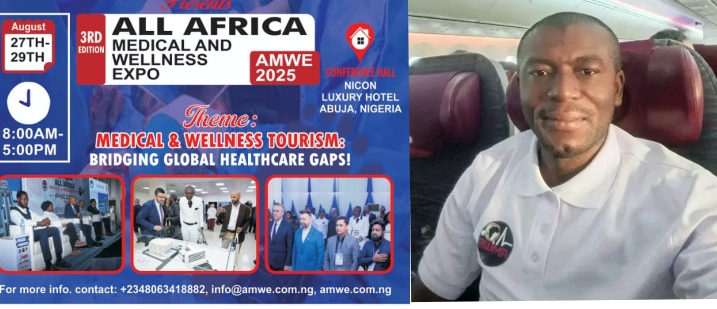
Exclusive Interview with Usman Isah, Executive Chairman of AMWE Medical & Wellness Foundation
Oru Leonard
The All Africa Medical & Wellness Expo (AMWE), 2025 is set to take place from August 27th to 29th, 2025, at the Nicon Luxury Hotel in Abuja, Nigeria. We spoke with Usman Isah, Executive Chairman of AMWE Medical & Wellness Foundation, about the event and the future of medical tourism in Africa.
Can you briefly introduce AMWE Medical & Wellness Foundation and how it connects with the All Africa Medical & Wellness Expo?
The All Africa Medical & Wellness Foundation (AMWE) is a distinguished non-governmental organization dedicated to connecting healthcare seekers around the world with the right medical and wellness service providers. Its mission is rooted in the belief that everyone deserves access to quality, specialized, and timely healthcare services. we are health and wellness tourism developers, promoter and advocacy.
AMWE Foundation powers the All Africa Medical & Wellness Expo (AMWE Expo), an annual event designed to spotlight healthcare providers, their innovations, and their services. While both the Foundation and the Expo are independently registered entities, the Foundation serves as the driving force behind the Expo.
The AMWE Expo provides a vital platform for: Healthcare providers to showcase their services, technologies, and expertise.
Healthcare seekers to connect directly with providers who can meet their specific needs.
Stakeholders to engage in meaningful discussions about transforming health facilities across Africa.
A core goal of the Expo is to promote medical and wellness tourism as a powerful tool for bridging global healthcare gaps. By educating the public and stakeholders, AMWE seeks to correct misconceptions about medical tourism and position it as a competitive solution for delivering seamless, cross-border care.
Through both the Foundation and the Expo, AMWE is committed to reshaping Africa’s healthcare narrative and enabling access to world-class health and wellness services for all.
What inspired the creation of this initiative, and what gap is it aiming to bridge in Africa’s healthcare landscape?
What inspired this initiative is the alarming rate at which Nigeria and Africa are losing patients to outbound medical tourism.
Every year, thousands of people leave the continent in search of quality and specialized healthcare abroad, often overlooking capable and highly skilled professionals within our borders. This growing trend not only drains financial resources but also undermines confidence in local healthcare systems.
The idea, therefore, is to create a platform where healthcare service providers across Africa, particularly in Nigeria, can showcase their expertise, innovations, and success stories. This platform would help identify and promote top-tier healthcare service providers, build trust in local systems, and reduce unnecessary medical travel.
In addition, the platform will serve as a space for robust discussions on critical issues such as health workforce migration. By fostering intelligent dialogue and collaborative solutions, we aim to address the brain drain syndrome in our healthcare sector and find sustainable ways to retain and empower our healthcare professionals.
There are many myths surrounding medical tourism. What is the most common misconception you’d like to correct?
A major misconception about medical tourism, especially in Africa, is that it only involves traveling abroad for treatment. This narrow view has led many to see it as a drain on national resources due to the billions USD lost annually to outbound medical tourism. As a result, some have developed resentment toward the concept, focusing solely on reducing healthcare costs through insurance and subsidies.
But this misses the point.
People don’t travel abroad for malaria fever, typordfever or minor illnesses they seek specialized care that may not be available locally. The real issue is the lack of advanced medical infrastructure at home.
Medical tourism is not the problem; it’s part of the solution. When embraced, it challenges countries to upgrade their health systems, attract investment, and seek global standards like JCI accreditation. This opens the door to inbound and intrabound medical tourism where other patients come in, or locals travel within their country for better care.
In truth, medical tourism brings healthy competition, drives innovation, and ultimately improves patient outcomes. It’s time we stop seeing it as a threat and start recognizing it as a strategic opportunity for healthcare transformation.
In your view, what key knowledge should every African citizen have about medical tourism and its benefits?
Medical tourism is often misunderstood, especially here in Africa. Many think it only means traveling abroad for treatment, what we call outbound medical tourism. But in reality, medical tourism includes inbound (when people come into a country for care), and intrabound (when people travel within their own country for better healthcare services).
The real issue is not that people are going abroad, it’s that some countries haven’t built the capacity to retain patients or attract others. The money lost to outbound medical tourism is not a loss if seen as a challenge. It’s a positive challenge, one that should motivate us to upgrade our health facilities, invest in specialized care, and seek international accreditations like JCI.
If we do this, we won’t just stop people from going out, we’ll begin to attract others to come in. Medical tourism brings healthy competition, improves service delivery, and ultimately leads to better patient outcomes. Rather than seeing it as a threat, we should recognize it as part of the solution to our healthcare challenges.
5With the continuous exodus of medical professionals from Nigeria, what practical solutions would you propose to curb this trend?
Well, the most practical solution to curb health workforce migration is strategic deployment and retention. It’s not just about appealing to patriotism it’s about creating an environment where healthcare professionals feel valued and fulfilled.
The key is retention through better deployment and improved welfare. We must offer competitive salaries, safe working conditions, career growth, and consistent policy support. For example, Rwanda tackled this by investing in health worker training, raising pay, and improving facilities and they’ve successfully retained their workforce. If we make professionals feel valued at home, they’ll stay.
How can Nigeria reposition itself to benefit from inbound medical tourism, rather than remaining a major source of outbound patients?
We can achieve this by developing a supportive, strong, and unified policy framework that encourages investment in cutting-edge healthcare technologies. This should include financial incentives, guarantees for return on investment, and streamlined access to funding.
The government can coordinate and integrate multiple strategies, such as access to finance, expansion of the National Health Insurance Authority (NHIA), and targeted financial incentives, under a single, investor-friendly policy. This unified approach will help attract both local and international service providers.
In addition, we must upgrade our healthcare facilities and ensure continuous training for our professionals, focusing on hands-on experience with top-tier medical technologies. Embracing medical tourism, obtaining Joint Commission International (JCI) accreditation, and securing other globally recognized certifications will enhance our visibility and competitiveness on the global healthcare stage.
Tell us about your upcoming AMWE Expo- what’s the vision behind it, who is it designed for, and how can people participate?
This event brings together healthcare providers and the public to connect, network, and learn. It’s a chance for providers to showcase their services, and for the public to discover the best care options available. If you say you’re the best, come and show us!
This year’s focus is on tackling global healthcare disparities and promoting healthy competition, especially among African providers.
Everyone is welcome, but registration is required. The link is on all our social media platforms, or I can share it here.
Exhibitors pay for stands. Attendance is free for non-exhibitors.
Date: 27th-29th August, 2025
Time: 08:00 prompt
Venue: CONFERENCE HALL
Nicon Luxury Hotel Abuja, Nigeria
For more information check, www.amwe.com.ng