2027 Elections: DICAN Challenges Political Parties on Internal Democracy, Accountability
Oru Leonard
The growing need for disciplined political parties, transparent leadership and stronger anti-corruption institutions has come under focus as Nigeria prepares for the 2027 general elections, with the Diplomlatic Correspondents Association of Nigeria (DICAN) urging political stakeholders to embrace reforms that will strengthen democratic governance.
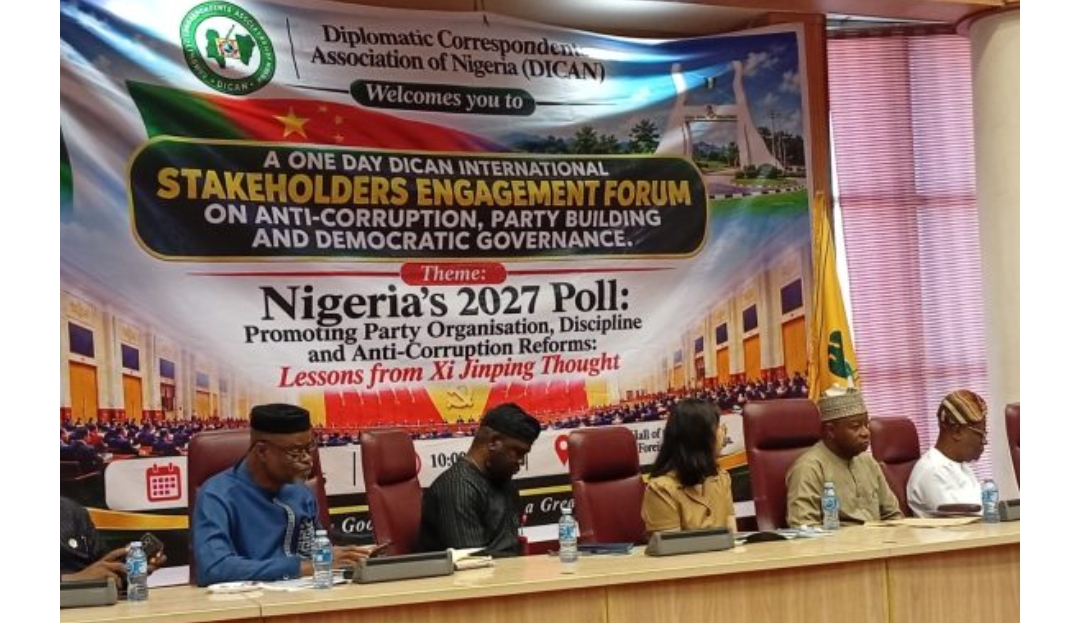
The association made the call at an international engagement in Abuja, where participants examined China’s governance and anti-corruption experience and identified lessons that could help address some of Nigeria’s political and institutional challenges.
The event, held on Wednesday, November 18, 2026, at Rotunda Hall, Ministry of Foreign Affairs, Abuja, was themed, “Nigeria’s 2027 Poll: Promoting Party Organisation, Discipline and Anti-Corruption Reforms: Lessons from Xi Jinping’s Thoughts.”
DICAN Chairman, Idehai Frederick, said Nigeria’s democratic development must extend beyond the conduct of periodic elections to building strong political institutions capable of promoting accountability, transparency and responsible leadership.
He challenged political parties to uphold their constitutions, strengthen internal democratic processes and ensure that members are held accountable for their conduct.
Frederick clarified that the engagement with China’s governance experience was not an endorsement of its political system but an opportunity to examine practices that could be adapted to improve Nigeria’s democratic institutions within the framework of its multiparty constitutional arrangement.
In her remarks, Counsellor Dong Hairong, representing the Chinese Embassy in Nigeria, highlighted the scale of China’s anti-corruption campaign, disclosing that approximately 8.1 million corruption cases had been recorded since 2012, with more than 7.9 million officials facing disciplinary and administrative sanctions.
She added that over 900 senior officials at vice-ministerial level and above were among those sanctioned, underscoring China’s emphasis on institutional supervision and enforcement of disciplinary measures.
The Chinese representative reaffirmed her country’s willingness to share relevant governance experiences with Nigeria and strengthen cooperation in accountability and anti-corruption initiatives.
Also speaking, political analyst, Dr Charles Onunaiju, identified weak internal party democracy, monetisation of elections and poor political discipline as major obstacles to Nigeria’s democratic progress.
He argued that electoral technology, while important, cannot independently guarantee credible elections without political parties that operate on clear ideological foundations and demonstrate transparency, accountability and organisational discipline.
Participants at the engagement stressed that the credibility of the 2027 general elections would depend not only on the efficiency of the electoral umpire but also on the conduct of political parties, the integrity of political leaders and the effectiveness of institutions responsible for enforcing democratic standards.
The discussions concluded with calls for stronger institutional collaboration, responsible political leadership and sustained anti-corruption reforms to strengthen public confidence in Nigeria’s democratic process.