THE MEAT OF THEIR MEAL Momodu, Fani-Kayode, Omokri—and the Quiet Capture of Choice
By Citizen Bolaji O. Akinyemi
In every African home, when elders quarrel over the cooking pot, the wise do not linger at the scene of the insult.
They return later—for the meat.
Because the meat is the meaning.
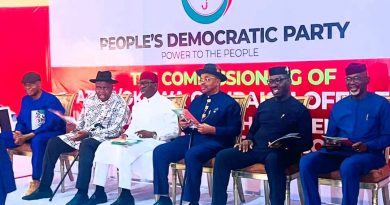
When Tunde Odesola chronicled the public brawl between Dele Momodu, Femi Fani-Kayode, and Reno Omokri, he captured the noise.
But the nation, distracted by the spectacle, abandoned the substance.
Now the dust has settled.
Let us return to the pot.
*The Real Issue They Buried*
At the center of that noisy exchange was a dangerous comparison—one that should have triggered national reflection:
The suggestion that the administration of Bola Ahmed Tinubu is beginning to echo structural tendencies of Sani Abacha.
But rather than interrogate that claim, the political class did what it does best:
They attacked the man.
They buried the message.
But the Real Meat Is Deeper
Even that comparison—powerful as it is—is not the deepest issue.
The true meat of the meal lies elsewhere.
It lies in law.
It lies in structure.
It lies in something quieter, more dangerous, and far more enduring:
The narrowing of democratic choice through the 2026 Electoral framework.
While I was busy analysing the game that may never be and many hailing my depth of it, because we are collectively ignorant of the change of the rules of the game in the middle of a match.
Imagine that ChatGPT was lost to the details of how and when our electoral law was changed. That bad!
Twice, it made reference to 2020 and 2022. Bro the rule has changed on February 18th 2026.
The Law That Doesn’t Shout—but Shapes Everything
With the signing of the amended Electoral Act 2026 by President Bola Ahmed Tinubu, Nigeria did not witness tanks on the streets.
There was no decree.
No midnight broadcast.
No soldiers at the radio station.
And yet, something fundamental shifted.
Not loudly.
But structurally.
How Choice Is Quietly Being Narrowed
Democracy is not merely about voting.
It is about who gets to be voted for.
And this is where the law becomes consequential.
1. Membership Before Movement
The new framework strengthens:
Verified party membership registers
Pre-primary documentation
Early institutional recognition
What this means in practice is simple:
You cannot arrive late—and still compete.
The door is not slammed shut.
It is simply… closed early.
2. Time as a Weapon
By compressing timelines and aligning them with strict administrative procedures, the system ensures:
Only those already embedded in party structures can emerge
Late coalitions become ineffective
New political energy is neutralised before it matures
This is not prohibition.
It is prevention by timing.
If anyone as of today doesn’t have a party, ‘am afraid such a person may not be on the ballot.
3. Party Elites as Gatekeepers
Control has shifted decisively to:
Party leadership
Internal registers
Delegate systems
Which means:
The people no longer determine who contests.
The system determines who qualifies to be presented to the people.
Democracy and the Question of Choice
Let us return to first principles.
Democracy, at its core, is built on one sacred idea:
Choice.
Not managed choice.
Not filtered choice.
Not pre-approved choice.
Real choice.
If citizens cannot freely access the political space—either as candidates or as voters with genuine alternatives—then democracy begins to lose its soul, even if it retains its structure.
Is This Democratic?
Yes—procedurally.
But in spirit?
That is where the trouble lies.
Because what we are witnessing is not the death of democracy.
It is something more subtle:
The domestication of democracy.
From Open Contest to Managed Outcome
When:
Entry is restricted early
Party structures are tightly controlled
Opposition is fragmented or absorbed
Timelines eliminate spontaneity
Then elections risk becoming:
Exercises in validation—not competition.
The people vote for the man behind the game.
Our politics 101 lecturer who before the 2023 election taught us the rudiments of the game, when he said; “Political power is not going to be served in a restaurant. They don’t serve it a la carte. At all cost, fight for it, grab it and run with it”.
Could it be that 2027 was grabbed right before our eyes and under our noses in 2023 while we were fixated on 2023.
Now the field has already been shaped and the goal post shifted.
Back to the Abacha Question
This is where the earlier comparison returns—not as insult, but as warning.
Sani Abacha did not merely rule through force.
He engineered inevitability.
By the time the political process matured, there was only one destination.
Today, Nigeria is not under military rule.
But if the political space continues to narrow structurally, we must ask:
Are we moving toward a system where outcomes are decided long before elections?
The Fear of Perpetual Power
In such an environment, even whispers become dangerous:
Third term
Extended influence
Perpetual incumbency
Not because they are declared—
But because the system gradually makes alternatives impossible.
The Bigger Danger: Silence
What made the Momodu–FFK–Omokri fight tragic was not the insults.
It was the distraction.
Because while they fought:
The law stood
The structure settled
The implications deepened
And the nation… moved on.
The Question Nigeria Must Now Answer
Who decides the future of Nigeria?
The people?
Or the structure that determines what options the people are allowed to choose from?
Conclusion: Returning the Meat to the Table
The Yoruba say: àgbà tí ń jà ní ọjà, ọmọ ló máa kó ẹran lọ.
When elders fight in the marketplace, the child takes the meat home.
Nigeria must refuse that fate.
We must return the meat to the table.
And the meat is this:
A democracy that quietly narrows choice is not strengthening itself—it is weakening its legitimacy.
Because in the end:
Democracy without choice is ritual
Elections without competition are ceremony
And power without challenge… is only waiting for history
Just as it waited for Sani Abacha.